Creole Connections

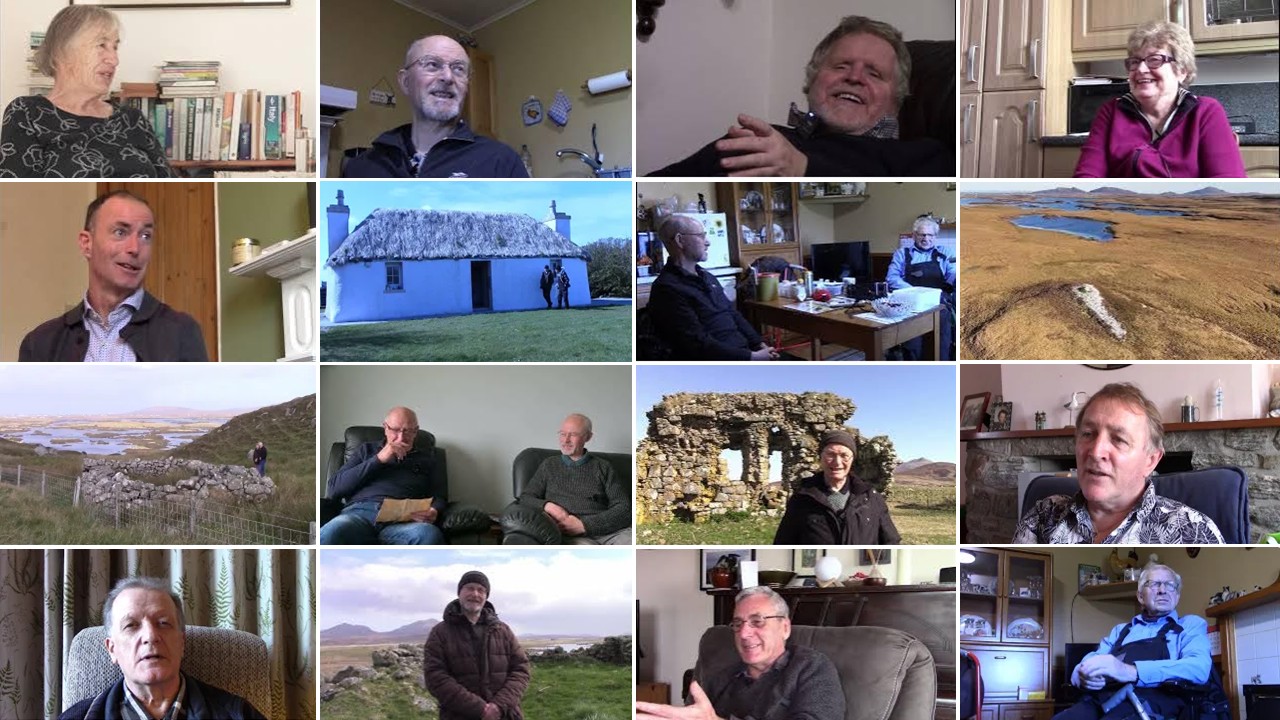
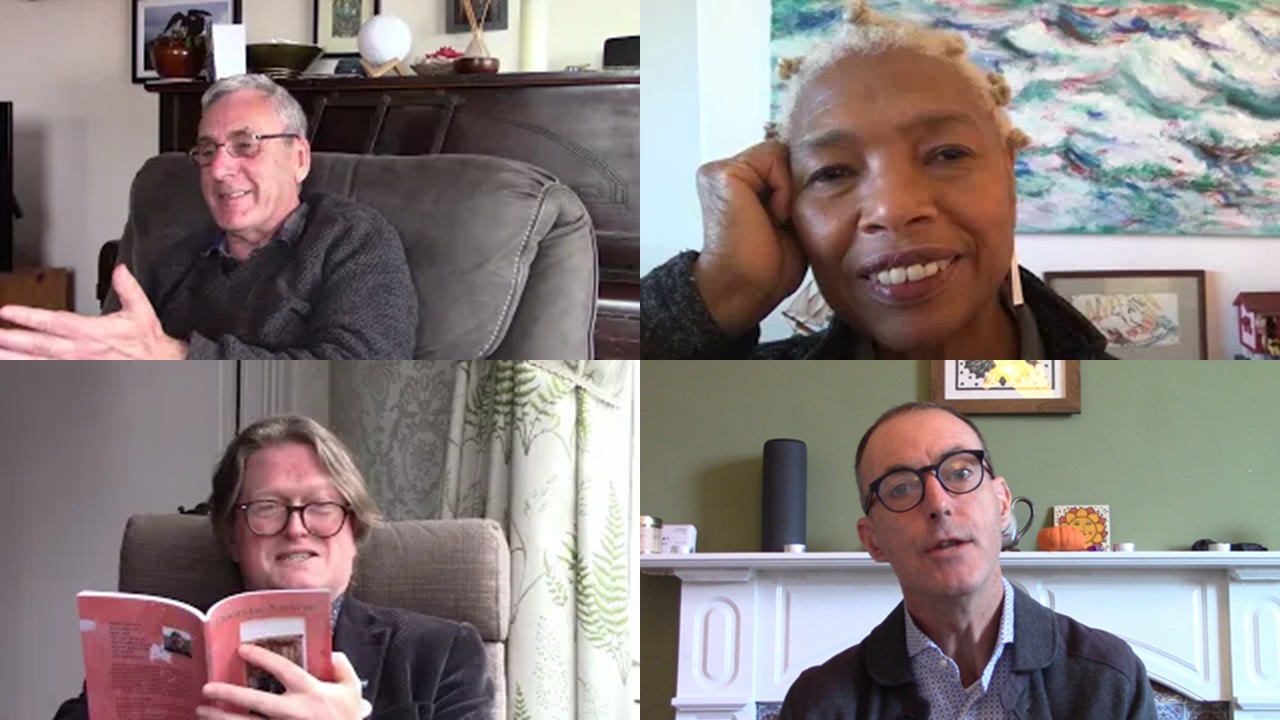
The Island Voices “Capture and Curation” approach is highly productive of new material in new languages to add to the original Hebridean focus on Gaelic and English, and it sometimes takes us to places where community language connections with our home territory may not always be immediately obvious. As we fill out new gaps which our CIALL-supported Extensions initiative has opened up, here are four new videos in Jamaican and Haitian Creole, adding to Caribbean-Hebridean links not often explored.

Audrey West, with Jamiekan ina Wielz, was our opening pioneer in taking our documentary plus interviews format beyond Scotland and into Wales, and also adding samples of poetic verse to the mix. Naturally, she followed that up later with her Jamaican voiceover of Ifor ap Glyn’s subsequent Welsh contribution. Here she completes the set with Jamaican versions of our documentaries on the three other writers so far featured – Donald S Murray, Christie Williamson, and Martin MacIntyre.

Donald:

Clilstore transcript: https://multidict.net/cs/12480


Christie:

Clilstore transcript: https://multidict.net/cs/12481


Martin:

Clilstore transcript: https://multidict.net/cs/12488


As Audrey’s own documentary illustrates, the Jamaican community presence in the UK is now of long standing. That includes the linguistic presence too, though widespread recognition of Jamaican speech as a fully functional communicative system perhaps remains elusive, with continued use of the “broken English” label pointing to a general lack of acknowledgement of the rule-governed grammar that generates its distinctive character. We congratulate Audrey on her determined promotion of her first language in a diasporic setting, and are thankful for the support of the Jamaican Language Unit at the University of the West Indies in helping to kickstart this aspect of our work.

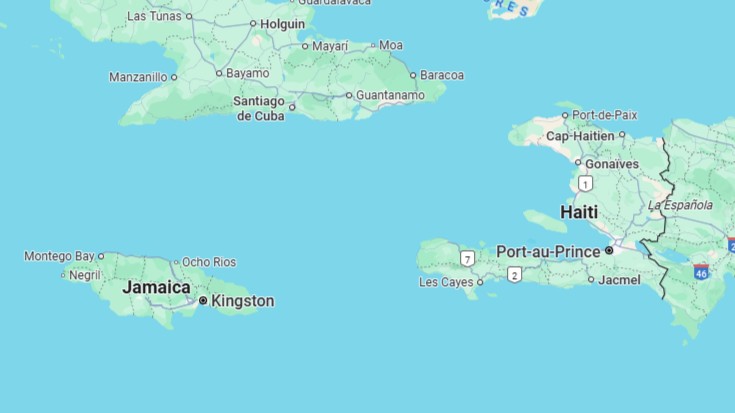
Within a Caribbean context, the neighbouring Haitian Creole provides an interesting comparator. Here, Mavreen Masere adds to her first voiceover of Audrey’s documentary, with a Haitian Creole version of our retrospective sampling of England’s urban multilingualism:

Mavreen:

Clilstore transcript: https://multidict.net/cs/12528


Haitian Creole, while not commonly encountered in the UK, appears to have achieved wider recognition of its independent linguistic status than Jamaican. It has long been listed among the languages available for treatment through Google Translate, for example. Subtitling under its own name is also an option on YouTube.

By contrast, “Jamaican Patois” has only recently been added to Google Translate, and has yet to be made available for subtitling on YouTube. This is why we still have to label as “English” the YouTube subtitles Audrey has created in Jamiekan using the Cassidy-JLU orthography, even while Google Translate will happily accept text using the same spelling system, identify it with the title “Jamaican Patois”, and make a decent fist of translating it into other languages.

From a home turf Hebridean viewpoint, both these languages may provide food for thought for those concerned about continuing the use of Scottish Gaelic. As a fellow minority language in the UK, Jamaican may be considered a near neighbour facing some similar issues around inter-generational sustainability in an overall polity where English monolingualism is the unmarked norm. Plus, as suggested previously, processes of linguistic creolisation, which are part of the historic experience of both Jamaican and Haitian Creole, may now be worthy of closer attention from would-be Gaelic revivalists. They may be particularly pertinent for those inclined to heavily invest their hopes in “naturalistic” Gaelic “immersion” for learners who have a different first language, perhaps in a well-meaning attempt to boost raw numbers of self-reporting speakers, irrespective of the surrounding cultural and community context in which their acquired additional competence might be exercised.

Brian Ó Broin has a very interesting chapter in the recently published open access book from the Language Science Press “Foundational approaches to Celtic linguistics”. With the title “Comparing the syntactic complexity of Gaeltacht and urban Irish-Language broadcasters”, the chapter reports on contrasting characteristics of these two groups. Principally, he finds it noteworthy that “the syntactic complexity of urban and Gaeltacht broadcasters … is significantly different” (p365).

This fuller quote is from his summing up (p366):

As I noted in my previous work on phonetics and morphology, urban broadcasters tend to be discarding features of Irish that are not found in English. Velar and palatal fricatives are being dropped in favor of the nearest English sound, for example, while nouns are frequently no longer morphophonetically marked for case, with eclipsis and lenition becoming optional. In this paper we make a compelling case that urban broadcast Irish is also significantly different in syntax, substituting subordinators with conjunctions that require the listener to intuit the relationships between clauses and rarely forming sentences that involve the nesting of embedded phrases and clauses.

These findings are appropriately hedged with all the necessary caveats for a small-scale initial study, of course. Nevertheless, they do clearly point to an issue in the Irish context which will surely ring bells for those with a Scottish Gaelic interest, for whom a similar contrast appears evident, and they prompt an important question. In a contact situation, what are the implications for the minoritised language of changing its structures, and adopting more and more features of the omnipresent majority one? It’s an easier question to pose than to tackle, but there are increasing signs that people involved in Gaelic medium education are questioning the nature of the language that their learners are producing. For all its sociolinguistic naivety, the phrase “’S fheàrr Gàidhlig bhriste na Gàidhlig sa chiste” (“Better broken Gaelic than buried Gaelic”) does roll off the tongue relatively easily as a soundbite slogan, but its immediately resonant appeal appears to diminish markedly in the face of the actual language practice that results from many current efforts to instil Gaelic competence amongst those learning it as a second language.

In contrast to the uncritical approach to “Gàidhlig bhriste” displayed by some self-assertive Gaelic learning enthusiasts, Caribbean language proponents have clearly rejected the “broken English/French” title, instead staking claims for the creation of new independent languages. Is that a route Gaelic revitalisationists might wish to tread? If the answer is “yes”, a second question follows. If not “Gaelic Creole” (“Cridheol”?) what name should be given to this new language? Conversely, if “no” – say because continuing adherence to recommended retro-vernacular norms is indeed preferred – what needs to be done differently to current approaches, so that the title “Gaelic” retains its standard meaning?

(In passing, if the Gaelic Creole claim is to be advanced, then Scottish speakers may wish to get in there quickly, before the Irish stake prior ownership! See the final question and answer in this recorded talk, which formed the basis for the Ó Broin chapter…)

Whatever the answer to those questions, it seems clear that the continued use over protracted time of different languages alongside each other ultimately demands some form of stable accommodation between them. Island Voices started out as a bilingual project, and has since become manifestly multilingual. From that point of view, we’re just delighted to have added further to our Jamaican Selection, and created a new Haitian Creole Selection, to sit amicably alongside our still growing video archive of mostly “retro-vernacular” 21st Century Gaelic – and many Other Tongues too!
Duncan Ban in the Park

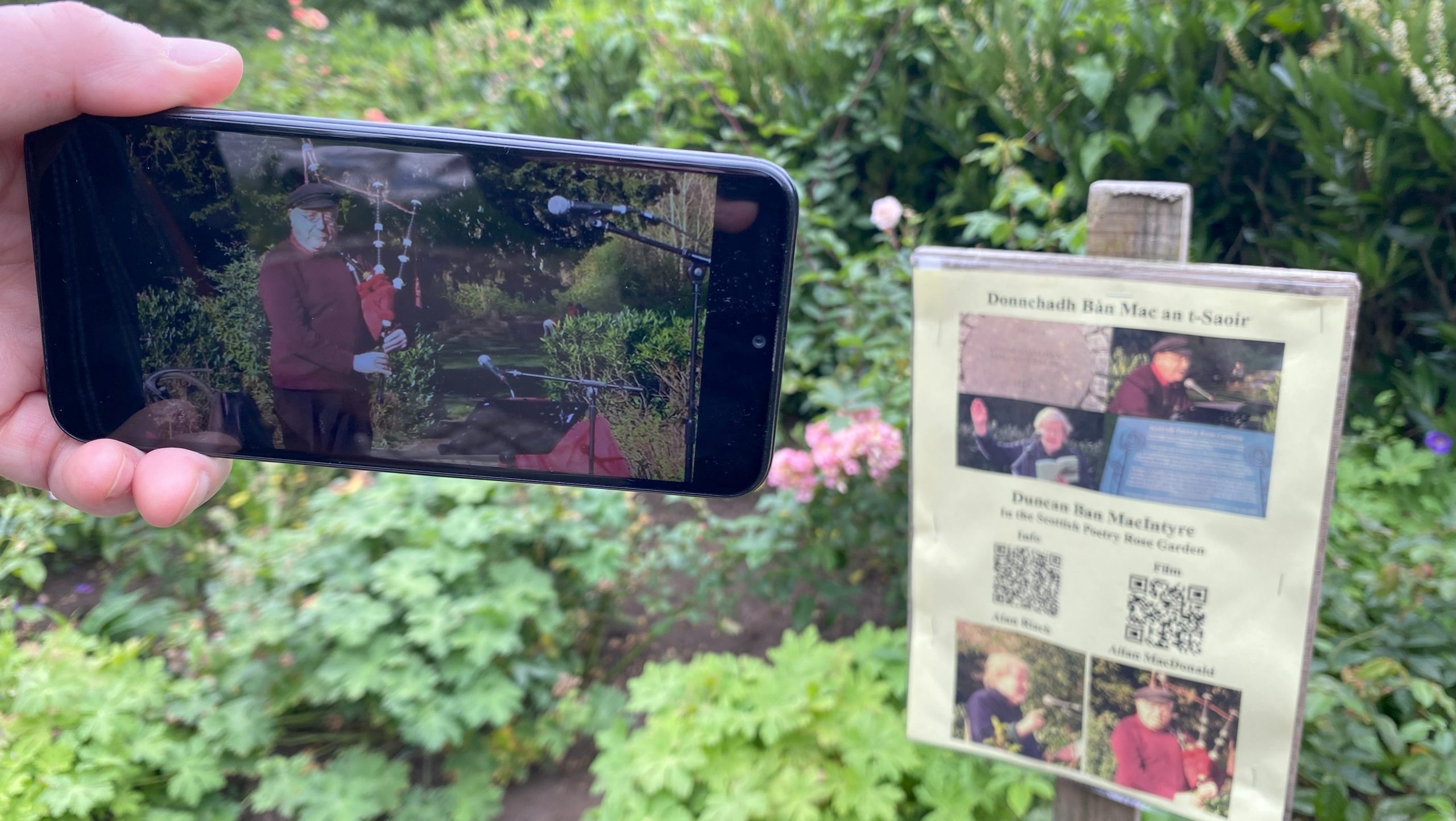
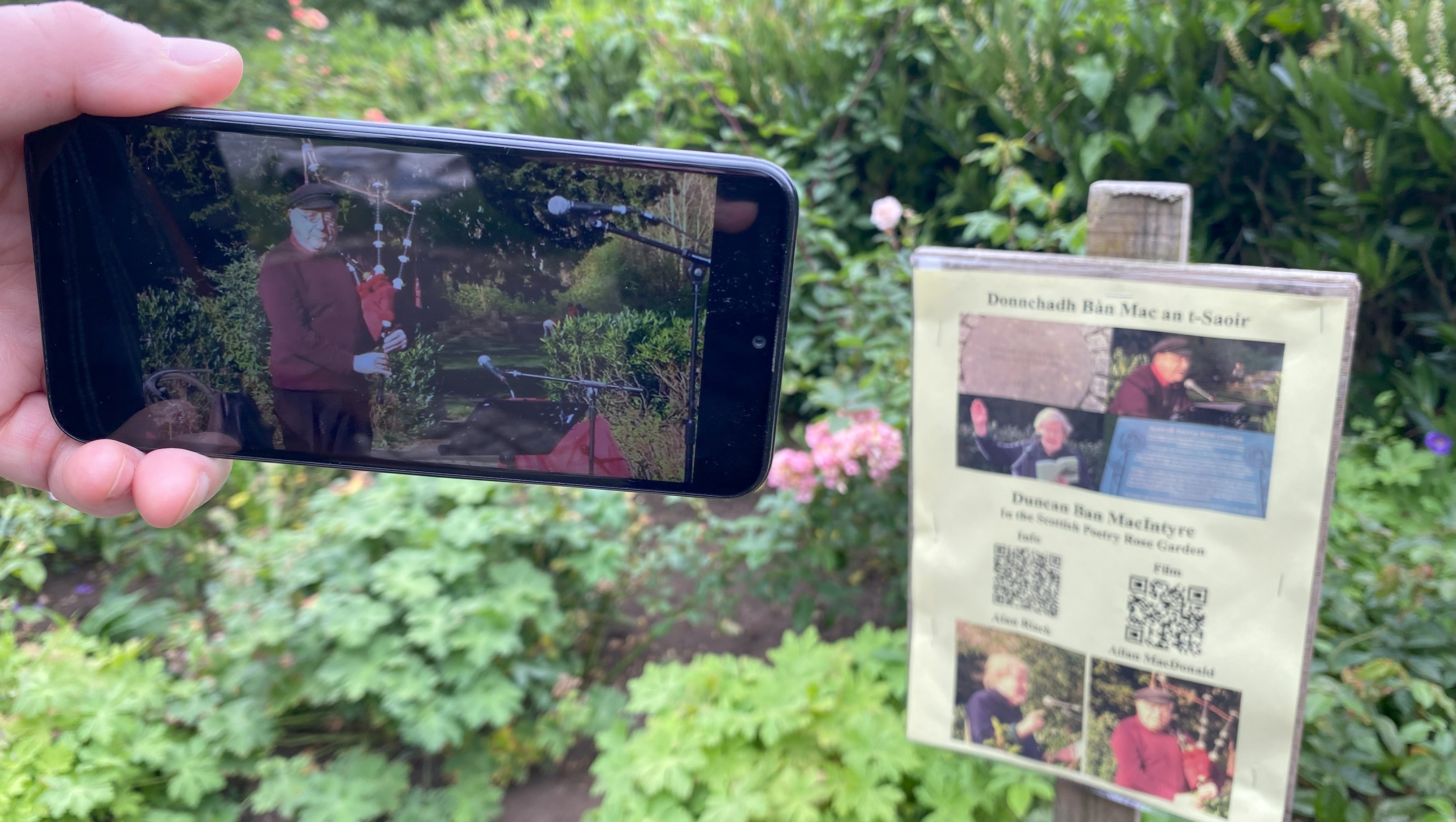
The sonorous verse of Duncan Ban MacIntyre can now be heard on your phone any time you visit the Scottish Poetry Rose Garden in Glasgow’s Queen’s Park.

Friends of Queen’s Park invited Alan Riach and Allan MacDonald to mark his 300th anniversary last year, and they provided a remarkable open air music and poetry double act in the garden, presenting extracts both in the original Gaelic and in English translation.

Island Voices were on hand to film the event, and we’re delighted that visitors can now access the recording in situ through these displayed QR codes, and so get a taste again of a magical occasion.

Queen’s Park will be humming again with snippets of Moladh Beinn Dòbhrain…

Guth Thormoid: Norman’s Voice

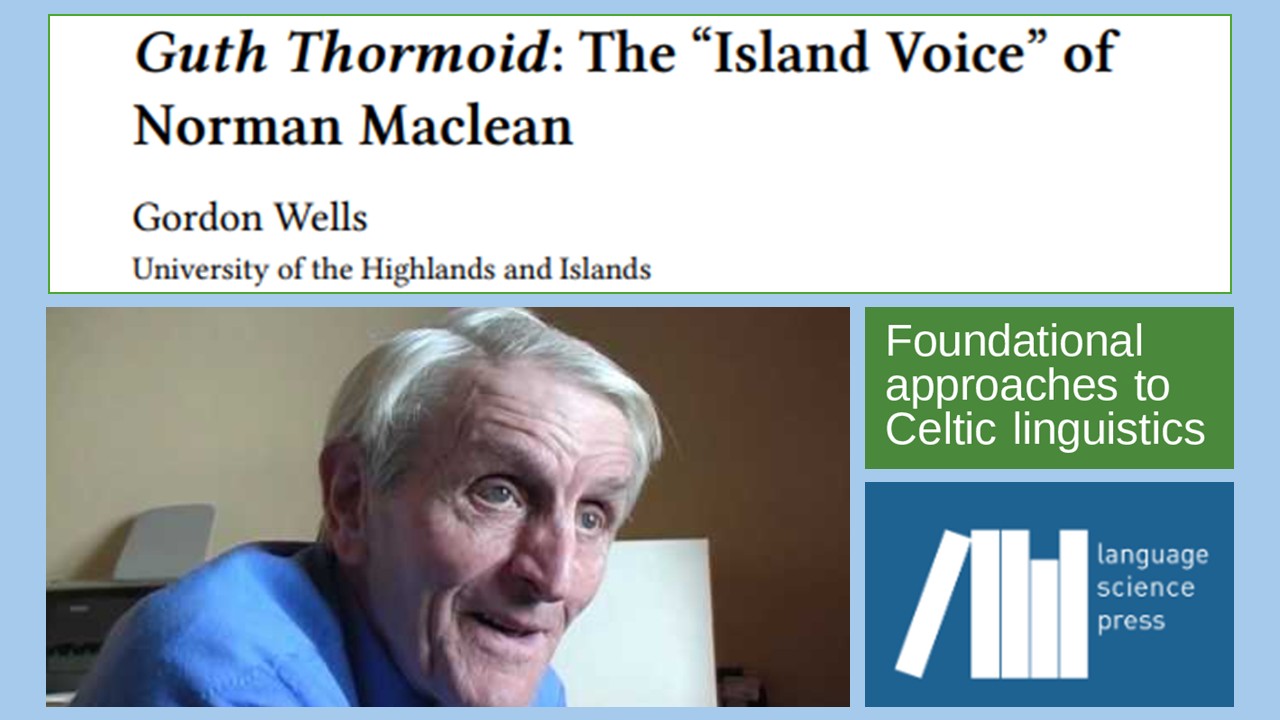
The Island Voices project is featured in the new book “Foundational approaches to Celtic Linguistics“, through a chapter on the late Norman Maclean by Gordon Wells. This volume is a first venture into current issues in Celtic linguistics for the free open access academic publisher, Language Science Press.

From the editors’ preface:

Gordon Wells’ chapter (Guth Thormoid: The “Island voice” of Norman MacLean) provides a case study that highlights the exceptional value of working closely with an experienced native speaker to not only provide linguistic data but to document vanishing cultures and values also impacted with language loss.

And here’s Gordon’s abstract:

This chapter samples and contextualises some of the multi-faceted Gaelic contributions by the multi-talented creative icon, Norman Maclean, to the Guthan nan Eilean ‘Island Voices’ online language capture and curation project. These include, in particular, Norman’s final Saoghal Thormoid ‘Norman’s World’ series of videoed conversations, recorded in April 2016 in which he spoke reflectively of his memories and impressions of bilingual life in Glasgow and the Hebrides from the middle of the Twentieth Century onwards. In addition to offering a vivid first-person voiced and experiential account of Gaelic life over a tumultuous period for the language, the Island Voices adherence to basic linguistic principles pays dividends in relation to some initially unpredicted spin-off applications, with potential for further development.

We’re delighted to see this account of our work with Norman placed online for unrestricted reading by anyone who may take an interest, and we’re very grateful to Andrew Carnie and the whole editorial team at the University of Arizona who made that possible. Mòran taing dhuibh uile!

Online publication also means, of course, that live links can be incorporated in the text, so that readers can quickly and easily sample the recordings referred to at the click of a mouse. This is no small consideration for a primarily speech-oriented project like Guthan nan Eilean!

You can freely find the article at this DOI: https://zenodo.org/records/15654881

The full Saoghal Thormoid transcripts, with description of method and a foreword by Professor Conchúr Ó Giollagáin are available in PDF format from the Island Voices Research/Reports page.

Jimí agus Pádraig updated

In the continuing collaboration through CIALL with Irish partners on Stòras Beò nan Gàidheal/Taisce Bheo na nGael we’re delighted to host two more recordings (Parts 3 and 4) of Jimí Chearra and Pádraig Chearra, in addition to those already posted. It’s a project which records the natural speech of Irish and Scottish Gaelic speakers in their own communities with user-friendly equipment and techniques. In an additional challenge for Scottish Gaelic speakers, the descriptions below are offered in Irish! (Clilstore transcriptions are also available via the above link.)

Part 3: Bainfidh na scéilíní grinn sa mír seo ag Jimí Chearra agus a mhac Pádraig gáirí amach: filleadh gan brabach ó Bhroomielaw na hAlban; ”gur olc an greim é greim baba” (ón Eachréidh); ”go n athródh Dia nó an deabhal” an aimsir (ón Eachréidh); postmortem ar asal na dtincéaraí; ”minic a bhí páidrín fada ag rógaire maith”; ionadh an Árainnigh a chonaic rothar; béadán Gaeilge ag seanmhná; tuthógaí go ”tuffin”’ an Bhéarla éigeantaigh; kick out a bhris clog sa scoil; ”Dismiss the case” an asail óig gan mhúnadh; telegram barrúil sreang-Bhéarla agus an posta gallda. Trácht freisin ar aontaí; ar shearrach á chloisteáil beo sula rugadh marbh é; athrúintí sa saol, borradh faoin mBéarla san áireamh.

Part 4: Scéalta áitiúla, an greann agus an ghruaim, sa mír seo ag Jimí Chearra agus a mhac Pádraig. Chaill bean a folt breá gruaige de bharr masla a chaith sí le fear siúil. Tháinig díleámh ar na Blácaigh, tiarnaí talúna, tar éis mhallacht an tsagairt i litir na n iomad clúdach. Cur síos fileata agus greannmhar ar asal, agus ar chaora strae a bhí ag Marcas Ó Céide. Rannscéal faoi phóitire a chuir luach bainbh faoin muineál i dteach an óil agus a d’éirigh as ansin. Seanchas eile ar an ól agus ar éagóir a rinneadh ar Pheadar Chois Fharraige, údar an leabhair Peadar Chois Fhairrge a chuir Seán Mac Giollarnáth, aturnae, giúistís agus athbheochantóir, in eagar. Diarmaidín Thomáis Thaidhg a dúirt gurbh é an milleán is mó a bhí ar an mBéarla aige nár airigh sé ariamh ach ag chuile bhacach é! Plé ar an Marainn Phádraig. Ag cuir láí go Beaty.

Gaelic Shorts

While recording natural conversational speech of fluent Gaelic speakers over the past couple of years, we have taken to also “scaffolding” these clips for the benefit of any Gaelic learners or non-speakers who wish to follow them as well. We now have a new “Shortcuts” page where these clips are collected together for ease of access!

How and why have we done this?

There is obviously a lot of talk about AI (Artificial Intelligence) these days, with plenty of excitement as well as concern over what the future holds for computer-assisted construction and deployment of “Large Language Models” (LLMs) etc, and where they might leave lesser-used languages like Gaelic. That said, the term “AI” itself lacks clear definition, and we have certainly been happy to use new technology to help capture and curate Gaelic and other languages since the very beginning of Island Voices, back in 2005!

Perhaps the most obvious example of this is our default construction of Clilstore transcripts for most of the recordings we make. Originally designed as a language learning aid (principally through its built-in dictionary look-up facility), Clilstore has proved equally valuable simply as an online platform for combining video recordings of authentic speech with verbatim transcripts. On our new “Shortcuts” page all the clips presented on YouTube are also made available on Clilstore. This will enable learners of Gaelic to match up the spoken and written word as they listen and read, and quickly check any unfamiliar vocabulary for translated meaning in an online dictionary. (Learners who find the real-time speed of fluent Gaelic speech challenging should also note the YouTube facility to slow video playback down without altering the pitch of the voice.)

Whether or not you consider Clilstore to be an example of AI, there is no doubting its place in automatic translation tools such as Google Translate. And we’ve been happy to incorporate that facility for the benefit of non-speakers of Gaelic when taking advantage of the Closed Caption (CC subtitling) option that YouTube offers. You can choose to either activate the CC button on our videos or leave it off. If you do use it, the subtitles will appear in Gaelic by default – a handy aid in itself for some – but you can also choose to get them auto-translated into other languages, including English. The results are not perfect – the software still has difficulty distinguishing between crofts and harps! – but it will give a pretty decent overall impression of the content of discussion.

As we know, there are plenty of non-speakers of Gaelic resident in the remaining Gaelic communities who are still interested in knowing what their neighbours, friends, or indeed other family members like to talk about. This kind of technology hints at new open access paths to community knowledge and local history without the need for Gaelic speakers to switch to their other language in order to pass on their own thoughts and feelings.

There’s a mix of speakers in the featured recordings. A good half have spoken Gaelic as their first language all their lives. Others learnt it after arriving in the Hebrides as young children, whether returning with family or being adopted into the community. And a couple of others, while also having a close family connection to the language, have taken the harder route to fluency, through active study as second language learners. In all cases we hope you will find they have interesting stories to tell!

You can find this shortcuts material here. Take a look and share with like-minded friends!

We are indebted to the UHI Language Sciences Institute’s CIALL project for its support over the last couple of years in enabling its production.

Caibeal agus Cladh

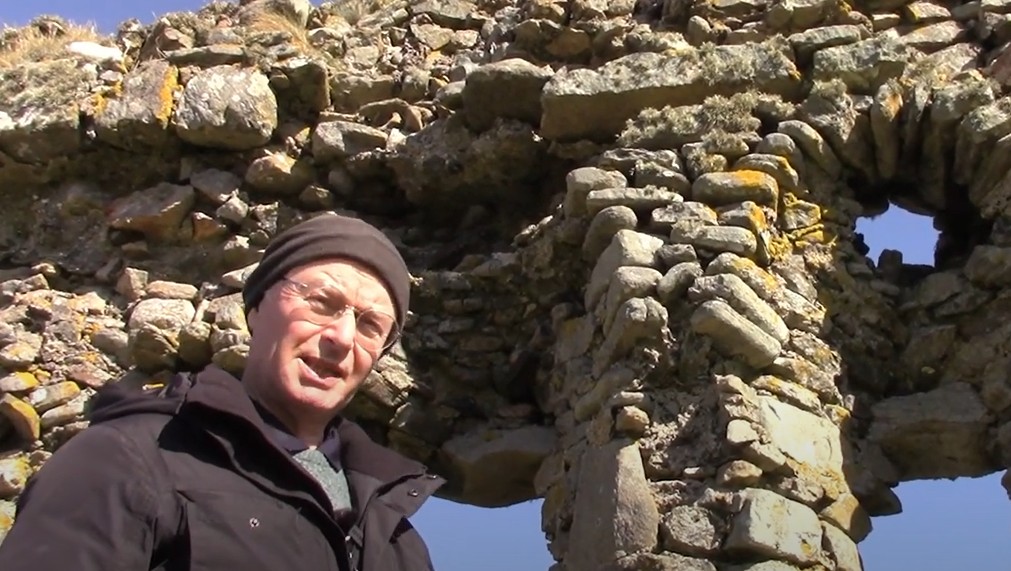
Tommy Macdonald of Howmore in South Uist delivers a Gaelic guided tour of the old chapels and graveyard, dating at least as far back as the 9th Century, and shares some stories about the burial practices which continued into living memory.

As a well-known and respected local historian Tommy has been the central linking figure over the last couple of years in creating a series of clips looking at local “taighean is tobhtaichean” (houses and ruins), recording stories associated with them, and talking to some of the people with experience of living in taighean-tughaidh (thatched houses) in particular. These have been gathered together in our special “Taighean-tughaidh Uibhist” YouTube playlist, to which this latest recording has also been added.

This recording, like the others, has been made in Tommy’s good South Uist Gaelic. But it’s definitely not an exercise in the exclusion of learners or non-speakers of the language. Same language Closed Caption (CC) subtitles are available at the click of a YouTube button, and viewers on a laptop or desktop computer will also be able to access automatic translation into English and other languages through the settings wheel.

You can also choose to slow down the video without altering the pitch of his voice through the same mechanism. And learners may further choose to follow the wordlinked transcript with the video embedded on the Clilstore platform: https://multidict.net/cs/12419.

Welsh Connections

Island Voices’ collection of Welsh recordings continues to grow as the Extensions “ripple effect” keeps on spreading out.

We already had Welsh versions as integral parts of the Audrey West and Martin MacIntyre packages – for obvious reasons! – with Ifor ap Glyn providing the voiceover on both occasions. We’re delighted to announce that Ifor has now gone on to provide us with the same service for both Christie Williamson and Donald S Murray as well.

Clilstore wordlinked transcript: https://multidict.net/cs/12343

Clilstore wordlinked transcript: https://multidict.net/cs/12342

These additions will bump the total number of films in our Other Tongues Welsh Selection up to five – with more to come!

Paul McCallum in Conversation

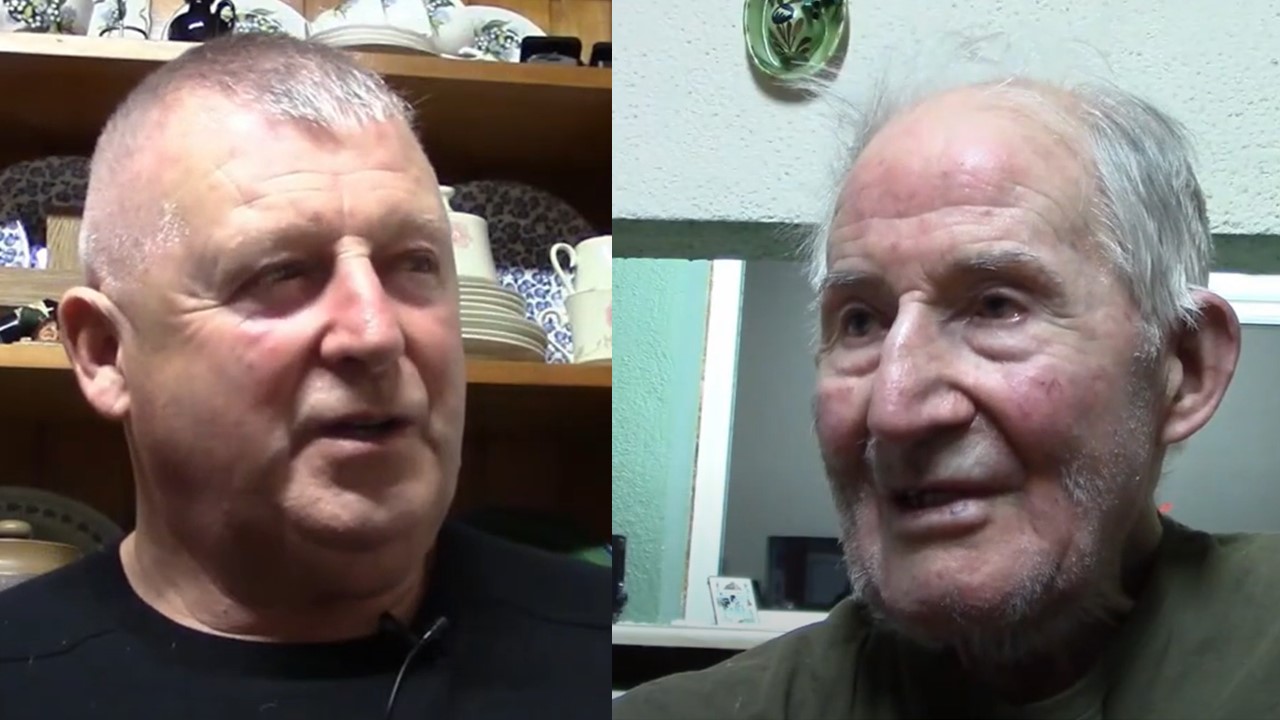
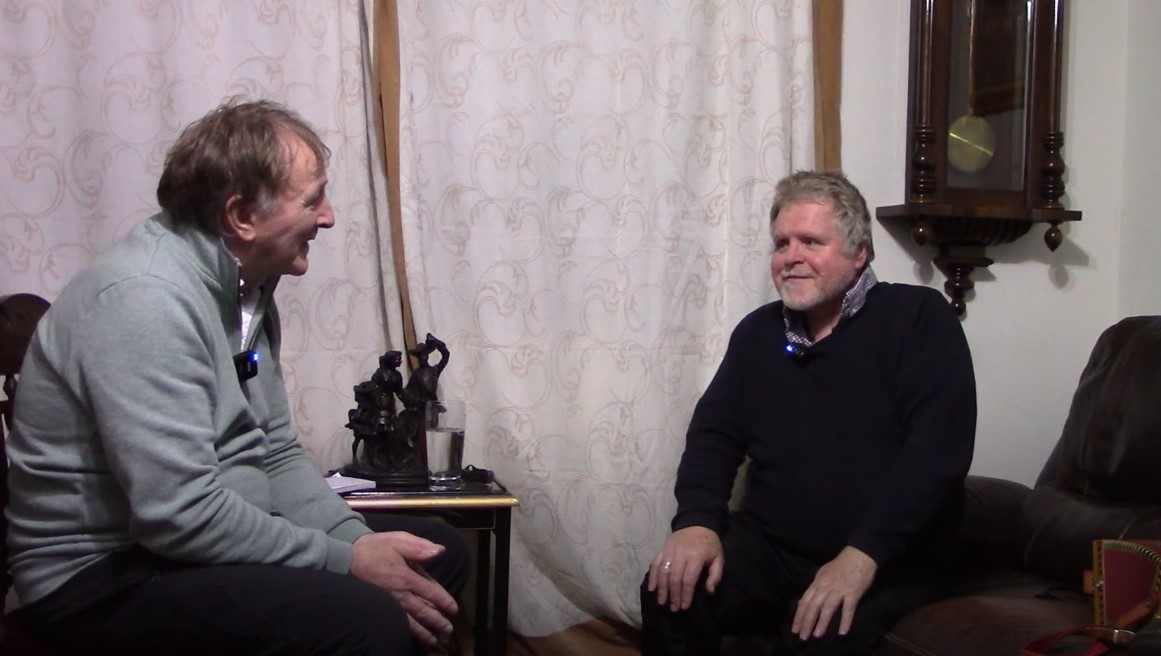
Well-known Gaelic singer Paul McCallum from South Lochboisdale, South Uist, talks to James MacLetchie, from Sollas, North Uist.

Paul and James share the same experience of having been brought to Uist as young boys to be taken into local families. They had a lot to talk about!

The full conversation has been split into two parts of roughly the same length, which are first presented here unfiltered and unsubtitled.

Again, we’ve also cut the conversation up into smaller chunks and added subtitles and Clilstore transcriptions to help learners or non-speakers of Gaelic get a good sense of how the conversation flowed, summarised below. (Technical note: the Closed Caption (CC) subtitles – directly available on YouTube via the bold blue links below – are in Gaelic by default. However, if you are viewing on a laptop or desktop computer the settings wheel will allow you to select auto-translation into another language of your choice – English included. Alternatively, “Clilstore units” combine the embedded video with a wordlinked Gaelic transcript with one-click access to an online dictionary for any words you don’t know.)

In Part 1A Paul recalls his memories of arriving in South Uist as a four-year old with his two older brothers, to be looked after by a local brother and sister family in South Lochboisdale with Eriskay connections. He came from a musical family and found himself in a musical place – “Gleann a’ Cheòlraidh” – where he picked up Gaelic, before starting school, with the help of his musical ear. (Clilstore unit: https://multidict.net/cs/12300)

In Part 1B he remembers his schooldays and some of his teachers, most of whom were Gaelic speakers even though education was conducted through English. He recalls how music came to him easily, and competing in mòds from an early age (at which he and James first came into contact). On leaving school he worked as a cook for MacBraynes on the Islay ferry, through which he came across Islay Gaelic, which was quite different from his own. (Clilstore unit: https://multidict.net/cs/12301)

In Part 1C James notes how the advent of electricity marked a turning-point in Gaelic cèilidh culture, and Paul reflects that good singers would not necessarily be comfortable performing on a stage. Nevertheless he is encouraged by signs of natural musical ability in the local community. After MacBraynes he moved on to a Dominican centre helping people with drug or alcohol problems, where he mixed with people from all walks of life, and experienced a meaningful education. (Clilstore unit: https://multidict.net/cs/12302)

In Part 1D Paul talks more about how his singing career took off, and how he received voice training in the classical tradition over a period of years. He points out that there are Gaelic songs that are classical, but notes also that the traditional worksongs of crofting communities provided natural voice training without the need for study, and that true vocal power is best demonstrated in soft singing. (Clilstore unit: https://multidict.net/cs/12303)

In Part 1E Paul explores further the differences between classical and traditional singing, and the importance, in his view, of presenting Gaelic songs to islanders in a natural manner which chimes with their environment, albeit with the help of classical training. (He listened to classical singers as a boy and received help from classical teachers.) In Gaelic domestic culture he experienced an ingrained prayerful spirituality that combined naturally with music and the environment. (Clilstore unit: https://multidict.net/cs/12304)

In Part 2A Paul and James share their experiences of being welcomed and absorbed into their respective communities in South and North Uist as young children. When James questions him about his later stage performances, Paul explains that that placed a distance between him and his audience, where he had the persona of “The Singer”, which was different from the Paul McCallum in his own home. Now retired from singing, he doesn’t miss the stage. He enjoys having his feet on the ground. (Clilstore unit: https://multidict.net/cs/12305)

In Part 2B Paul talks a bit about his own writing, and how it’s inspired by the local environment. Moving on to discuss local poets from earlier times he notes the exemplary command they had over the language and how today’s Gaelic has changed. He regrets the loss of vocabulary and idiom and cautions against a felt need to change the language to “keep up” with today’s world. If the language is indeed “dying” we should be careful not to kill it off with words and idioms that don’t belong to it. (Clilstore unit: https://multidict.net/cs/12306)

In Part 2C, reflecting on the disappearance of cèilidh houses, Paul suggests it is the community that is dying, more than Gaelic. He is reminded of recent visitors who talked of their memories, and about sloinnidhean – genealogies – and how much he enjoyed and learned from those visits. He believes young community members are also interested in old stories, but time needs to be found for such activities. Like James, he is a fluent Gaelic speaker and it’s the language he prefers to use in the community. Questioned by Paul about his own musical tastes, James talks about his influences, for example, Runrig. (Clilstore unit: https://multidict.net/cs/12307)

In Part 2D James asks Paul if he thinks they both value Uist and Gaelic so highly because of the way they were taken there. Paul points out that, rather than being taught Gaelic formally, they absorbed it naturally. They arrived with nothing, and were given access to life, language, culture, music, beliefs, which may well have given them a deeper appreciation of their language and surroundings. James echoes his appreciation of the learning he received, especially from his adoptive father and other elders in the local community. (Clilstore unit: https://multidict.net/cs/12308)

In Part 2E Paul turns the tables on James and asks him about his own writing of songs, and encourages him to pass them on – “Bheir seachad iad”. Once they’re written they no longer belong to him. They should be shared, to help keep the language and the music alive. “You could take it all over the world.” James reflects on Gaelic connections with First Nations of North America, and Paul notes commonalities in their troubled histories. But looking forward, he repeats his warning about needless change to the language – “Mura h-eil e briste, na cuir air dòigh e”. (If it ain’t broke, don’t fix it.) (Clilstore unit: https://multidict.net/cs/12309

These recordings were made with the support of the CIALL project, based in the Language Sciences Institute of the University of the Highlands and Islands.

Gael in Edinburgh

Select any video clip in this landscape format, or use the phone-friendly portrait layout.

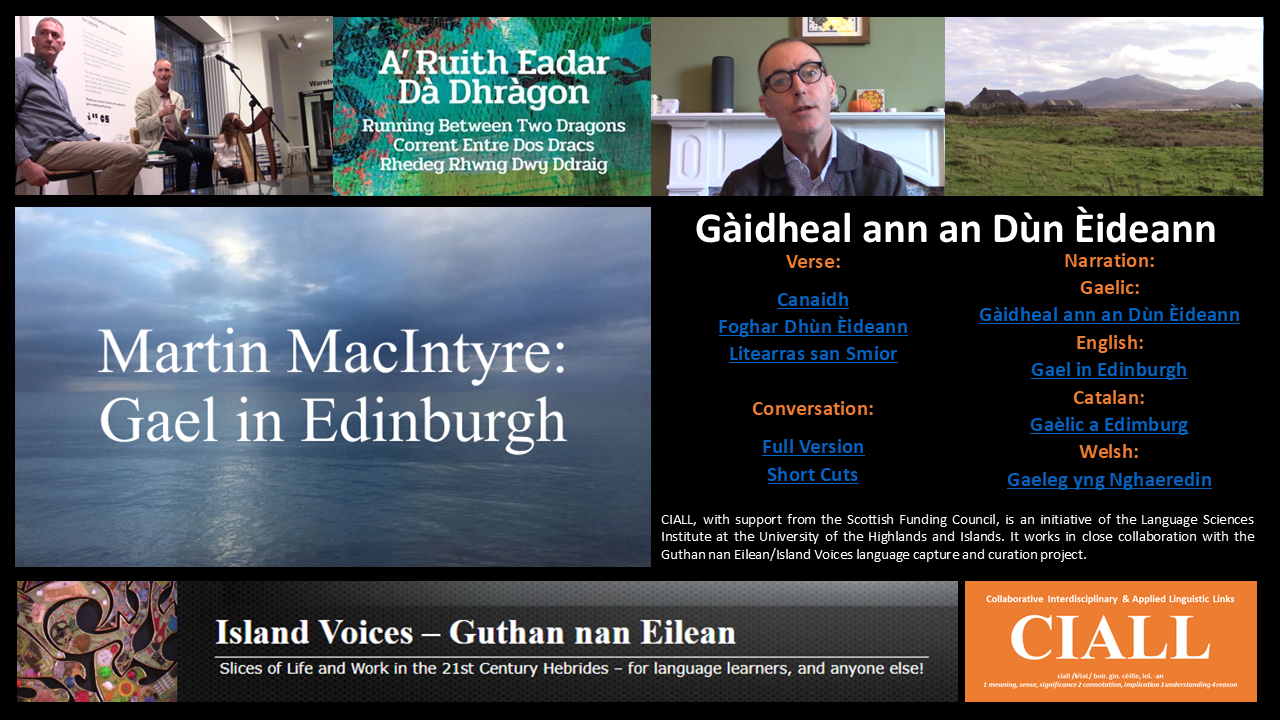
Writer, poet, and “Edinburgh Gael” Martin MacIntyre (Màrtainn Mac an t-Saoir) is the subject of our latest “Extensions” project, in which we present narrative, conversational, and poetic samples of Gaelic and other languages in previously unexplored contexts. Martin himself is the narrator of both the Gaelic and English versions of the introductory documentary, and we were delighted to engage Ifor ap Glyn, and Noèlia Díaz-Vicedo, Martin’s collaborators on A’ Ruith Eadar Dà Dhràgon, for the Welsh and Catalan versions*. Martin’s own recitations of Canaidh, Foghar Dhùn Èideann, and Litearras san Smior give a taste of his wide-ranging poetic output.

In the recorded conversation he talks to Island Voices co-ordinator, Gordon Wells. In the full version, the topics covered include Martin’s island family connections and his Gaelic learning journey, comparing and contrasting island and mainland urban contexts, as well as questions around multilingualism, and discussion of literacy and oral and written literature. In conclusion the possible affordances of new media are also considered.

In an alternative approach that may suit learners or non-speakers of Gaelic, the same conversation is broken down into short extracts, which are optionally supplemented with auto-translatable subtitles and/or wordlinked transcripts:

In Part 1, Martin outlines his island connections to Benbecula, South Uist, and Barra, reeling off a sloinneadh of impressive length that traces his genealogical roots on his father’s side as far back as the late 17th century. He visits when he can, though he has always been mainland-based, having been brought up in Lenzie, a town to the north of Glasgow which itself has a Gaelic-based name.

In Part 2, Martin talks about his Gaelic learning journey, an interest that has been with him since his first visit to South Uist with his father and brother when he was still in primary school, where he first encountered the language in an extended family and community setting. He describes his father’s initial surprise at his son’s interest, and how in time they came to speak Gaelic to each other more and more, and how this also helped when it came to raising his own children with Gaelic.

In Part 3, Martin first develops his thoughts on the affective implications of language choice and use, particularly in relation to emotional bonds, for example between family members. The conversation moves on to consideration of community factors in Gaelic use and maintenance in a context of ongoing language shift to English, and his own family’s notable success in passing the language on to a new generation in the urban context of Edinburgh. He cites close family connection, the importance of habitual use of the language, including listening to Gaelic radio, and involvement in school and community activity as crucial factors.

In Part 4, still discussing Gaelic’s minority status in Edinburgh, Martin suggests the evident multicultural milieu may in some ways and in some situations make it comparatively easy to mount Gaelic events, while also noting that he perceives a move towards more specifically Gaelic activities among Gaelic communities. He goes on to describe the inspiration he has derived from other minority language contexts, particularly Catalan and Welsh, and his collaborative work with poets in those languages in one of his latest books.

In Part 5, moving on from other multilingual contexts the conversation turns to questions of literacy and literature in a Gaelic context, where many of the most fluent speakers of Gaelic do not habitually read or write it. Martin reflects on the lasting legacy of the historically poor treatment of the language in education, while also recording his appreciation of the Gaelic oral tradition, and of songs and stories created by speakers who were not writers.

In Part 6, the conversation moves on to discussion of possible positive steps that may help ameliorate a difficult situation for Gaelic. Martin points out that, irrespective of age, people are capable of learning new skills, for example in the use of computers. Traditional speakers’ knowledge of the cultural and oral tradition should be valued. At the same time, he notices more confident use of Gaelic on social media. Picking up on voice-notes, he also suggests that new technologies could enable easier creation of audio-books that could help bring new literature closer to traditional speakers.

*September 2025 update

Since original publication a new version of the documentary has been added to the collection in Jamaican, with an accompanying transcript and background information.

Audrey and the Dragon

leaflets16to9COD

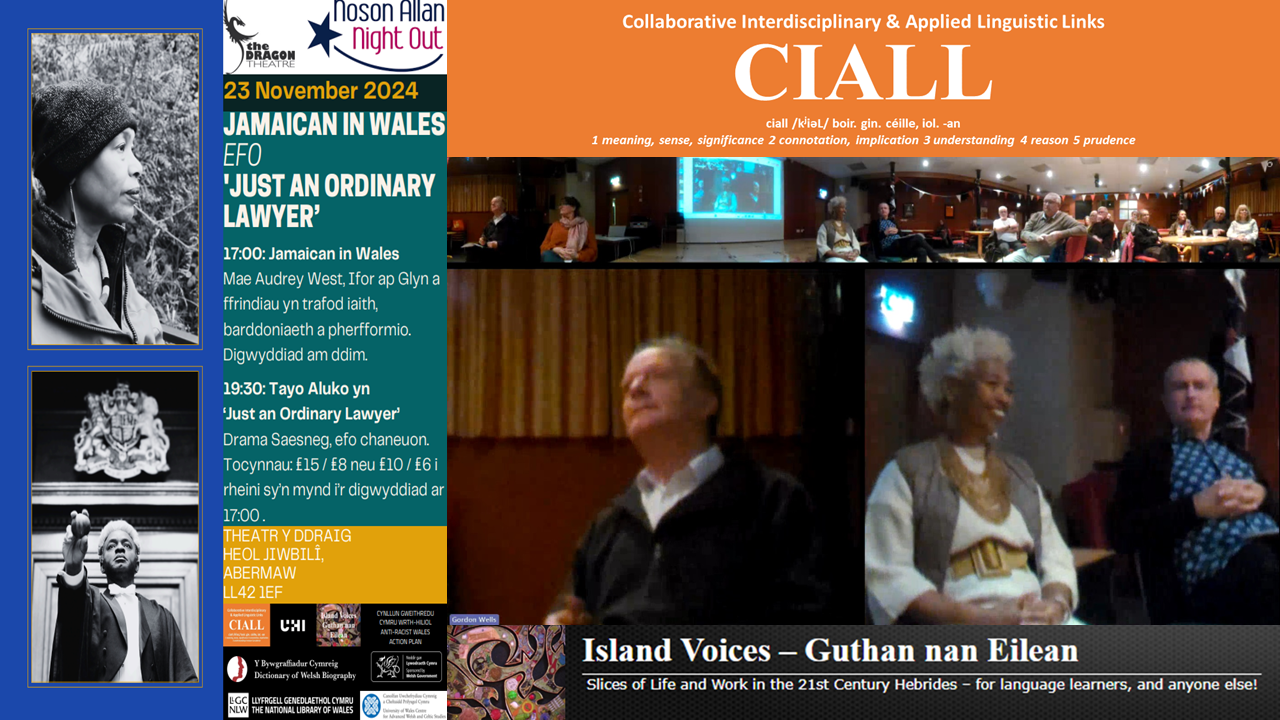
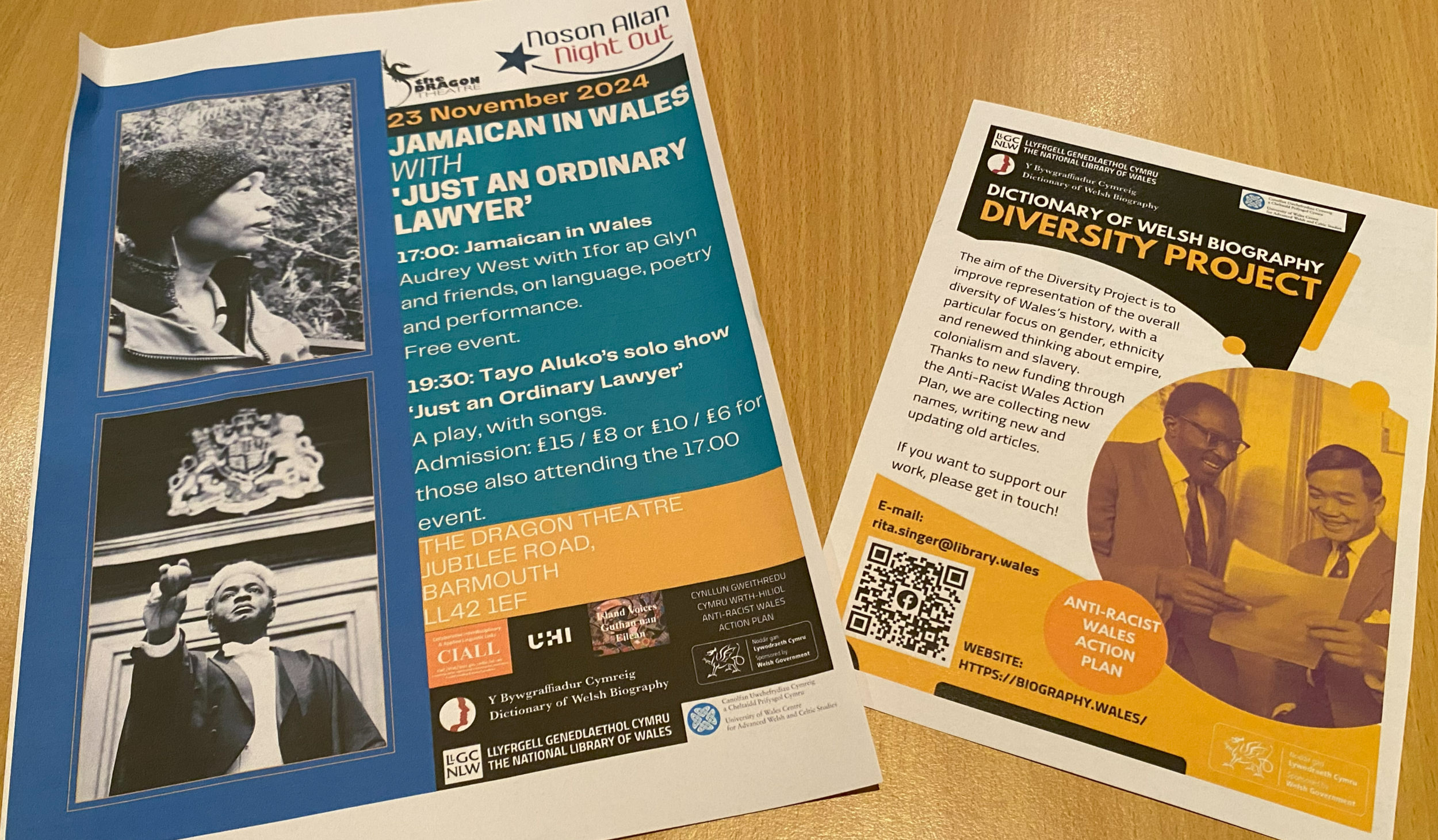
On a stormy night, with serious flooding to the south and Met Office warnings to avoid driving, there was still a sturdy local attendance for this thought-provoking double bill at Barmouth’s Dragon Theatre on November 23rd. Tayo Aluko had driven up from Cornwall in the morning to be ready to perform his one-man play “Just an Ordinary Lawyer” in the evening slot at 7.30pm. This was preceded at 5pm by the multilingual local launch and community discussion of the Island Voices video cluster, “Jamiekan ina Wielz” featuring Audrey West.

In addition to Jamaican and Gaelic, the introductory documentary video is currently also available online in Welsh, English, and Portuguese, with the prospect of other languages to follow, in line with our “Other Tongues” and “Extensions” initiatives. We didn’t get a chance to sample all of these on the night, but we were pleased to include Welsh, in addition to Jamaican itself, through the skilful chairing of panel presentations and the wider discussion by Ifor ap Glyn (National Poet of Wales 2016-2022), who had himself supplied the Welsh translation and narration of the film.

With contributions also from Rita Stringer at the Diversity Project of the Dictionary of Welsh Biography, and from Island Voices’ co-ordinator Gordon Wells, the discussion was wide-ranging, touching on what we mean by “Black history” or “Welsh history”, or indeed “everybody’s history”, as well as languages and linguistics (particularly in relation to multilingualism in present-day society). Audrey herself talked freely about her personal, professional, and artistic journey up to today, and was happy to answer questions from the audience about the Jamaican language, for example about the origin of words like “pikni”.

It was a full hour and a half of viewing and talking in total. This short video gives a taste of some of the topics covered as well as snippets from the video in question in Welsh, Gaelic, and Jamaican.

The multilingualism poses something of a challenge for YouTube’s subtitling services! But auto-generated English titles are enabled, as well as Welsh and Gaelic transcriptions in appropriate places. (For non-speakers of these two languages you can get auto-translations through YouTube’s settings wheel.)