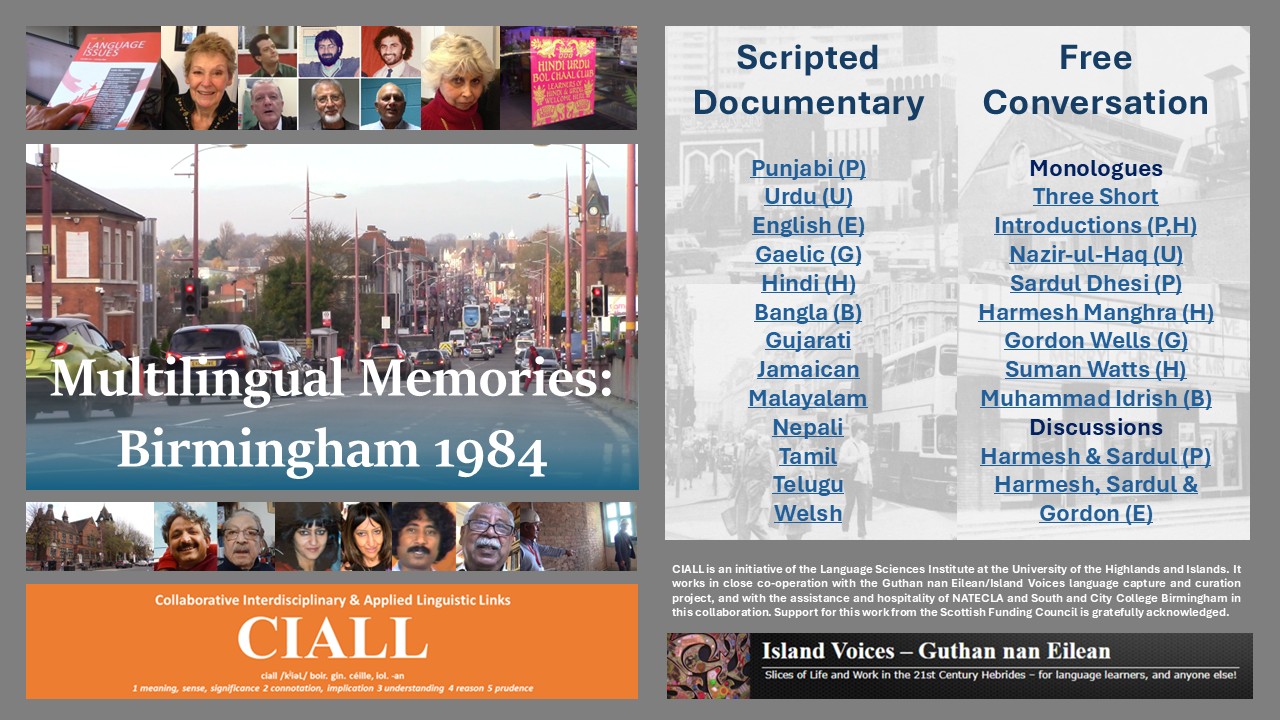
Multilingual Memories: Birmingham 1984

With a multilingual trip down Memory Lane, Island Voices visits Central England, in a new contribution to the CIALL-supported “Extensions” initiative. This collection comprises a short documentary introduction – available in various community languages now spoken in the UK – plus a range of recorded conversations and interviews about the 1980s Industrial Language Training (ILT) service, each recorded in a particular language, but made accessible for non-speakers or learners of that language through YouTube subtitling and/or a supporting Clilstore transcript.

Scripted Documentary

The documentary uses a scripted narrative to follow three Birmingham ILT workers as they meet together for the first time in 40 years in their old workplace. The film introduces various aspects of the ILT programme, from onsite teaching of English to Speakers of Other Languages (ESOL) to training and advice in Equal Opportunities and Anti-Racism, as well as innovative support for Community Languages. Team members also visit other key locations and organisations, such as the office of NATECLA, the National Association for the Teaching of English and other Community Languages to Adults, and recall the BBC “Hindi Urdu Bol Chaal Club” in a Soho Road restaurant. Multiple versions of the film are available in English, Gaelic, Jamaican, Welsh, and nine of the South Asian languages spoken most widely in the UK by census results.*

Here’s the English version:

And here’s the Clilstore English transcript, with the video embedded, incorporating one-click access to online dictionary support for any unfamiliar vocabulary: https://multidict.net/cs/12354

To see the video narrated in another language, click on the landscape poster (or phone-friendly portrait option) to choose your own preferred version of the documentary. Or select from the table below for the equivalent Clilstore unit.

Bangla Gaelic Gujarati Hindi
Jamaican Malayalam Nepali Punjabi
Tamil Telugu Urdu Welsh

Free Conversation

The interviews and conversations are accessible through the same landscape or portrait links, or directly through the bold blue titles below, and they comprise live and unscripted samples of authentic speech. YouTube subtitles are available through the Closed Caption (CC) button, and viewers on a laptop or desktop computer should also be able to get these auto-translated into the language of their choice through the Settings Wheel. Every film (except the first short introduction and the 3-way English discussion) is also accompanied by a Clilstore transcript. Links to rough written English translations are also available via the video description and reproduced below. In some cases where reference is made to related postgraduate study, links are also given to participants’ own papers from the time to give a sense of contemporary research and debate about then dominant issues from a practitioner perspective.

Three Short Introductions

The opening conversational clip quickly introduces the three former members of Birmingham Industrial Language Training Services featured in the documentary, as they speak Punjabi or Hindi to briefly outline their ILT experience and say where it eventually led them. Subtitles in both these languages are available, including for auto-translation if necessary.

Nazir ul Haq

Speaking in Urdu at some length, Nazir ul Haq, last leader of the Birmingham ILT team of the mid-1980s before its absorption into the college, offers memories and reflections – judiciously supplemented with quotations from well-known Urdu poets – on the work of the local unit, as well as the national service, during that time. This clip is an amalgamation of a series of short recordings that Nazir made over a number of days, as detailed with links below, in which, alongside critical analysis, he also creates a humane picture of the team’s mission and working ethos, with poignant reminiscences and tributes to those no longer with us.

00:09 Introduction
02:04 ILT 1980s role
06:16 Memory and reminiscence
09:53 Personal journey
14:57 Equal Opportunities: appreciation of colleagues and contributions
19:35 Summary critique of ILT approach to racism awareness and anti-racism

Wordlinked transcript (Clilstore unit)
Written translation (online PDF)

Nazir also mentions his PhD-level postgraduate studies at Birmingham University during the same period, and his continuing association with the university after the closure of ILT. For an example of his work in the area of diaspora formation with specific reference to the Kashmiri community you can read his paper presented some years later at a conference in Budapest: Diaspora Formation and Ethnic National Mobilisation of Kashmiris in Britain: A Reflective Case Study.

Sardul Dhesi

Speaking Punjabi, Sardul Dhesi, retired Deputy Principal of South and City College Birmingham, gives a summary account of his 48-year Further Education career in the city, including his time with Birmingham ILT in the late 1970s and early 1980s. His time with ILT was a seminal period for him, including a one-year secondment to get a Master’s degree in Race and Education, from which he never looked back. Also important to him were his trade union links, with particular regard to equality initiatives. Over his long subsequent career, he occupied increasingly senior positions in what has become the biggest college in the West Midlands.

Wordlinked transcript (Clilstore unit)
Written translation (online PDF)

For more specific detail on Sardul’s work on and research into Trade Union links to ILT you can read his essay on Trade Unions and Racial Inequalities: An examination of the role of ILTS in removing the barriers, written as part of his M.Soc.Sci course at Birmingham University during his 1985-86 secondment, together with the appendix containing a selection of contemporary ILT and TUC materials. In another scanned essay for the course, Sardul discusses ILT Training for Equal Opportunities, including his overview of how and when the service first came into being and its development path thereafter.

Harmesh Manghra

Speaking Hindi, Harmesh Manghra, retired Inspector of Education, recounts the various stages of his career in some detail, including his time with Birmingham ILT in the early 1980s. He starts with the multilingual education he received in India before arriving in the UK, when job opportunities were initially limited despite his qualifications. But his time with ILT provided a springboard into a varied and stimulating career across various educational sectors. Even in retirement he remains committed to easing newcomers’ passage through educational opportunities.

Wordlinked transcript (Clilstore unit)
Written translation (online PDF)

Gordon Wells

Speaking Gaelic, Gordon Wells, researcher with the CIALL project, outlines his career path, including his time with Birmingham ILT in the 1980s and what he learned from that experience for use in later years, including with Island Voices. It was the rising interest in “Mother Tongue” maintenance that inspired him to start learning Gaelic, and his experience working on the BBC’s “Hindi Urdu Bol Chaal” series that developed his interest in recording speech in particular. This was reinforced by the ILT emphasis on close community connection with the day-to-day concerns of working people.

Wordlinked transcript (Clilstore unit)
Written translation (online PDF)

Gordon’s research topic for his 1987 dissertation for the MSc in Applied Linguistics at Edinburgh University, while on secondment from ILT, was on Concepts of “Mother Tongue” and “Native Speaker” in Relation to the Teaching of Languages to Adults. This paper, later cited in Professor Alan Davies’ 1991 book “The Native Speaker in Applied Linguistics”, anticipated by some years a now longstanding debate on the question of “native” vis-à-vis “non-native” English speaking teachers.

Suman Watts

Suman Watts came into ILT from a broadcasting background on local radio. She briefly explains in Hindi that she put these skills to good use in helping prepare audio-visual teaching materials. In her later career she helped not only English learners, but also learners of community languages like Hindi and Urdu, within the context of the issues and principles that informed the ILT ethos.

Wordlinked transcript (Clilstore unit)
Written translation (online PDF)

Muhammad Idrish

Speaking Bangla, Muhammad Idrish, who worked at the neighbouring Asian Resource Centre in the 1980s, offers succinct memories of friends and colleagues in the Birmingham Industrial Language Training team (as well as the Dudley team), and their contribution to the anti-racism movement in the community, including the NALGO-supported nationwide Muhammad Idrish Defence Campaign.

Wordlinked transcript (Clilstore unit)
Written translation (online PDF)

Harmesh Manghra and Sardul Dhesi

In this longer conversational extract Harmesh and Sardul, speaking Punjabi, recall shifts in focus of the ILT service at national and regional levels from language teaching, through cultural and racism awareness training, to structural analysis of social problems. Their career development paths took them on to West Midlands-wide initiatives with an emphasis on greater community engagement by colleges, opening local centres and providing appropriate facilities. Statistics now show far greater proportions of Black and Asian staff and students engaged in Further Education.

Wordlinked transcript (Clilstore unit)
Written translation (online PDF)

Harmesh Manghra, Sardul Dhesi, and Gordon Wells

This is an extended three-way conversation in English between Sardul, Harmesh, and Gordon about the ILT legacy, with a particular focus on language support in relation to both ESOL and Community Languages:


00:06
First reminiscences and appreciations
The three recall how ILT launched them into their professional careers under the guidance of Clarice Brierley, then leader of a dynamic team.
04:12 Bilingualism, ESOL, and Community Languages
Harmesh and Sardul were among the first bilingual ESOL teachers whose skills in other languages were recognised and increasingly valued, when Mother Tongue maintenance was also beginning to be raised as an issue, and NATESLA changed its name to NATECLA and established a national base in the college.
10:05 Materials development
The local authority’s supportive approach to staff development was instrumental in enabling team members to develop new skills and ideas, including Gordon’s role in the innovative BBC Hindi Urdu Bol Chaal project.
13:12 Community context
The ILT approach to ESOL and Community Languages was strong on addressing language learning in the grounded reality of the learners’ own situation, so community linkage was essential. The team members discuss how this guiding principle can be equally applied in other language contexts, for example with Gaelic in Scotland or many endangered languages in India.
16:05 Confidence issues
Team members share stories from personal or family experience of assimilative social pressures to suppress mother tongue use – whether Punjabi or Gaelic – and a Punjabi summer school initiative in the college is noted.
19:28 Final reflections
Lastly, each member reinforces the learning and confidence-building benefits of their early involvement in ILT, whether in relation to language skills and use, subsequent career paths, or social justice concerns, noting also how some issues first tackled 40 years ago, for example around workplace learning, remain prevalent today.

Linguistic Diversity

In conclusion, we may note that the year 1984 is now further back in the past than it was then still in the future when the dying George Orwell was putting the final touches to his doom-laden “Nineteen Eighty-Four” novel in a writer’s hideaway on the Hebridean Isle of Jura. Central to the workings of the totalitarian society he was predicting was “Newspeak” – a reduced and distorted officially approved form of language with a simplified grammar and reduced vocabulary, intended to promote social conformism and inhibit critical thinking.

This project is a new contribution from those we might now literally call “Old Speakers”(!), which looks back at the linguistic reality of the actual 1984 of urban England through the eyes of ILT staff and associates who were there at the time, with the benefit of their now 40 years of hindsight. If Orwell could have come back to visit us in the 1984 of real history he might well have been first shocked, then perhaps relieved on reflection, to find ample evidence of significantly increased linguistic diversity compared to the England he knew, at least at grassroots community level. It’s a confounding contrast, rooted in lived community reality, to the uniform and restrictive Newspeak monolingualism against which he had imaginatively warned.

We are deeply indebted to all the contributors who have made this collection possible. In addition to those appearing onscreen, we must also note particularly the crucial assistance of Professor Udaya Narayana Singh, a longterm partner in Mediating Multilingualism, in co-ordinating through Adhibhash the South Asian language translation and transcription work with his team of collaborators. In a previous “Talking Points with Norman Maclean” contribution he references the concept of “jugaaR” to illustrate a South Asian propensity for inclusive linguistic accommodation. And in a more recent lecture for Bhasha Mela he similarly contrasts the Orwellian vision of 1984 with the historical facts of interlingual coexistence in South Asia, thus providing an alternative optimistic vision and rationale for maintaining cultural diversity. With that in mind, we also thank and salute Audrey West, another of our Talking Points collaborators and Extensions pioneers, for her continuing determined local promotion of the Jamaican language. We are also delighted that Magaidh Smith consented to take part in true vernacular Gaelic style, and we welcome the fresh Welsh voice of long-settled Grimsay resident, Rhodri Evans. In the face of encroaching Anglophone monoculture, every similar contribution underlines the value of ongoing linguistic diversity.

Transcription, Translation and Narration Team:

Bangla documentary

Suchita Singh

English documentary

Suman Watts

Gaelic documentary

Maggie Smith

Gujarati documentary

Natwarlal Modha

Hindi documentary

Udaya Narayana Singh

Malayalam documentary

V. Geethakumary

Nepali documentary

Dhaka Ram Kafley

Jamaican documentary

Audrey West

Punjabi documentary

Kamalmeet

Tamil documentary

B. Vijayakumar

Telugu documentary

Matthew, P.S.

Urdu documentary

Qudsi Rizvi

Welsh documentary

Rhodri Evans

Bangla conversational transcription

Muhammad Idrish

Gaelic conversational transcription

Gordon Wells

Punjabi and Hindi conversational transcriptions

Gaurav Sharma

Urdu conversational transcription

Hamza Younas

National overview of ILT:

Tom Jupp, who set up ILT, together with Celia Roberts and Evelyn Davies provide a detailed account of the national scheme in Language and Discrimination, first published in 1993 and available as an e-book since 2014. This link also provides useful abstracts for individual chapters.


*September 2025 update

Two new versions of the documentary have been added to the collection in Farsi and Haitian Creole, with accompanying transcripts and background information. 
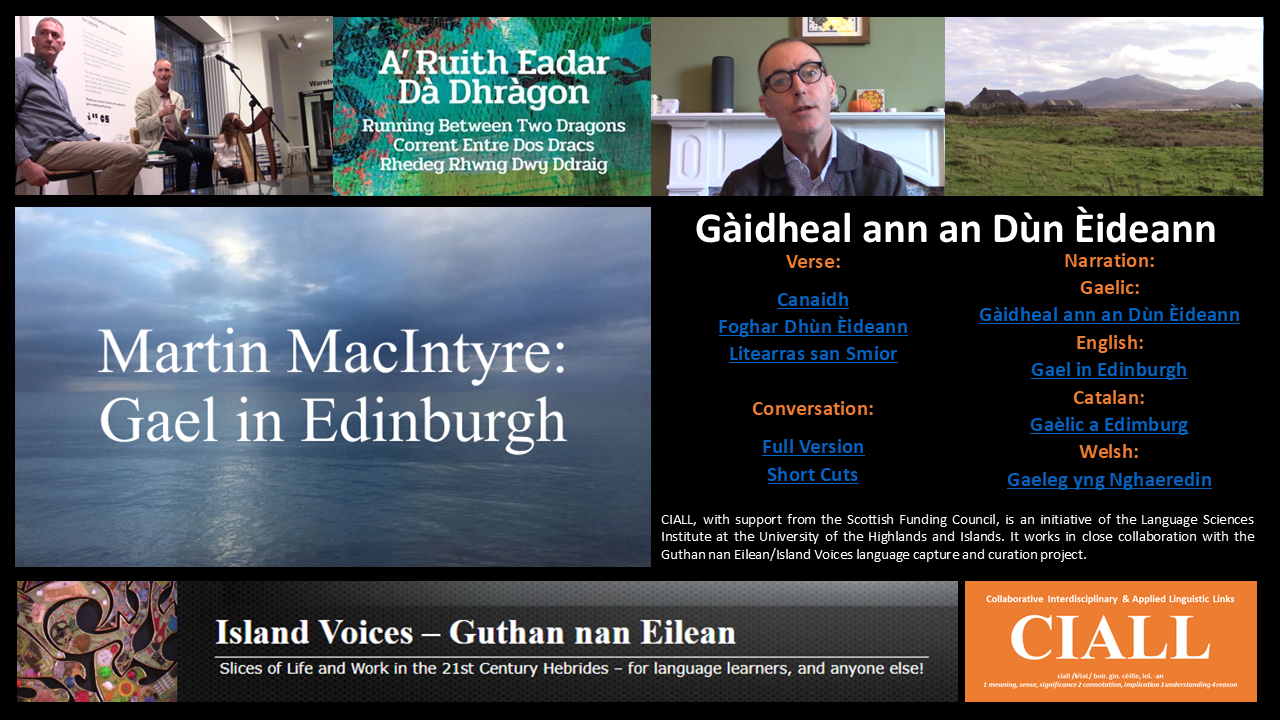
Gael in Edinburgh

Select any video clip in this landscape format, or use the phone-friendly portrait layout.

Writer, poet, and “Edinburgh Gael” Martin MacIntyre (Màrtainn Mac an t-Saoir) is the subject of our latest “Extensions” project, in which we present narrative, conversational, and poetic samples of Gaelic and other languages in previously unexplored contexts. Martin himself is the narrator of both the Gaelic and English versions of the introductory documentary, and we were delighted to engage Ifor ap Glyn, and Noèlia Díaz-Vicedo, Martin’s collaborators on A’ Ruith Eadar Dà Dhràgon, for the Welsh and Catalan versions*. Martin’s own recitations of Canaidh, Foghar Dhùn Èideann, and Litearras san Smior give a taste of his wide-ranging poetic output.

In the recorded conversation he talks to Island Voices co-ordinator, Gordon Wells. In the full version, the topics covered include Martin’s island family connections and his Gaelic learning journey, comparing and contrasting island and mainland urban contexts, as well as questions around multilingualism, and discussion of literacy and oral and written literature. In conclusion the possible affordances of new media are also considered.

In an alternative approach that may suit learners or non-speakers of Gaelic, the same conversation is broken down into short extracts, which are optionally supplemented with auto-translatable subtitles and/or wordlinked transcripts:

In Part 1, Martin outlines his island connections to Benbecula, South Uist, and Barra, reeling off a sloinneadh of impressive length that traces his genealogical roots on his father’s side as far back as the late 17th century. He visits when he can, though he has always been mainland-based, having been brought up in Lenzie, a town to the north of Glasgow which itself has a Gaelic-based name.

In Part 2, Martin talks about his Gaelic learning journey, an interest that has been with him since his first visit to South Uist with his father and brother when he was still in primary school, where he first encountered the language in an extended family and community setting. He describes his father’s initial surprise at his son’s interest, and how in time they came to speak Gaelic to each other more and more, and how this also helped when it came to raising his own children with Gaelic.

In Part 3, Martin first develops his thoughts on the affective implications of language choice and use, particularly in relation to emotional bonds, for example between family members. The conversation moves on to consideration of community factors in Gaelic use and maintenance in a context of ongoing language shift to English, and his own family’s notable success in passing the language on to a new generation in the urban context of Edinburgh. He cites close family connection, the importance of habitual use of the language, including listening to Gaelic radio, and involvement in school and community activity as crucial factors.

In Part 4, still discussing Gaelic’s minority status in Edinburgh, Martin suggests the evident multicultural milieu may in some ways and in some situations make it comparatively easy to mount Gaelic events, while also noting that he perceives a move towards more specifically Gaelic activities among Gaelic communities. He goes on to describe the inspiration he has derived from other minority language contexts, particularly Catalan and Welsh, and his collaborative work with poets in those languages in one of his latest books.

In Part 5, moving on from other multilingual contexts the conversation turns to questions of literacy and literature in a Gaelic context, where many of the most fluent speakers of Gaelic do not habitually read or write it. Martin reflects on the lasting legacy of the historically poor treatment of the language in education, while also recording his appreciation of the Gaelic oral tradition, and of songs and stories created by speakers who were not writers.

In Part 6, the conversation moves on to discussion of possible positive steps that may help ameliorate a difficult situation for Gaelic. Martin points out that, irrespective of age, people are capable of learning new skills, for example in the use of computers. Traditional speakers’ knowledge of the cultural and oral tradition should be valued. At the same time, he notices more confident use of Gaelic on social media. Picking up on voice-notes, he also suggests that new technologies could enable easier creation of audio-books that could help bring new literature closer to traditional speakers.

*September 2025 update

Since original publication a new version of the documentary has been added to the collection in Jamaican, with an accompanying transcript and background information.

Island Poets through Portuguese

Audrey and Christie

Our collaborator, Marina Yazbek Dias Peres, has excelled herself in her mission to bring Island Voices documentaries to Portuguese speakers around the world, this time re-rendering two of our most recent productions from our Extensions page! Lovely work, Marina!

“Jamaicana no País de Gales” offers a documentary slice of Jamaican life in Wales, featuring Audrey West, poet, artist, and community worker.

And “Shetlandês em Glasgow” gives us a parallel treatment of Shetland poet Christie Williamson’s life in Glasgow.

Clilstore units have also been created for each of these films. You can simultaneously view the films and read the transcripts for Audrey here, and for Christie here.

AAS: Wellbeing, Stories, and Gaelic

AASYouTubemontage1

Gordon Wells talks about his view of the importance of stories and the place for Gaelic to the Wellbeing group in the Aire air Sunnd project led by Comann Eachdraidh Uibhist a Tuath (North Uist Historical Society). He has recorded English and Gaelic versions of this talk. Click on any link below to get to the YouTube video.

Wellbeing, stories & Gaelic (in English) – full talk
Wellbeing, stories & Gaelic (in Gaelic) – full talk

Both English and Gaelic talks can also be viewed in two parts each. In part 1 Gordon recounts a story about his uncle, Norman Maclellan, supplemented with some family photos. In part 2 he offers some general thoughts and reflections, particularly in relation to language, arising from this family story. The Gaelic parts are accompanied by optional YouTube subtitles, which can further be auto-translated into the language of your choice through the YouTube settings wheel.

Wellbeing, stories & Gaelic (in English) – Part 1
Wellbeing, stories & Gaelic (in English) – Part 2
Wellbeing, stories & Gaelic (in Gaelic) – Part 1 (subtitled)
Wellbeing, stories & Gaelic (in Gaelic) – Part 2 (subtitled)

The original Gaelic version of Anna Sheonaidh’s article in An t-Uibhisteach, referred to in the first part of Gordon’s talk, and an English translation are available here: https://gordonwellsuist.wordpress.com/2011/04/09/ban-uibhisteach-ann-an-india/

Access to the articles referred to in the second part of Gordon’s talk is freely available here: hhttps://www.northpost.co.uk/uhi/research/

More information on the Island Voices contribution to Aire air Sunnd is available here: hhttps://www.northpost.co.uk/uhi/aire-air-sunnd/

This series of videos for the Aire air Sunnd Wellbeing group is cumulatively collected on the dedicated Phase 2 Videos page.

A Faculdade Gaélica da Escócia

Faculdade GaelicoWe were delighted to receive another Portuguese contribution from our new collaborator Marina Yazbek Dias Peres, to add to the Children’s Parliament in Benbecula film she’s already done for us. This time, Marina chose to do a Portuguese version of our film about Sabhal Mòr Ostaig, the Gaelic college on the Isle of Skye.

A wordlinked transcript with the video embedded is available here: https://multidict.net/cs/12087

Marina promises more is yet to come. Muito obrigado, Marina!

O Parlamento de Crianças

CPBenFicheadEunUm pequeno documentário em Português sobre um encontro do Parlamento de Crianças de Uist e da Barra

At Island Voices we welcome participation and contributions from speakers, learners, and researchers of any age and stage in multiple languages from all over the globe!

Marina Yazbek Dias Peres is a student in the Research Program at Princeton High School, New Jersey, in the USA. In this program, each student learns to research, and conducts their own project over the course of three years. Marina’s research project is focused on “uncovering the motivation behind the preservation of dying/endangered languages, and analyzing the causation behind the lack of their use”.

Marina is bilingual in English and Portuguese, and is also studying French and Mandarin in school. During discussion of her research topic with Gordon Wells she kindly offered to add Portuguese to the Island Voices list of “Other Tongues“, choosing the Children’s Parliament in Benbecula film in Series 2 Generations. We were happy to accept! Perhaps her example will inspire others like her to take an interest and think about participating too?

A wordlinked transcript with the video embedded is available here: https://multidict.net/cs/11930

Island Voices through Indian Languages

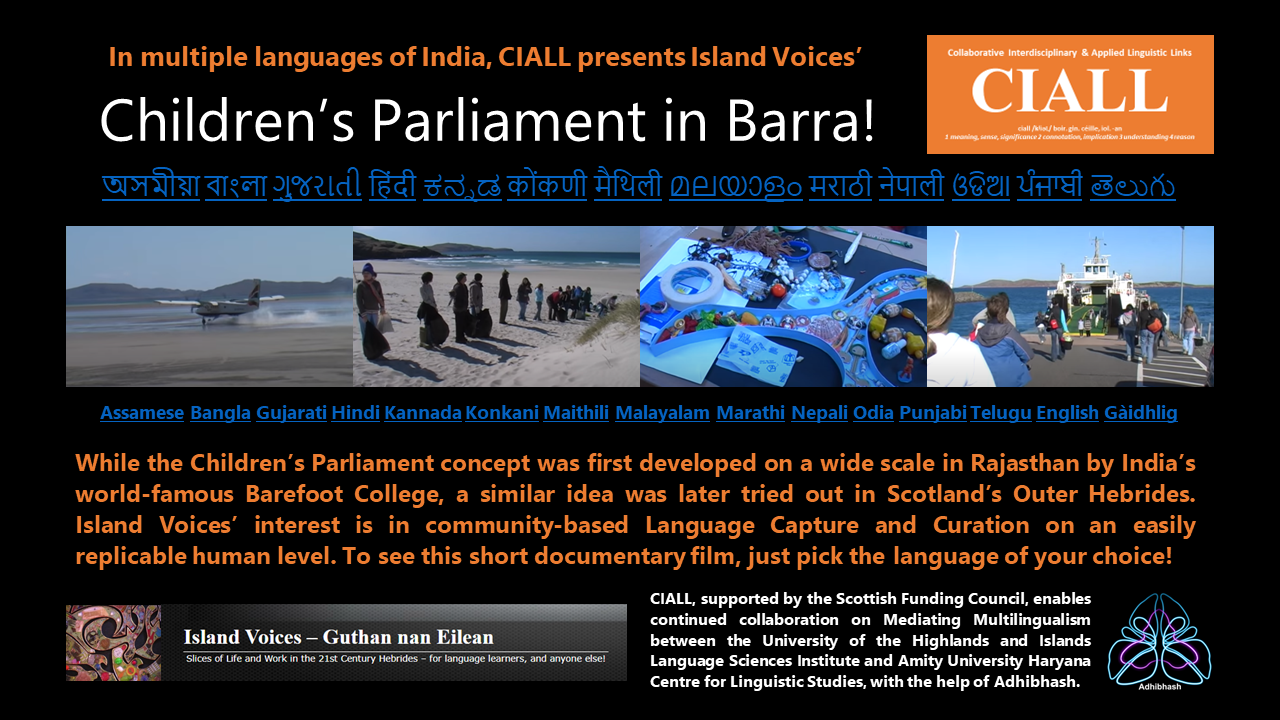
Indian Languages Poster Picture FinalSelect any language in this landscape poster, or use the phone-friendly portrait layout.

The Children’s Parliament concept was first developed to scale in Rajasthan by India’s world-famous Barefoot College. UNESCO documented some of this fascinating history-in-the-making in video form. A similar idea was later tried out in the Outer Hebrides by the Scottish Children’s Parliament organisation, which continues to work across the country to this day.

Around the time of the Children’s Parliament in Uist and Barra project, Island Voices was already developing its interest in community-based Language Capture and Curation on a shareable human scale, so recording this meeting of the Children’s Parliament in Barra (as well as the follow-up in Benbecula) was a natural step to take, with versions in both Gaelic and English included under the Series 2 Generations theme.

Following years of grounded Hebridean growth and developing partnerships, Island Voices came to Indian linguistic attention through the Mediating Multilingualism collaboration between the UHI Language Sciences Institute and AUH Centre for Linguistic Studies, serviced initially through the Soillse network and continued now by CIALL. This work has been generously supported by the Scottish Funding Council, and publicised through their EDI blog.

This brings us up to the present day, and this testing at scale of the notion that short documentary films with a focus on localised linguistic communities can be both easily and usefully re-purposed in other languages in which similar issues around contact, use, and sustainability may also be pertinent. We’ve been doing it off and on in ones and twos for a while through our Other Tongues theme. Moving in one go from two versions of one film to fifteen is a significant step-change!

The image at the top of this post, available in landscape or portrait layout, supplies live links to the film in each of the languages listed, as well as to relevant websites of the partners mentioned. Alternatively, you can just click on any of the language names in the top row of the tables below to get straight through to the YouTube version of your choice.

অসমীয়া বাংলা ગુજરાતી हिंदी ಕನ್ನಡ
Assamese Bangla Gujarati Hindi Kannada
कोंकणी मैथिली മലയാളം मराठी नेपाली
Konkani Maithili Malayalam Marathi Nepali
ଓଡିଆ ਪੰਜਾਬੀ తెలుగు English Gàidhlig
Odia Punjabi Telugu English Gaelic

(The English name of the language in the second row is a live link you can click to get to the Clilstore unit, in which the online transcript – with the video embedded – enables one-click access to an online dictionary for any words you don’t know.)

We are particularly indebted to Adhibhash for their vital work in recruiting and co-ordinating a wonderful team of translators and narrators who worked at pace to deliver these great new recordings!

The primary aim for Mediating Multilingualism was to deliver innovative and collaborative work of genuine value for partners outside Scotland. We have continued in that spirit, while recognising also the mutual benefit derived. It will not have escaped local notice that several of the languages listed above, notably Punjabi, as well as Bangla and Gujarati, are widely spoken (and taught to some degree) in “diaspora” communities here, while Hindi (or Urdu) may still serve as a link between speakers of different South Asian languages in the UK.

And as we, in Scotland, continue to struggle at community level to develop an equitable working relationship between English and Gaelic which would enable both to be fruitfully used, we might do well to remind ourselves that other countries appear to handle regional linguistic variation of far greater complexity. India has 22 scheduled languages written in to its constitution, including all those on our list above, mostly associated with different regions or states. It’s a longstanding example of differential recognition of, and official support for, local languages across multiple regions within one overall polity, as well as some which cross international boundaries. If there’s truly a mind for it, is it really beyond Scotland’s wit to meaningfully recognise “Areas of Linguistic Significance” for Gaelic within its own borders?

Returning to the Indian context and the Barefoot College, they had their own 50th anniversary celebrations in 2022. If you follow this video news report, at 11.36 you can find an interesting alternative take on literacy and education from founder Bunker Roy, in terms that again chime nicely with the Island Voices focus on the Primacy of Speech:

“Illiteracy is not a barrier for anyone to become a barefoot engineer, communicator, designer, architect… We have learnt that there’s a big difference between literacy and education. Literacy is what you learn to read and write. Education is what you get from your family environment, and your community. So our stress at the Barefoot College has always been on education. Literacy may be there, but it’s incidental for me. What is more important is the human being behind – the person who is working with us. Has he or she got the compassion, patience, tolerance, simplicity? All these are Gandhian values, which we think should set an example for anyone working in the college…”

This may be considered a simple statement of fundamental principles. But it is also perhaps another reason, alongside the recently cited example of Duncan Ban MacIntyre, to recognise anew the importance of natural speech in a community setting as the crucial ingredient in any attempt at creating a definitive recipe for promoting genuinely communicative use of any language, no matter what its circumstances. That said, none of the newly added languages here could be considered at risk of disuse in the way Gaelic is, except perhaps in diaspora contexts. But if the Island Voices home-grown and “haund-knitted” (may we call it “barefoot”?) capture and curation model works for these, could it not also be applied with other indigenous and endangered languages, whether in India, Scotland, or elsewhere?

The Composer, Duncan Ban MacIntyre

AlanandAllan

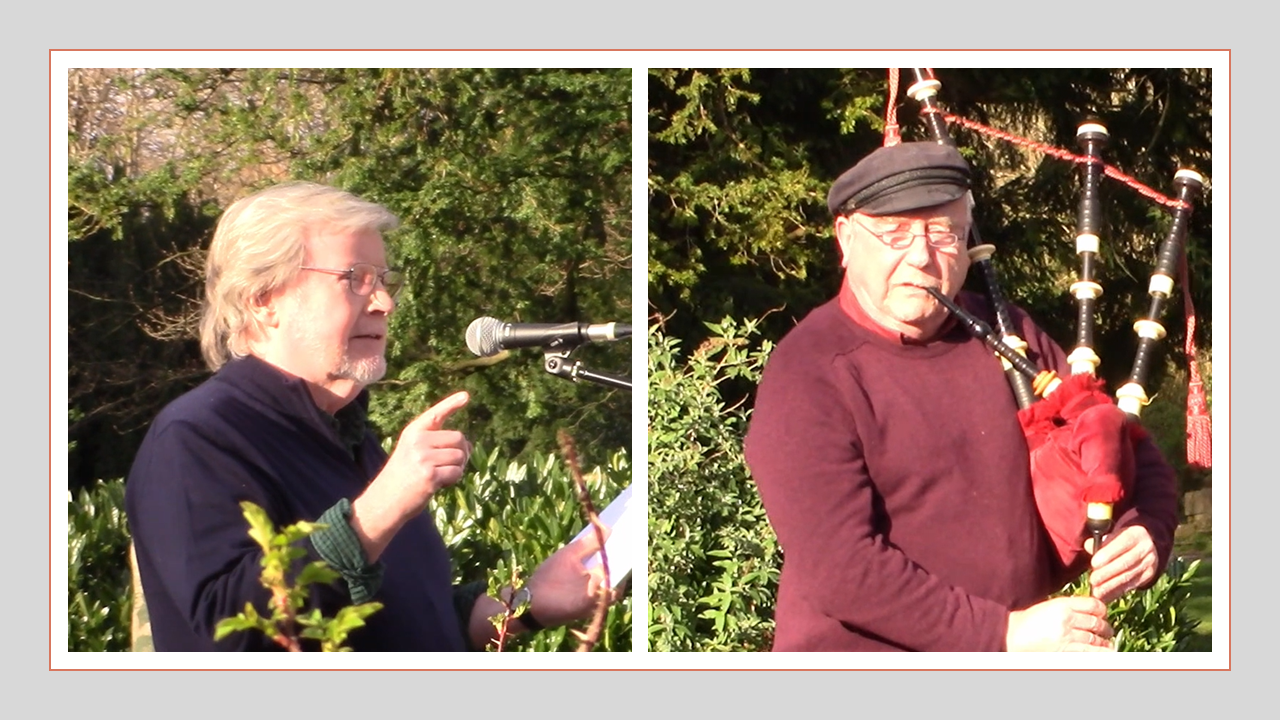
Island Voices just struck lucky on a visit to Glasgow, witnessing and recording this free and open bilingual event put on by the Friends of Queens Park to mark the 300th anniversary of the birth of Duncan Ban MacIntyre – Donnchadh Bàn Mac an t-Saoir. The occasion was blessed by the renowned performing talents of Alan Riach and Allan MacDonald in both Gaelic and English, and a large and appreciative audience.

While poetry has not featured hugely in Island Voices recordings to date, that is about to change, with conversations with, and recitals from, various contemporary writers currently in the works, and not just in Gaelic or English. These will be in video form, as we maintain our focus on the Primacy of Speech, a fundamental tenet of linguistic analysis that may be easily forgotten, or brushed over, in times of near-universal literacy. How appropriate then that Donnchadh Bàn is currently being commemorated, a non-writer of Gaelic, but great composer of remarkable poetry.

This event kicked off with Allan MacDonald “singing on the pipes”. The video contains selected snippets to give a taste of the proceedings. Enjoy the voices of these accomplished artists!

“Baile m’ àraich” – Catrìona Dhuirl

CatrionaDhuirlClilstorepic

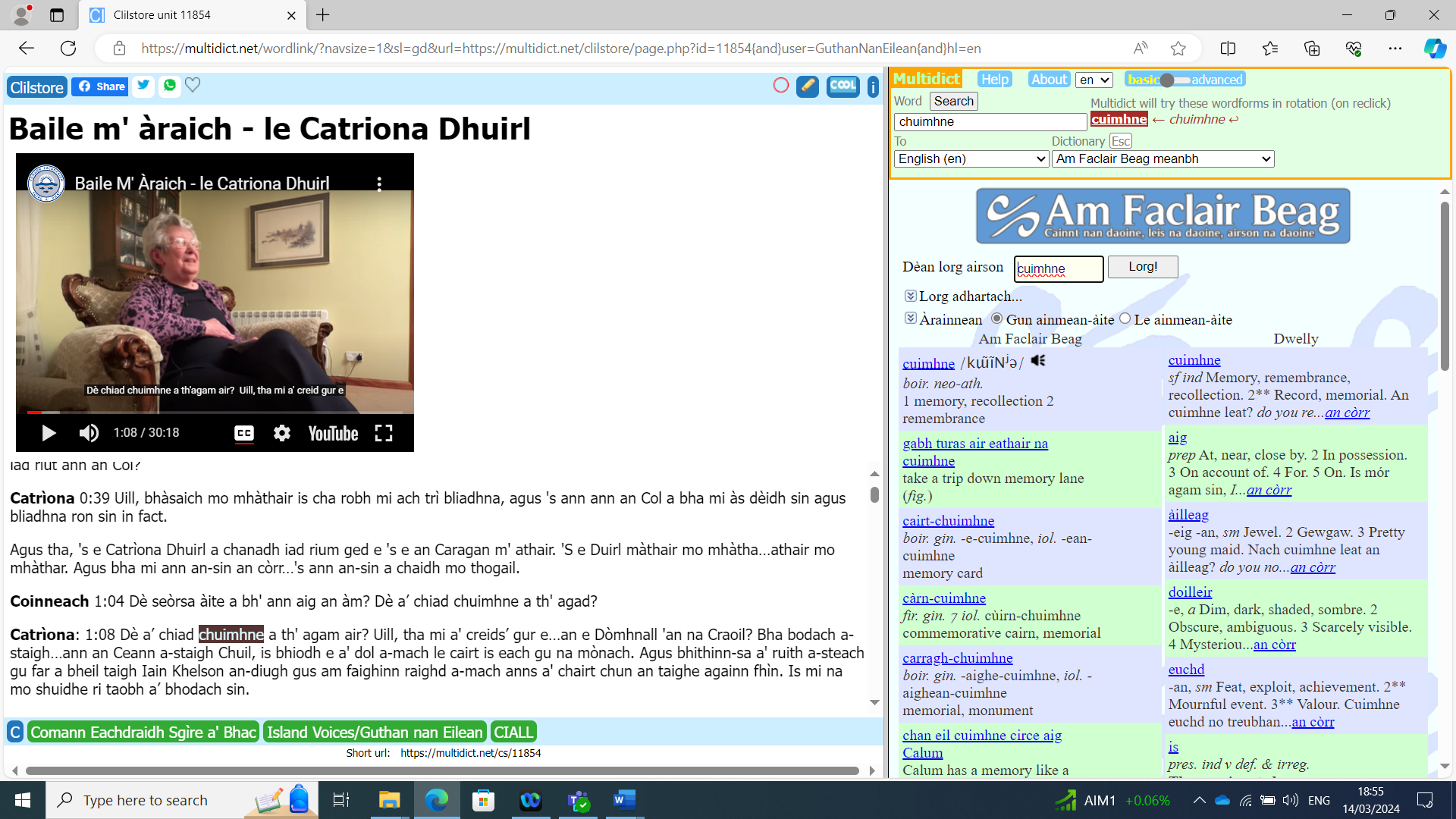
Island Voices re-posts another video from Comann Eachdraidh Sgìre a’ Bhac on the Clilstore platform, as part of the University of the Highlands and Islands CIALL initiative.

“Coinneach visited Catriona MacCarthur (Catriona Dhuirl), who is in her 90s, although she certainly doesn’t look it. She recalls the days of her youth and being brought up in Coll, reminiscing about people and pastimes, community life and some of the effects which WWII had on her generation.”

You can watch the video while reading the wordlinked transcript in this Clilstore unit: https://clilstore.eu/cs/11854