Guthan nan Eilean ann an Èirinn

Tha sgioba Uibhisteach a’ dol a-null a dh’Èirinn gus an obair aig Guthan nan Eilean a thaisbeanadh ann an Áislann Rann na Feirste.

Tha Sabhal Mòr Ostaig air a bhith ag obair mar-thà còmhla ri Ollscoil Uladh air a’ phròiseict Eòrpach TOOLS.

Le cuideachadh bhon sgeama Colmcille thathas a’ sùileachadh a-nis air mar a ghabhas an dòigh obrach a th’ aig Guthan nan Eilean cur gu feum le Gaeilge na h-Èirinn cuideachd.

Seo am prògram.

A Uist team is going over to Ireland to talk about the Island Voices project at Áislann Rann na Feirste.

Sabhal Mòr Ostaig has already been working with the University of Ulster on the European TOOLS project.

With help from the Colmcille scheme the partners will be considering how the Island Voices approach might be put to use with Irish as well.

Tommy agus Am Prionnsa

Tommy DòmhnallachTha Tommy Dòmhnallach a’ bruidhinn ri Gordon Wells mun obair rannsachaidh a tha e a’ dèanamh airson Stòras Uibhist. Mar a tha fhios aig mòran bha Am Prionnsa Teàrlach an seo ann an Uibhist is Beinn na Faoghla fad treiseag mus do theich e dhan Eilean Sgitheanach le cuideachadh Flòraidh NicDhòmhnaill. Tha Tommy airson sgeulachdan is òrain mu dheidhinn àite sam bith san robh am prionnsa a chruinneachadh, a dh’fhaodadh a dhol air làrach-lìn ùr a bhios tlachdmhor do luchd-turais, a bharrachd air muinntir na sgìre fhèin. Nach cuir sibh fios thuige ma tha sgeul agaibh fhèin ri innse!

Èistibh an seo:

(English explanation here on the Am Pàipear “Guthan: Voices” page.)

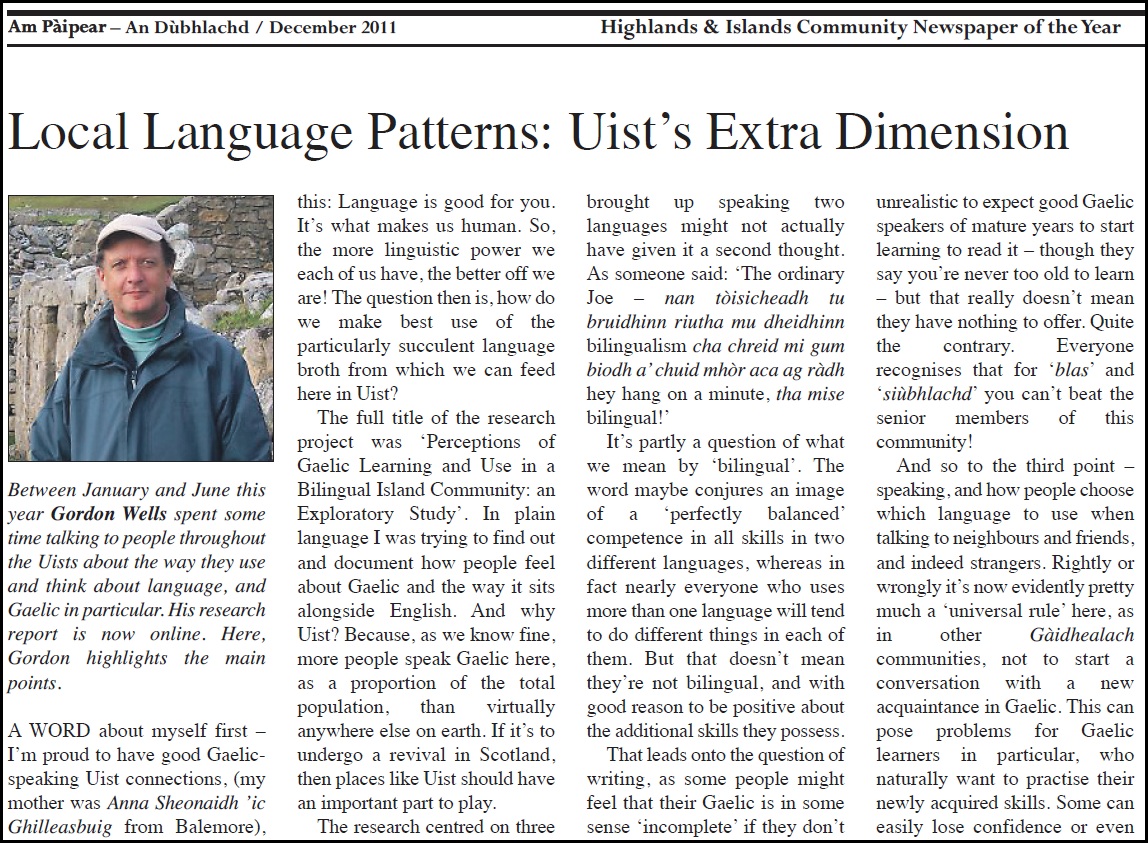
Hey, hang on a minute, tha mise bilingual!

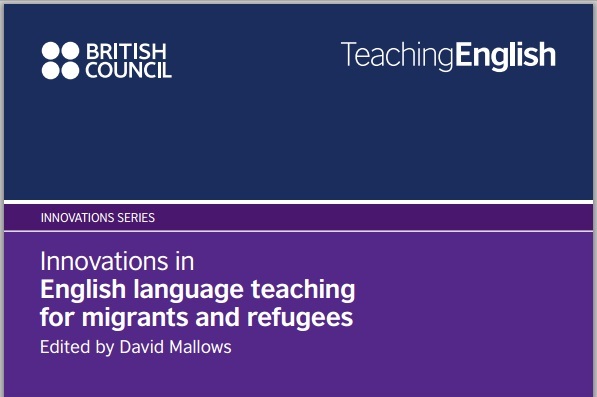
The British Council book, “Innovations in English language teaching for migrants and refugees”, edited by David Mallows, was published this month (December 2012), and includes a chapter on Guthan nan Eilean/Island Voices by the project co-ordinator, Gordon Wells, entitled “ESOL in the Hebrides and Island Voices – ‘Hey, hang on a minute, tha mise bilingual!'”. The book is published in hard copy and is also available freely online here. The online version conveniently includes live links to relevant websites (such as this one!) and other reference material.

In his introduction David Mallows has this to say on the Island Voices chapter: “Gordon deals with a juxtaposition of technological ‘newness’ and community ‘tradition’. Through a case study set in the Outer Hebrides he relates how aspects of both, often treated as opposing forces, can be harnessed in pursuit of a holistic, bilingual enrichment programme that seeks (among other things) to aid the development of ESOL skills in a small but significant migrant population as part of a community-wide language and media promotional strategy.”

Visiting Professor

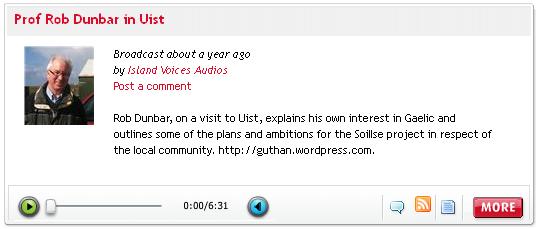
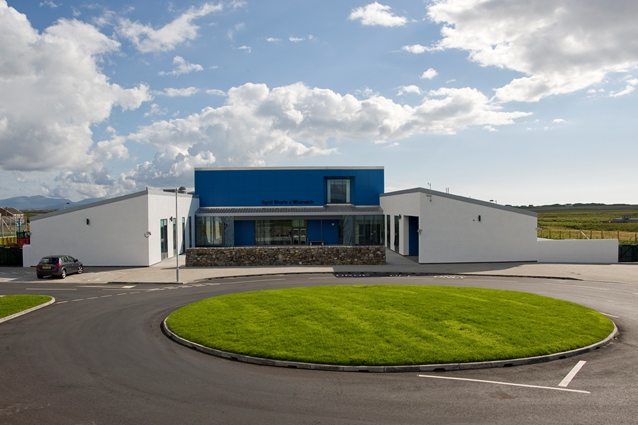
Uist welcomed a short visit from Soillse Director Professor Robert Dunbar this week. During his tour he was able to visit the offices of Am Pàipear and Sgoil Lìonacleit, as well as speak with Gordon Wells, Island Voices/Guthan nan Eilean co-ordinator. Originally from Canada, Rob’s first introduction to learning Gaelic was through teachers from Uist – and he’s never looked back!

Here he speaks also about his ambitions for the Soillse research project to engage closely with the local interest in Gaelic – in education, in the family and the community, and in relation to policy and planning.

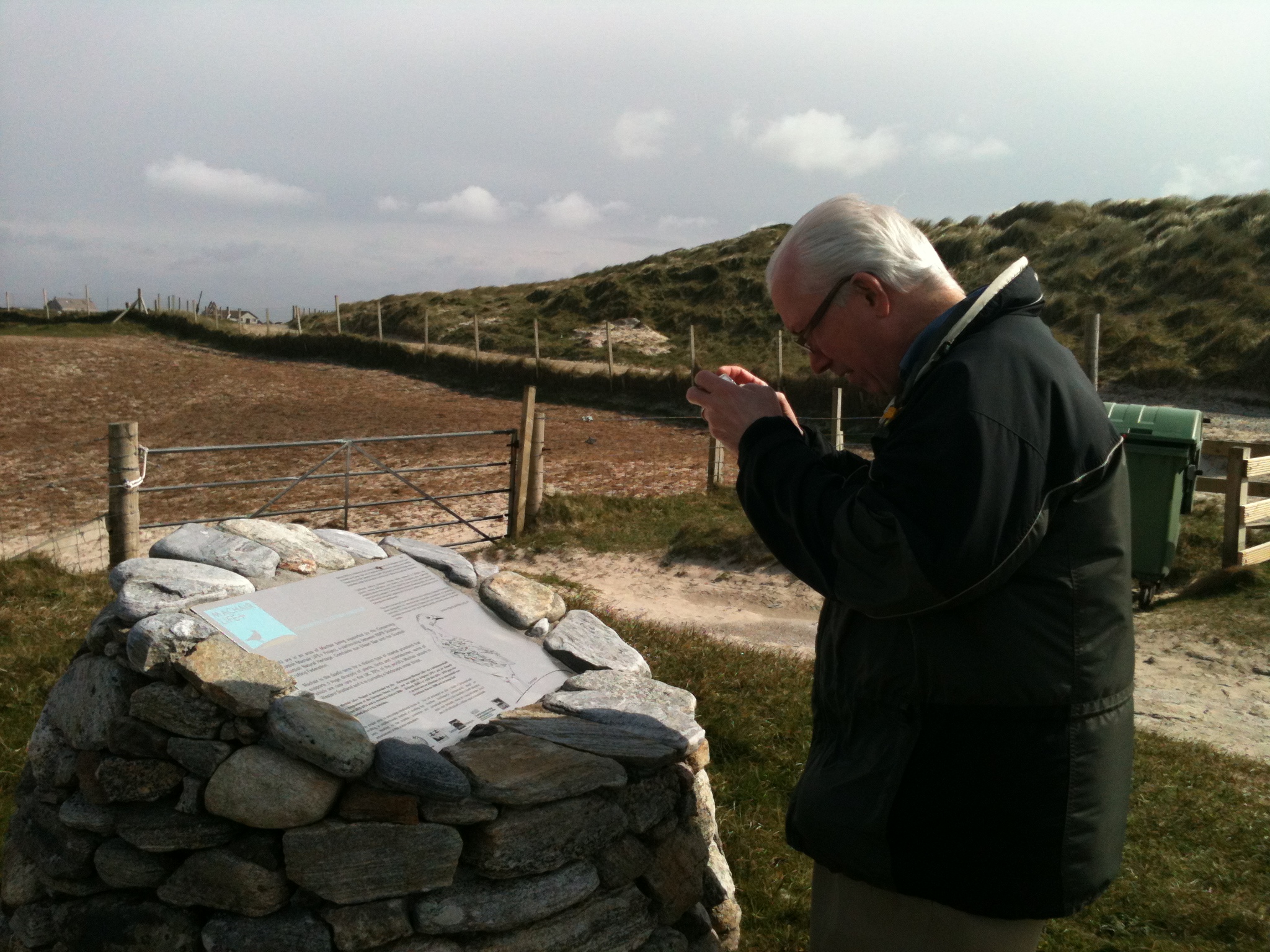
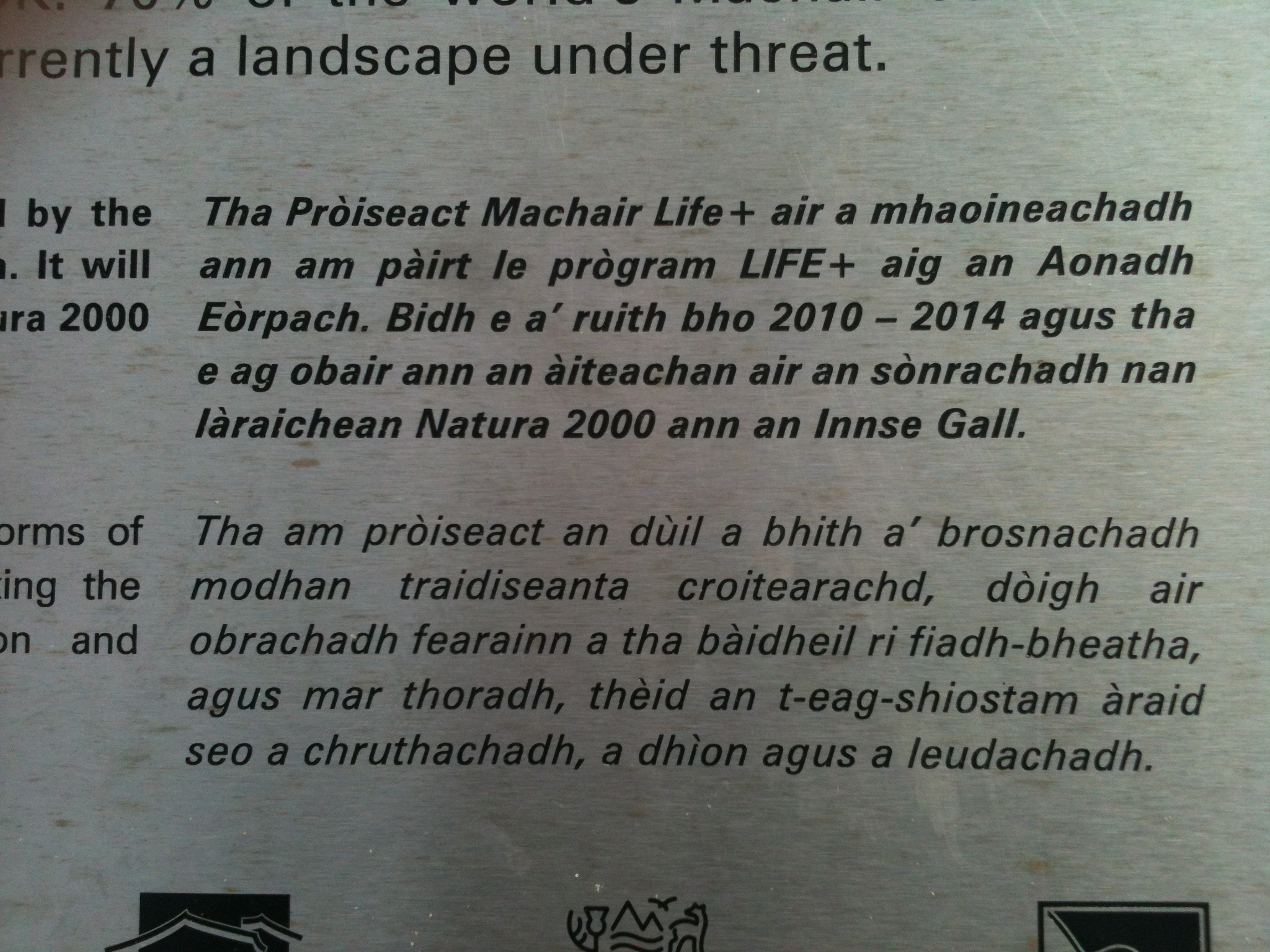
Public visibility of the Gaelic language in written form may be one of many factors affecting perceptions of its current state and future prospects. Rob takes an interest in linguistic landscapes, and took the opportunity to gather some examples during his visit. (Click to enlarge.)

Live Demonstration

There was an encouraging turnout for last night’s meeting on “Community Voices in a Digital Age”. It started with a presentation by Gordon Wells of some of the easy-to-use online platforms that are integrated in the Guthan nan Eilean project. This included two live demonstrations of the Ipadio audio-recording function which instantaneously converts a telephoned voicemail into a webpage with sound embedded.

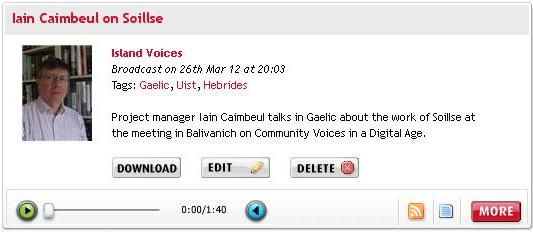
First to go was Iain Caimbeul, the project manager for the Soillse inter-university Gaelic research network, who, speaking in Gaelic, explained the main aims of the organisation and what it was keen to explore in partnership with island communities.
In the second test run local resident Volker Labitzke, speaking in English, compared his experiences of learning English and Gaelic, and talked about how he felt his language learning helped him to settle in his new home.
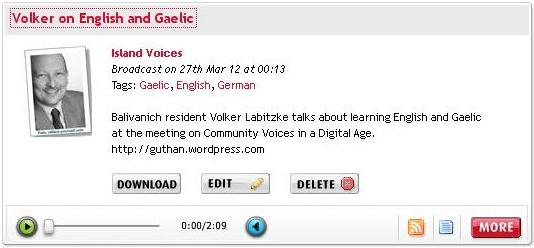
In the second half of the meeting there was open discussion of ideas for supporting language, and particularly Gaelic, development in the community. The new “Guthan: Voices” tab on the Am Pàipear website was cited as a new opportunity for “lifestyle” contributions, in writing or speech, from members of the public. Also highlighted were community drama, community lunches,  and community radio, as well as the importance of links to schools and young people, though it was noted that the use of Facebook and Twitter is by no means restricted to the younger generations! The meeting finished with Volker remarking on the enthusiasm within the group, and the desire to see some or all of the ideas mentioned taken forward as a result.

Future meetings may continue to be held in Balivanich, but there is no reason why interested parties in North or South Uist should not prefer to meet closer to their own homes. Or individuals may feel inspired to work on their own! Gordon is happy to assist in any appropriate manner, and can be reached on 07879 644984. It will be interesting to see how, if at all, engagement with the new media affects patterns of language use – a topic which Soillse is keen to explore.
Follow-up Meeting: Balivanich

The “Local Language Patterns” meeting on 6th March generated a lot of ideas for discussion. A common theme that emerged was the sheer amount of mainly voluntary activity that goes on in the community that supports our linguistic diversity.  This is a tremendous resource for language learners who successfully develop social networks outside the classroom walls. Particular mention was made of a recent community drama in North Uist, and the fortnightly Grimsay lunches, where both languages are welcome and actively used. In fact, there was more to say than there was proper time for! As a result, a follow-up meeting has been set up:

“Community Voices in a Digital Age”

Balivanich School

Monday 26th March, 7.30pm

More ideas are sought at this follow-up meeting at which the new “Guthan: Voices” page on the Am Pàipear website will also be introduced and demonstrated, using the fantastic facilities at Balivanich School. An open invitation is again extended to any interested community member to come along. Please advise Gordon Wells beforehand on 07879 644984. A rough idea of numbers will help with preparing teas and coffees!

Meeting: Local Language Patterns

As a follow-up to last year’s Soillse small research fund project a meeting has been organised:

“Local Language Patterns: Uist’s Extra Dimension”

Balivanich School

Tuesday 6th March, 7.30pm

The purpose of the meeting is to discuss the findings from the report, and exchange ideas on any actions that groups or individuals might like to take in light of it. The title of the study is “Perceptions of Gaelic Learning and Use in a Bilingual Island Community: an Exploratory Study”, and the full report can be found online via this link. A half-page summary by Gordon Wells was also published in the December issue of Am Pàipear and can be found here.  Everyone who took part in the project is invited to come along, and that invitation extends to any other members of the community who take a positive interest in this subject. Tea and coffee will be available!

The meeting will start with a brief presentation on the main points of the report, to be followed by questions and discussion. Some ideas for development out of the Guthan nan Eilean/Island Voices project will be presented, and other suggestions will be most welcome! If you are interested in attending, do please come along. It would be helpful if you could let Gordon know beforehand by phoning/texting 07879 644984.

Extra Dimensions

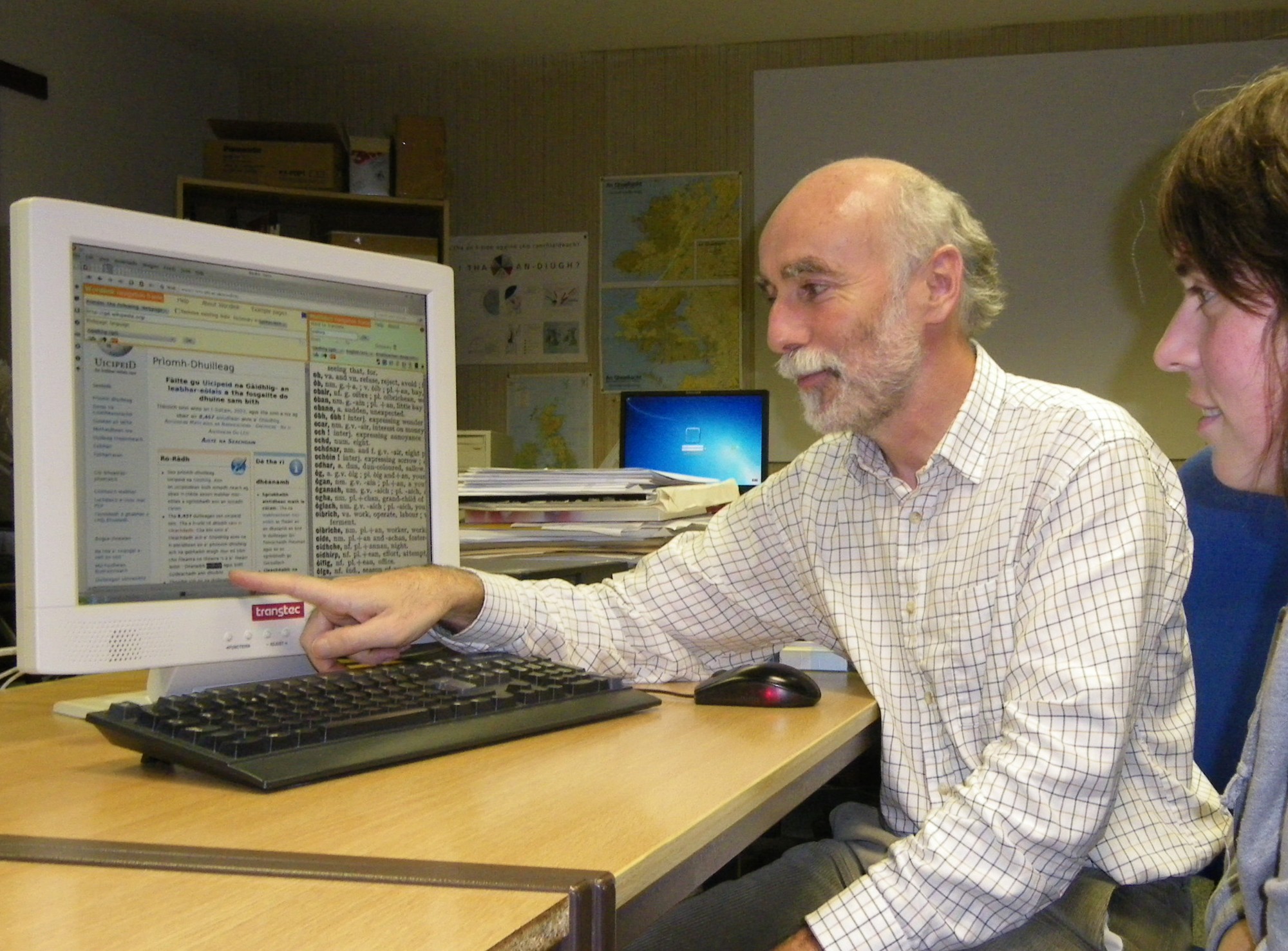
Caoimhín Ó Donnaíle demonstrates the use of Multidict and Wordlink with Gaelic Wikipedia

The latest issue of Am Pàipear carries a couple of articles with a bearing on Guthan nan Eilean/Island Voices. In the first, “Local Language Patterns: Uist’s Extra Dimension”, Gordon Wells highlights and discusses the main points arising from the recent Soillse research project he conducted through Cothrom. This may be a useful summary alternative to reading the full report, already published online.

The second article, “From POOLS to TOOLS: Sabhal Mòr Ostaig leads the multilingual way”, gives more detail on a new European project due to start in January, in which new multilingual software will be trialled. It will be interesting to see if and how a new “cyberspatial” connection can enhance language learning and use in a real community!

Research student visiting Uist

Beth Cole, from Aberdeen University, is keen to talk, listen, and record:

“I’m conducting research for my PhD at the University of Aberdeen as part of the Soillse Network and I am trying to find local Gaelic speakers, of any ability, over the age of 30 who would be willing to take part in a short interview. I am interested in all aspects of Gaelic use but particularly my research examines how Gaelic has been changing in recent years in different Gaelic speaking areas and I’m especially interested in studying Uist Gaelic as it is so rich and its speakers so loyal. For my research I need to record natural conversation between native speakers so interviews would be conducted in pairs or small groups. These would be very informal and relaxed situations with no strict topics of discussions. There would also be a short set of English sentences to verbally translate into Gaelic. The whole interview would last no more than an hour, and would be conducted at a time and place that was mutually convenient. I will be in Uist from 24th November to 1st December; if you are interested in being involved or would like more information please feel free to contact me (Beth Cole) on e.cole@abdn.ac.uk or 07793 937766.”

Anyone interested should please contact Beth directly.