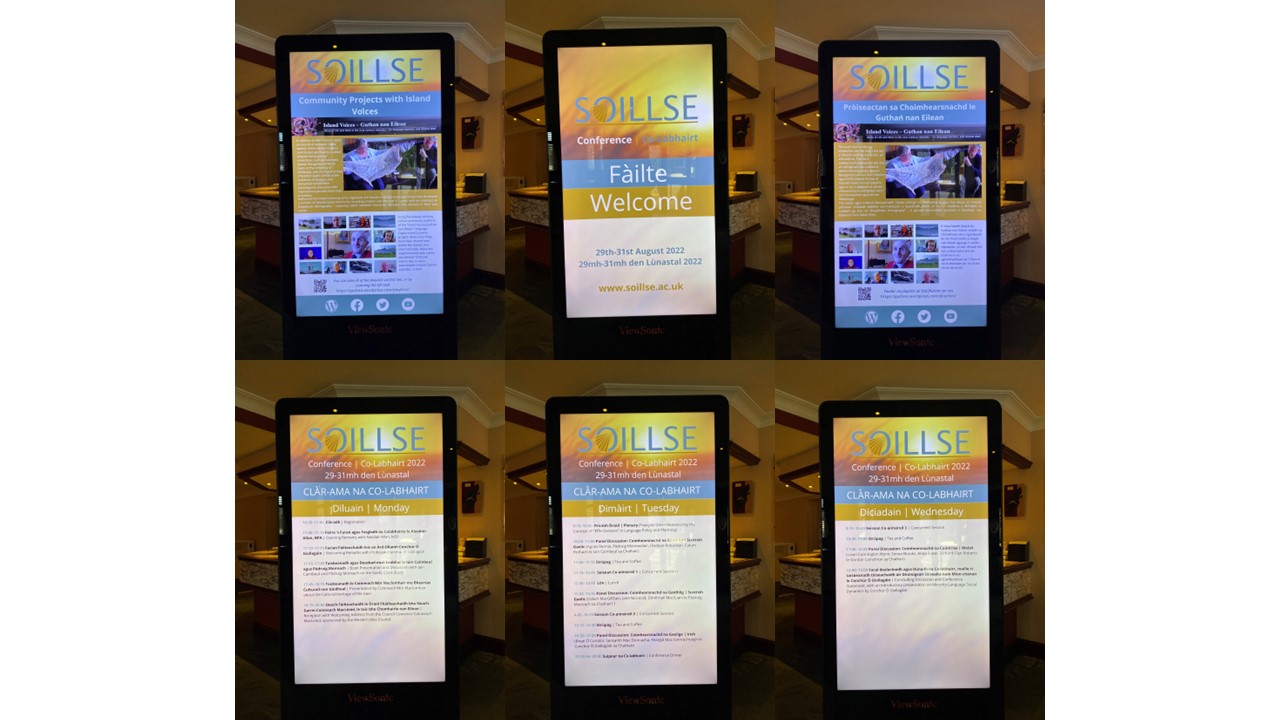
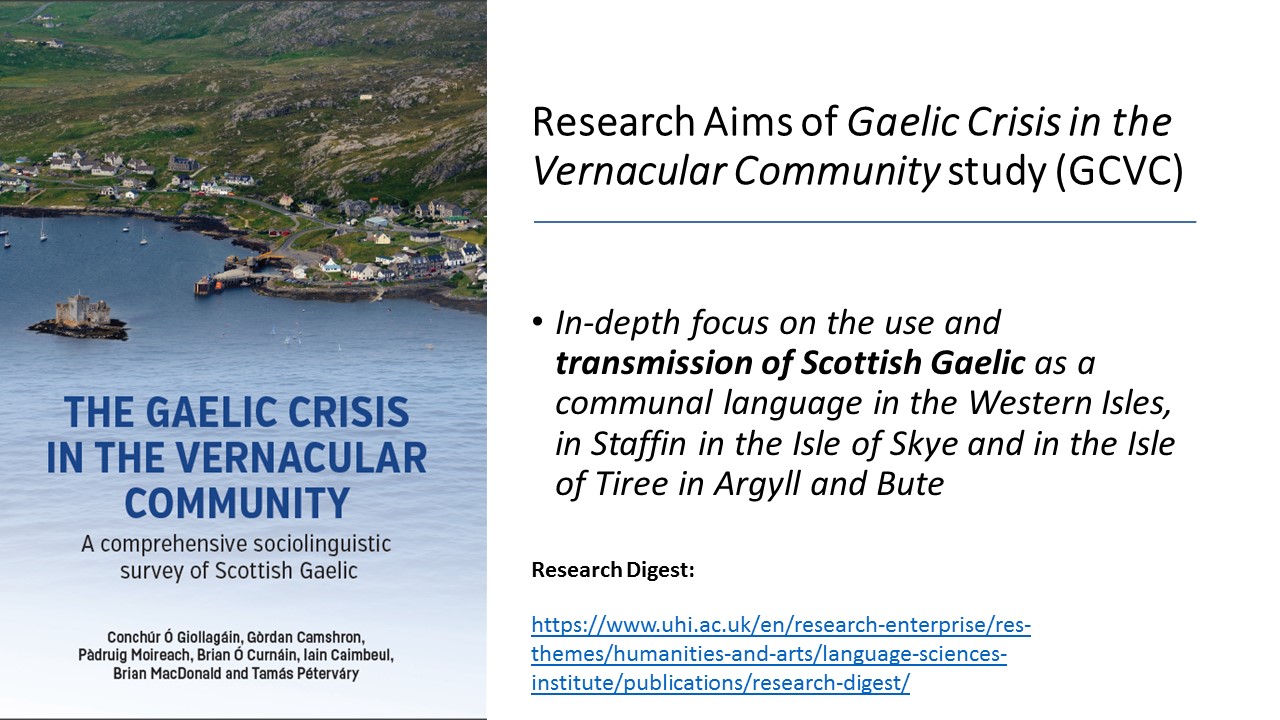
Participants at the Soillse conference on Rooting Minority Language Policy in the Speaker Community have come from across Europe and North America, from across Scotland, Wales, and Ireland, and from across the Hebridean islands that were the focus of the “Gaelic Crisis in the Vernacular Community” publication in 2020. The programme is challenging for those with an interest in generating and maintaining effective policy to address the declining use of the language in the heartland communities where it has survived until now.
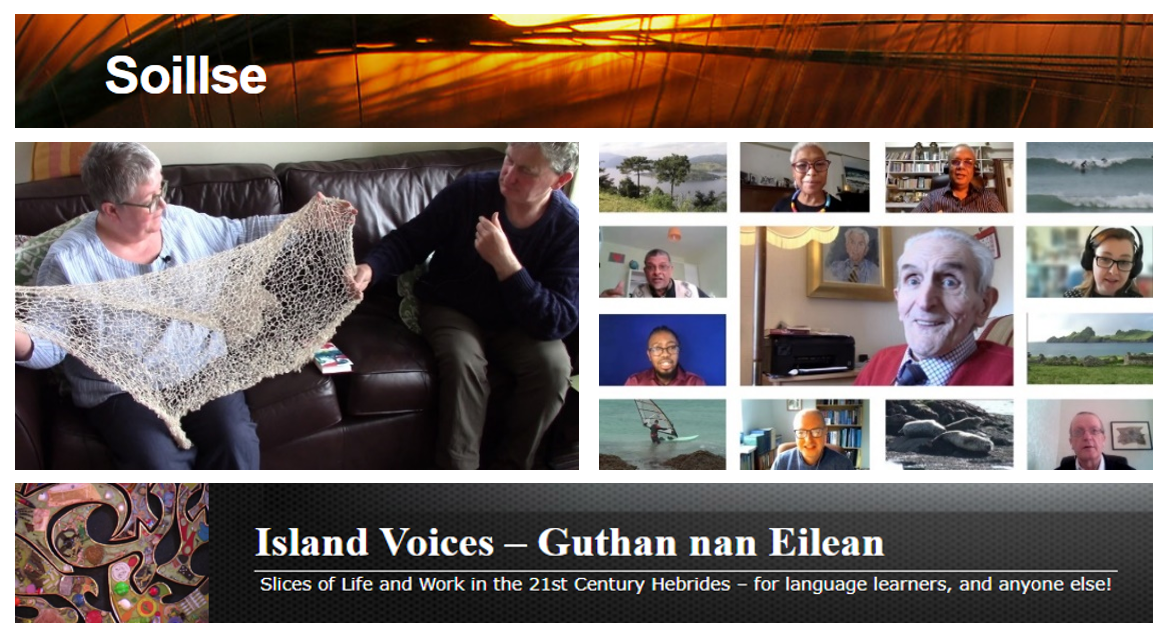
In addition to these key policy questions on the formal programme, samples of the video recording work in which Island Voices has been engaged, frequently in association with the Soillse network, are also available to view on the conference “fringe”. Nach math gu bheil Guthan nan Eilean rin cluinntinn aig co-labhairt mu dheidhinn cànan nan Eilean!
Looped Island Voices playlists will again be on display in Sgoil Chàirinis, North Uist, at the Comann Eachdraidh Uibhist a Tuath Digital Fèis for the “Aire air Sunnd” well-being project at the beginning of September.
As part of the event, there is a drop-in café where people can stop by for a chat, or simply sample some of the many local Gaelic voices that have been recorded over the years. Gordon Wells will be in attendance, ready to talk to anyone interested in how the collections were made, or who might like to add to the ever-growing archive of recordings.
And on the Saturday morning, Archie Campbell, who has been leading a series of Gaelic walks over the summer, will also be on hand for anyone who likes to chat over a cup of tea. Agus ‘s e a tha math gu bruidhinn! You can view the full programme for the fèis here.
It’s a digital event, so virtual attendance is also possible for those reluctant or unable to attend in person. You can find the event on Facebook. Likewise, the playlists are all accessible online. Use the live links in this bilingual poster, and you can start watching right away!
A sharpening of focus on the vernacular Hebridean communities has become evident in some Gaelic sociolinguistic research in recent years. In this period, Island Voices has partnered with various related projects, and helped to spread news and discussion of findings and issues.
At the same time, a parallel interest in wider international comparators for the Gaelic context has also been broadcast through Island Voices channels.
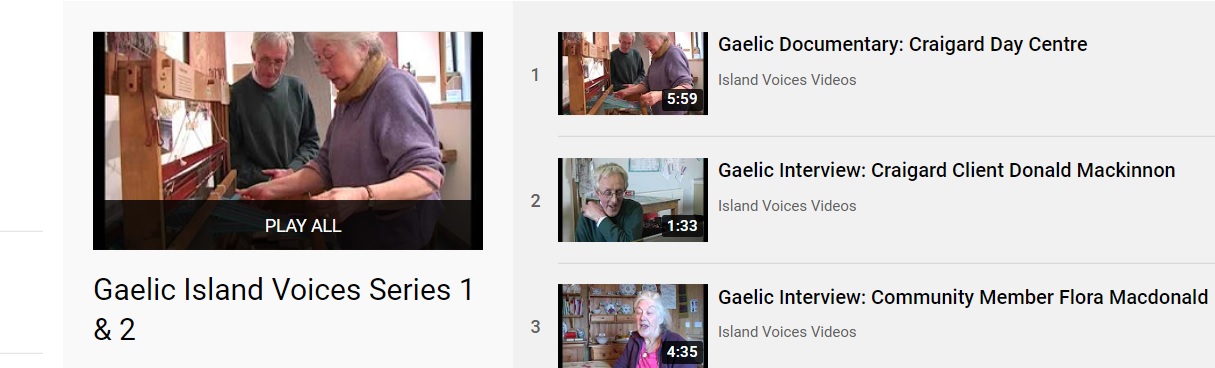
Projects with close community links will be on display at the Stornoway conference on Rooting Minority Language Policy in the Speaker Community at the end of August. Series of videos will be viewable in Island Voices playlists, including “Stòras Beò nan Gàidheal”, “Saoghal Thormoid”, “Island Voices Series 1&2” and “International MOOT”.
And the playlists can be viewed remotely as well, with live links embedded in this PDF poster. This also includes additional information about the links between Soillse and Island Voices, and other collaborative research work with other universities in Scotland and internationally.
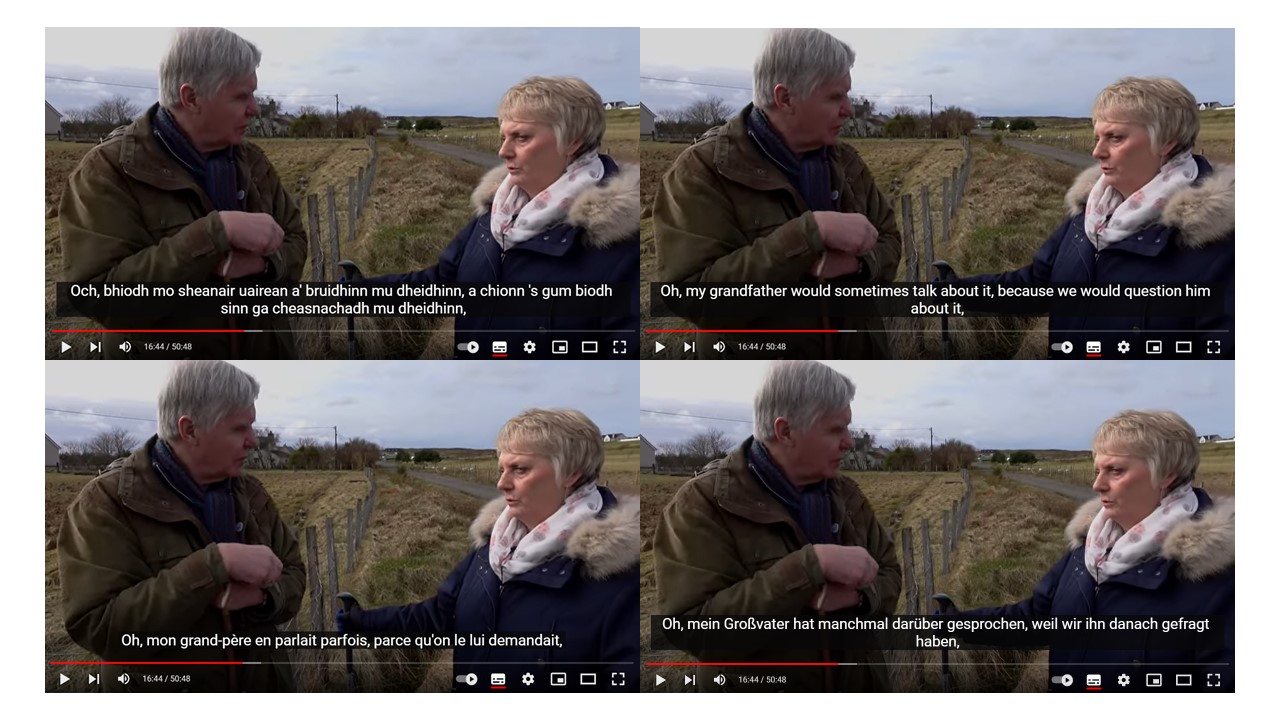
Here’s a new departure with some well-known and well-loved faces. Comann Eachdraidh Sgìre a’ Bhac (Back historical society) have been producing home-grown videos for YouTube for a while now, many of them fronted by Coinneach MacÌomhair, a very familiar voice from decades of sterling service with BBC Radio nan Gàidheal. In the video below, he’s joined by renowned singer Maighread Stiùbhart as they take viewers on a walking tour of Col Uarach.
It’s a remarkable film, in which the presenters’ deep knowledge and love of their home turf shine through, beautifully expressed in Gàidhlig Sgìre a’ Bhac. The video has been online for a few months now, but there’s been a new development – the addition of CC subtitles (which you can switch on or off, according to taste). This has been made possible following meticulous extra work by Maighread to transcribe the entire video so that it can be added to the Stòras Beò nan Gàidheal collection. And as followers of Guthan nan Eilean know, once the Gaelic subtitles are up, YouTube settings will also offer you auto-translation into many other languages – English included!
Plus, the “Stòras Beò” treatment means you can also access the full wordlinked transcript online through this Clilstore unit: https://clilstore.eu/cs/10540
Naturally, we’re delighted at Island Voices to be able to work with another local history society in the Western Isles. We hope such partnerships will continue to blossom and grow!
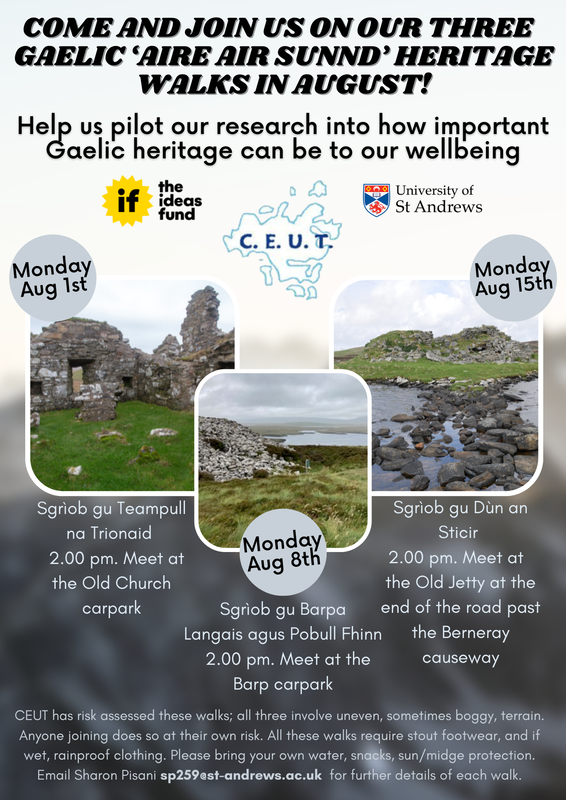
Three “Gaelic walks” have been announced for August, as part of the Aire air Sunnd project led by Comann Eachdraidh Uibhist a Tuath. Gum bi deagh shìde ann air an son!
Aodán Ó Cearbhaill from Gaoth Dobhair speaks to Colm Mac Giolla Easpaig.
In the first part Aodán describes his family background and his teaching career to date.
He goes on to detail the career break he took to teach Irish in Nova Scotia. In preparation for this role, Aodán describes how he learnt Scottish Gàidhlig and this leads him and Colm to discuss the similarities and differences between the Donegal dialect and Gàidhlig.
Finally, Aodán describes his affinity with Tory Island, the birthplace of his father, and recites a famous folklore story about how Colm Cille came to bring Christianity to the Island.
A wordlinked transcript alongside the embedded video is available here: http://multidict.net/cs/10578
In the second part of the conversation, Aodán describes some customs and superstitions from Tory Island, most notably the story behind the Tory soil that keeps rats at bay. They discuss the musical heritage of the island before Aodán sings “An Buachaill Deas Óg”, and they chat about how Aodán is newly married and living in the area.
This leads them to discuss the fate of this rural area. Aodán explains his fear about the future of the language but also his hopes for tourism in the area. Planning issues are discussed before Aodán details the polytunnel he had installed in his new home. They end the conversation with Aodán describing the unique manner in which he would spend a win on the National Lottery, and he finishes with a rendition of the renowned Tory Island song “Amhrán na Scadán”.
A wordlinked transcript alongside the embedded video is available here: http://multidict.net/cs/10580
This is the third set of Irish recordings in the Taisce Bheo na nGael project in which the UHI Language Sciences Institute with Sabhal Mòr Ostaig and Soillse, together with Irish partners, record the natural speech of Irish and Scottish Gaelic speakers in their own communities with user-friendly equipment and techniques. We are again indebted to Dr Gearóid Ó Domagáin of Ulster University for his meticulous work on the transcriptions.
With all 75 Gaelic videos having been CC subtitled in Series 1 and Series 2 Outdoors, Generations, and Enterprise, they have now been collected into a single playlist on YouTube. Set aside some time, a chàirdean, for the ultimate box set binge! (And remember you can use the settings wheel to get automatic translations into multiple other languages…)
Following on from the May launch of the Aire air Sunnd project with Comann Eachdraidh Uibhist a Tuath, the first online session of the Gaelic-focussed strand was held on 17th June. As planned, the “hybrid” session was open to participation by Zoom as well as physical attendance at Sgoil Chàirinis, with Ùisdean Robertson taking the chair. The session started with a presentation by members of the research team behind the publication of “The Gaelic Crisis in the Vernacular Community“, principally Iain Caimbeul with support from Conchúr Ó Giollagáin. This presentation was recorded and has now been placed on the Island Voices YouTube channel. You can view it here:
The session was held entirely in Gaelic. YouTube subtitling will also allow viewers to read as they listen, and offers auto-translation into other languages, including English, using the settings wheel.
The presentation was followed by a lively and open discussion between CEUT members and the presenters about many of the points raised. This has laid a valuable foundation for further Gaelic activities as part of the Aire air Sunnd project, which will include walks and other events over the summer period, before returning to further online workshops planned for the autumn, which may take a closer look at selected Island Voices recordings.
Iain’s full Powerpoint presentation is available in PDF format here.
This is one of four linked blogposts, building on the Norman Maclean “Talking Points” series of discussions, which focus on specific contributions from the participants.
Jane NicLeòid was raised speaking Gaelic, and later English as well, on the Isle of Lewis. A trained teacher, she worked on the mainland for some years, before recently returning to her home island, where she continues to teach Gaelic, and is also closely involved in the new pressure group, Guth nan Siarach, to promote the interests of vernacular speakers.
Jane made a thoughtful and challenging early response to the 2020 “Gaelic Crisis” report by the Soillse team led by Conchúr Ó Giollagáin, on the influential Bella Caledonia website, in which she drew on her rooted teaching and community experience. You can read it here.
And in this final extract from the Norman Maclean Language Contact discussion Jane summarises key points of commonality identified in Norman’s thoughts, and underlines her own perception of the disconnect between institutional support for Gaelic, and a grassroots activism and egalitarian sensibility uniting the various interest groups.
Links to the three other blogposts in this short series are given below:
This is one of four linked blogposts, building on the Norman Maclean “Talking Points” series of discussions, which focus on specific contributions from the participants.
Audrey West’s first language is Jamaican, and she’s trained to teach Spanish and French, as well as in Cultural Memory.
This gives her an awareness of the intergenerational post-trauma resulting from the trans-Atlantic practice of enslaving Africans for European colonial gain.
Resident in North Wales, she works as an artist, poet, linguist, psychotherapist, trainer, and community development practitioner.
In this extract from the Norman Maclean Language Hierarchies discussion Audrey reflects on her unrecognised bilingualism, being brought up in a Jamaican home in London. Norman’s exhortation to maintain the mother tongue struck home as she acknowledges how stigmatisation prevented ongoing intergenerational transmission.
Over the course of the Talking Points sessions, Audrey also circulated this filmand the script of her poem amongst the participants, an extract from which is given at the end of the Language Contact discussion. She’s kindly agreed to share the full text below.
How did you end up here? Where do you come from?
I remember a place Where I am cradled by the Mountains Rocked by the sea…
Mi memba a plies We di mountin dem kriegl mi We di sii rak mi in aar skort Op di goli, pan tap a di hil Mi kyan si faar faar Plenti chrii, plenti griin, plenti sii
Memba a plies We dem nuo mi niem Dem nuo mi mada, nuo mi faada Nuo mi fambili Mi a smadi
Mi nuo se mi kom fram wie bak A Timboktuu dem kaal it? Mi piipl dem chravl a Hiijip Riich bak uom, A di mountin an di sii
Iz ou mi hen op ier?
Mi nuo se som a wi De pan buot Pak op pak op, stingk op stingk op Kyaan briid Bot wi riich
A wan plies dem kaal Jamieka Nier di mountin, bai di sii We dem Mek wi wok Brok wi bak Tek wi uman Kil wi pikni Fi notn
Bot iz ou yu en op ier?
Mi nuo se mi kom fram faar faar Mosi wan plies we niem Fraans We dem fait. Nier di mountin, bai di sii Fait so bad, dem kaal dem Espeute, fi suod. Dem kaal dem Juu Mek dem ron
Chravl faar faar Riich klier a San Domingue We dem Mek dem wok Bruk dem bak Tek dem uman Kil dem pikni Fi notn
Mais d’ou viens tu?
Ron klier a Virginia Weh dem Mek dem wok Bruk dem bak Tek dem uman Kil dem pikni Fi notn
Bot iz ou yu en op ier?
Mosi chruu wan plies we niem India Nier di mountin, bai di sii Dem bring wi bak Fi wok Til wi bak brok Lef wi uman Lef wi pikni Fi likl ar notn
¿Pero, como llegaste aquí?
Ron we, beli onggri Go klier a Panama Nier di mountin, bai di sii Luk fi wok Til mi bak brok Dem tek mi uman Kil mi pikni Fi notn
Bot, a we yuu kom fram?
Mosi fram wan plies dem kaal Skatlan. Plenti hil, An di sii skort uova aar fiit Nier di mountin, bai di sii Iz ou yu gaan klier a Skatlan? Iz ou yu en op dier?
Onggri beli Kech buot, kom a Hingglan Riich a Soutamton bai di sii Riich a Landan. Bes suut Fi luk wok Til mi bak brok Sen fi mi uman Dem kil mi pikni Fi notn
Mi no si no sii. Mi no si no mountin. Grie so til. Gaan bak uom. We dem nuo mi niem, Nuo mi fambili Mi a smadi Tek mi uman Lef mi pikni Dem aal rait
How did you end up here? O le wyt t’in dod?
Pikni riich a Naat Wales I’ve come a long way baby Back to the mountains, Back to the sea Back home, to Luxe, calme, et volupté
Homage to my parents
Alvin and Mary West
Copyright: Audrey West
June 2020
You can follow this link to get Audrey’s own translation of her poem into Standard English.
Links to the three other blogposts in this short series are given below: