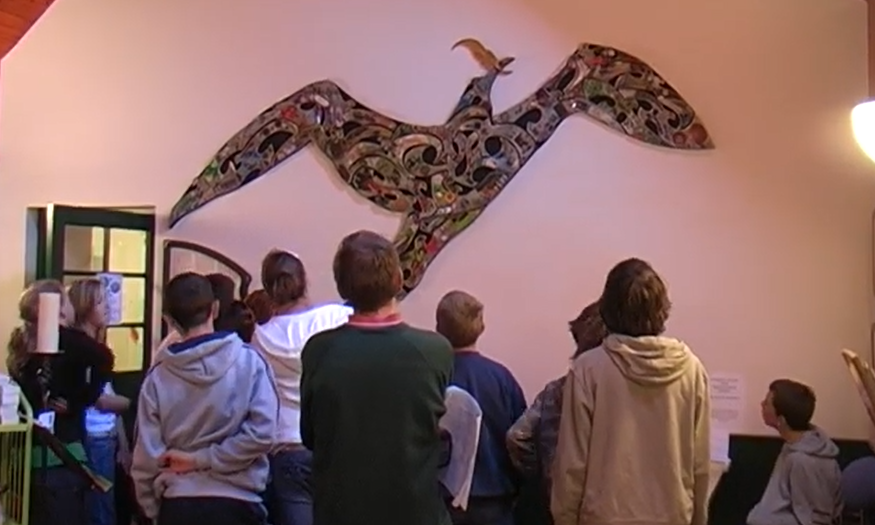
O Parlamento de Crianças

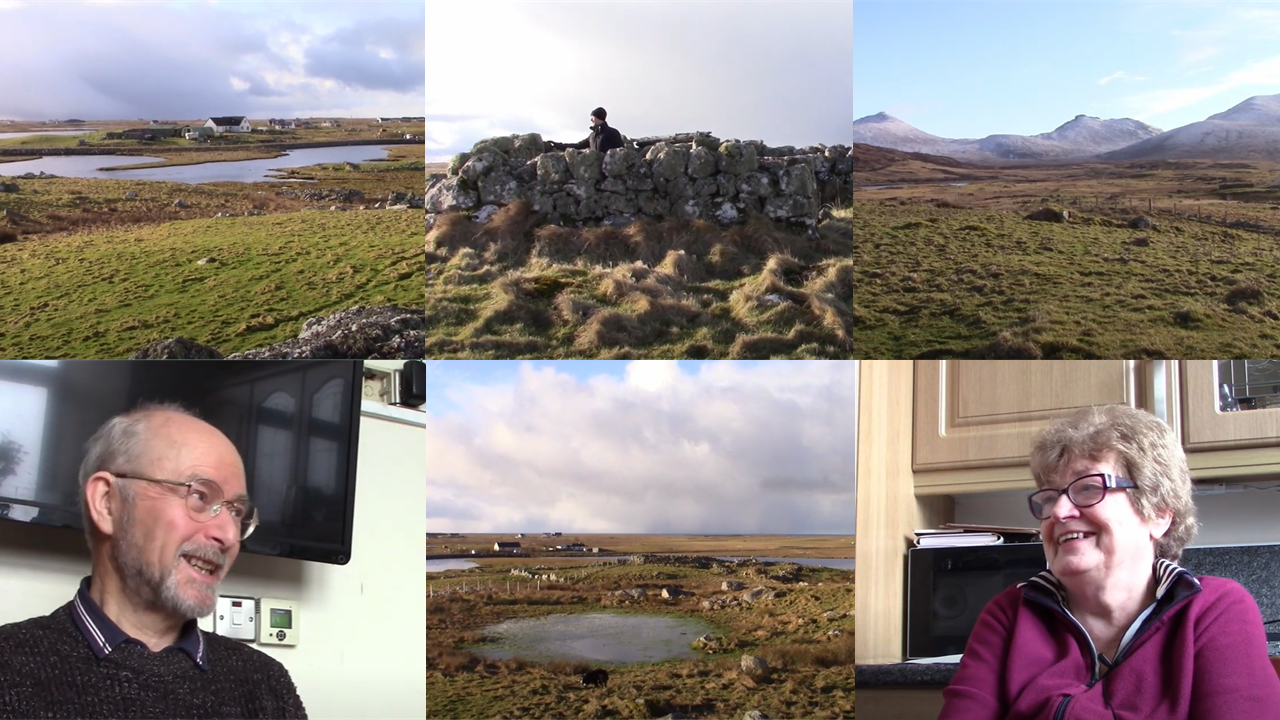
CPBenFicheadEunUm pequeno documentário em Português sobre um encontro do Parlamento de Crianças de Uist e da Barra

At Island Voices we welcome participation and contributions from speakers, learners, and researchers of any age and stage in multiple languages from all over the globe!

Marina Yazbek Dias Peres is a student in the Research Program at Princeton High School, New Jersey, in the USA. In this program, each student learns to research, and conducts their own project over the course of three years. Marina’s research project is focused on “uncovering the motivation behind the preservation of dying/endangered languages, and analyzing the causation behind the lack of their use”.

Marina is bilingual in English and Portuguese, and is also studying French and Mandarin in school. During discussion of her research topic with Gordon Wells she kindly offered to add Portuguese to the Island Voices list of “Other Tongues“, choosing the Children’s Parliament in Benbecula film in Series 2 Generations. We were happy to accept! Perhaps her example will inspire others like her to take an interest and think about participating too?

A wordlinked transcript with the video embedded is available here: https://multidict.net/cs/11930

Taighean-tughaidh playlist

TommyandBettyTobhtapic

Island Voices has created a new playlist on the YouTube video channel for the collection of recordings made about Uist’s taighean-tughaidh – thatched houses. First contributions have come from Tommy MacDonald, telling some of the history from the site of Tobhta Mhic Eachainn and its connection to the “French Macdonalds”, and then quizzing his wife Betty on her memories of being raised in a taigh-tughaidh.

These recordings have been broken up into bite-sized manageable chunks.

In the first two from Tobhta Mhic Eachainn, Tommy presents some stories about Neil MacEachan and his son Alexandre – the “French Macdonalds” – from the remains of Neil’s original house, which was later to be visited by the Duke of Tarentum in an act of filial homecoming following the Napoleonic wars. The video descriptions include links to Clilstore online transcripts for both of these clips, which are also optionally subtitled.

The conversation with Betty comes in four parts. In the first section Betty recalls who built her house (her grandfather), and aspects of her childhood life on the croft, including the herding and milking of the cattle, as well as some of the thatching process as she remembers it.

In the second part Tommy and Betty go on to discuss some of the stiff challenges that would be entailed in keeping a traditional thatched house on a par with modern standards. Talking about the cèilidh culture of earlier times, Tommy recalls how stories would be shared between family members and visitors – some of which remain unexplained to this day.

In the third section Betty and Tommy’s attention turns towards food and drink, and the important place of staples such as eggs and milk – and sometimes rabbit. Services such as electricity and water were a relatively recent introduction. They recall some of the other thatched houses in the area, with a handful having been done up to meet modern standards.

Finally, in the fourth part, Tommy and Betty share memories of more recent times, when a thatched house was converted into a hostel for tourists, under Betty’s mother’s care. In the early days visitors would often stay for weeks, helping out on the croft, and they are fondly remembered. To end, more stories are shared of amusing and perplexing incidents.

Again, Clilstore links are available in the video descriptions, with auto-translatable subtitles an additional option for learners or non-speakers of Gaelic.

The seventh video in the playlist is a longer “omnibus” edition of the Tommy and Betty conversation, which is presented without transcript or subtitles.

With Tommy planning further recordings in the community we can expect more additions to this work in progress in coming weeks, with ongoing CIALL support and in collaboration with the UHI archaeologists based at Cnoc Soilleir.

Jamiekan ina Wielz

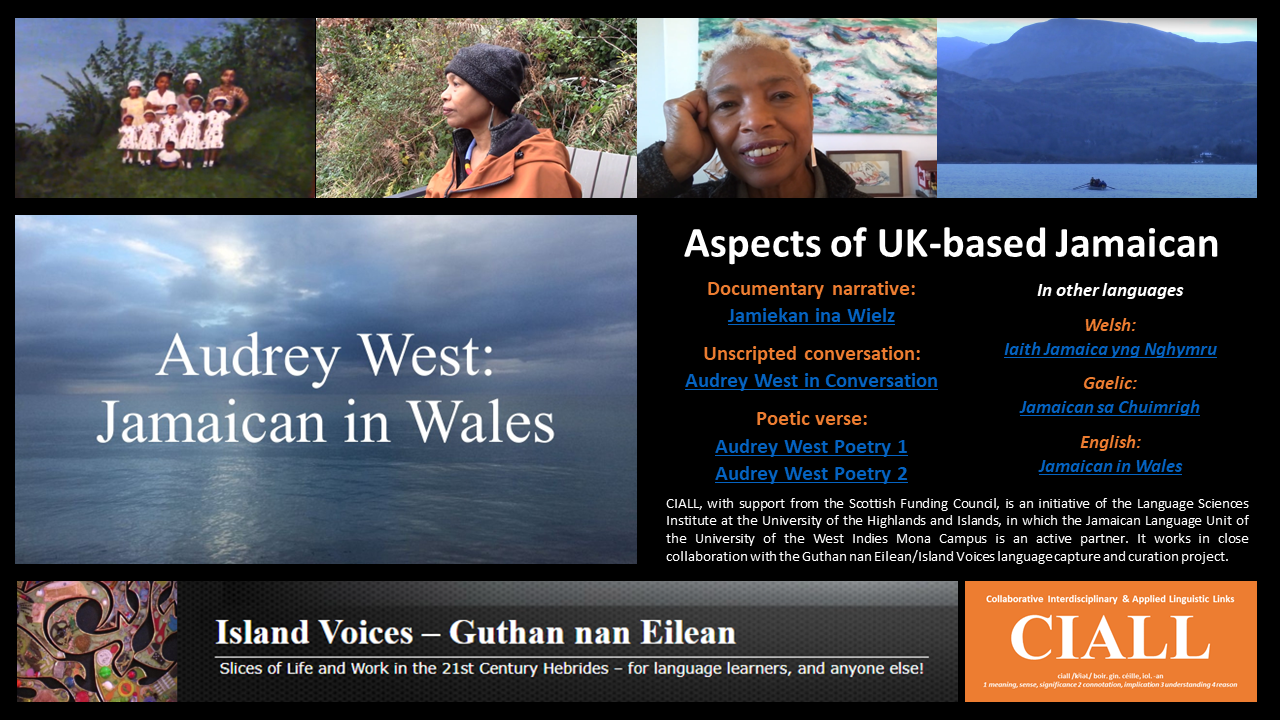
Jamiekan yuus puoster pikcha lanskiep faainalSelect any video clip named in this landscape poster, or use the phone-friendly portrait layout.

Island Voices is extending its “language capture and curation” model, with CIALL support, to new contexts, new genres, and new languages, including the recording of aspects of UK-based Jamaican language use. Gaelic enthusiasts can rest assured this development does not represent a move away from our key linguistic interest in the Outer Hebrides! Far from it, as we engage with other language communities near and far, new opportunities are created for fresh spoken material in video format in Gaelic (and English – and other languages).

We recently filmed Jamaica-born, but London-raised, artist and poet Audrey West at her home in Wales. (Keen followers may well recognise Audrey from her previous contribution to our “Talking Points with Norman Maclean” debates.) We have now created Island Voices-style short video clips in the familiar “documentary” and “interview” formats, while adding a third category of “recitation”, newly included to capture Audrey’s poetry. These films are all listed in the poster above. You can click for either landscape or portrait versions to access live links to any and all of the videos created.* 

We’re also indebted to Dr Joseph Farquharson from the University of the West Indies Jamaican Language Unit (another Talking Points contributor!), for overseeing the creation of the documentary script in the institutionally approved Cassidy-JLU orthography. Joseph and the JLU team have been extremely busy recently, also providing expert advice to Kingsley Ben-Adir and other cast and production team members for the “Bob Marley: One Love” biopic. As one commenter(!) put it, this YouTube discussion provides “really interesting insights into how skilled linguistic, particularly phonetic, analysis and description can percolate beyond academia and deliver practical applied impact. Bravo JLU!”

This system has enabled regularised subtitling of the clip on sound linguistic principles. Ironically, as YouTube/Google Translate does not recognise Jamaican as a language, we have paradoxically been forced to label the language used in the Jamaican documentary as “English” in order to be able to add the proper Cassidy-JLU subtitles which underline its separate status! We can confidently predict that the YouTube auto-translate function, which we normally commend, is going to struggle with this!

Our aim, in due course, will be to also create a Clilstore transcript incorporating the new Custom Dictionary tool, along similar lines to previous contributions from the Jamaican Language Unit.

We have been demonstrating for some time through “Other Tongues” that the re-purposing in different languages of documentary work in our local community context can be accomplished relatively easily and simply. And we most recently illustrated this at scale with the Children’s Parliament in Barra film. The wider point is that this can be a 2-way street, or perhaps a multi-lane spaghetti junction! With Audrey’s documentary we’ve started with a film made originally in Jamaican and, in a reversal of previous examples, worked up a Gaelic version from it. Not only that, we’ve got Welsh and English versions too!

As hinted in our Duncan Ban MacIntyre piece, “Jamaican in Wales” is just the first of a short series of collections in similar style that explore new fields for Island Voices, including poetic expression, and in “displaced” or “exile” contexts. This is work in progress, with more to come from other island geographies.

Di stuori stil a gwaan. Jos laik Bob Marley se, “Wi faawad in dis jenarieshun chrayomfantli!”

*September 2025 update

Since original publication two new versions of the documentary have been added to the collection in Catalan and Portuguese, with accompanying transcripts and background information. 

Kenny Murdo ‘s Christine Dhòmhnaill Ghoidy

Kenny Murdo is Christine Clilstore

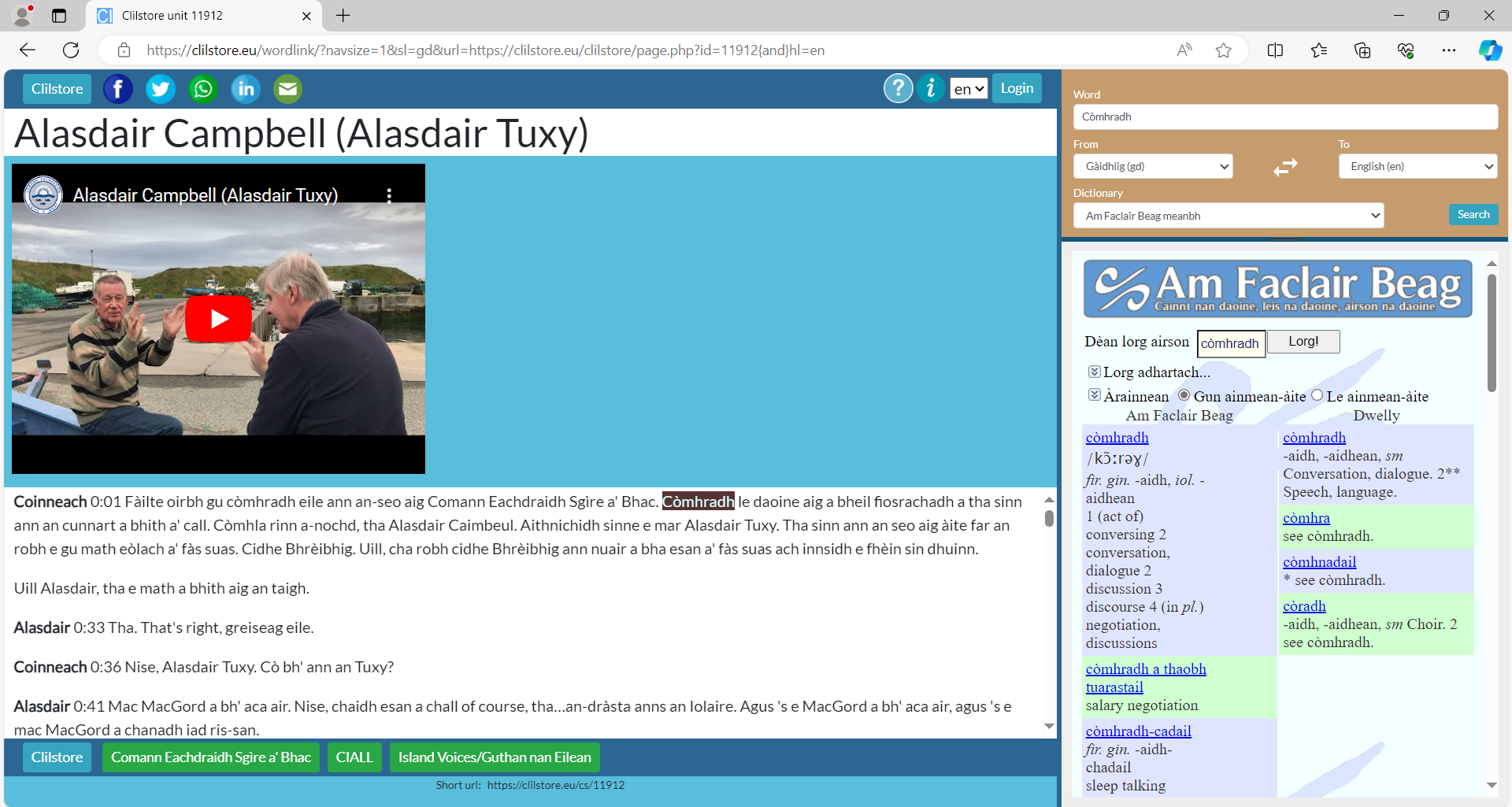
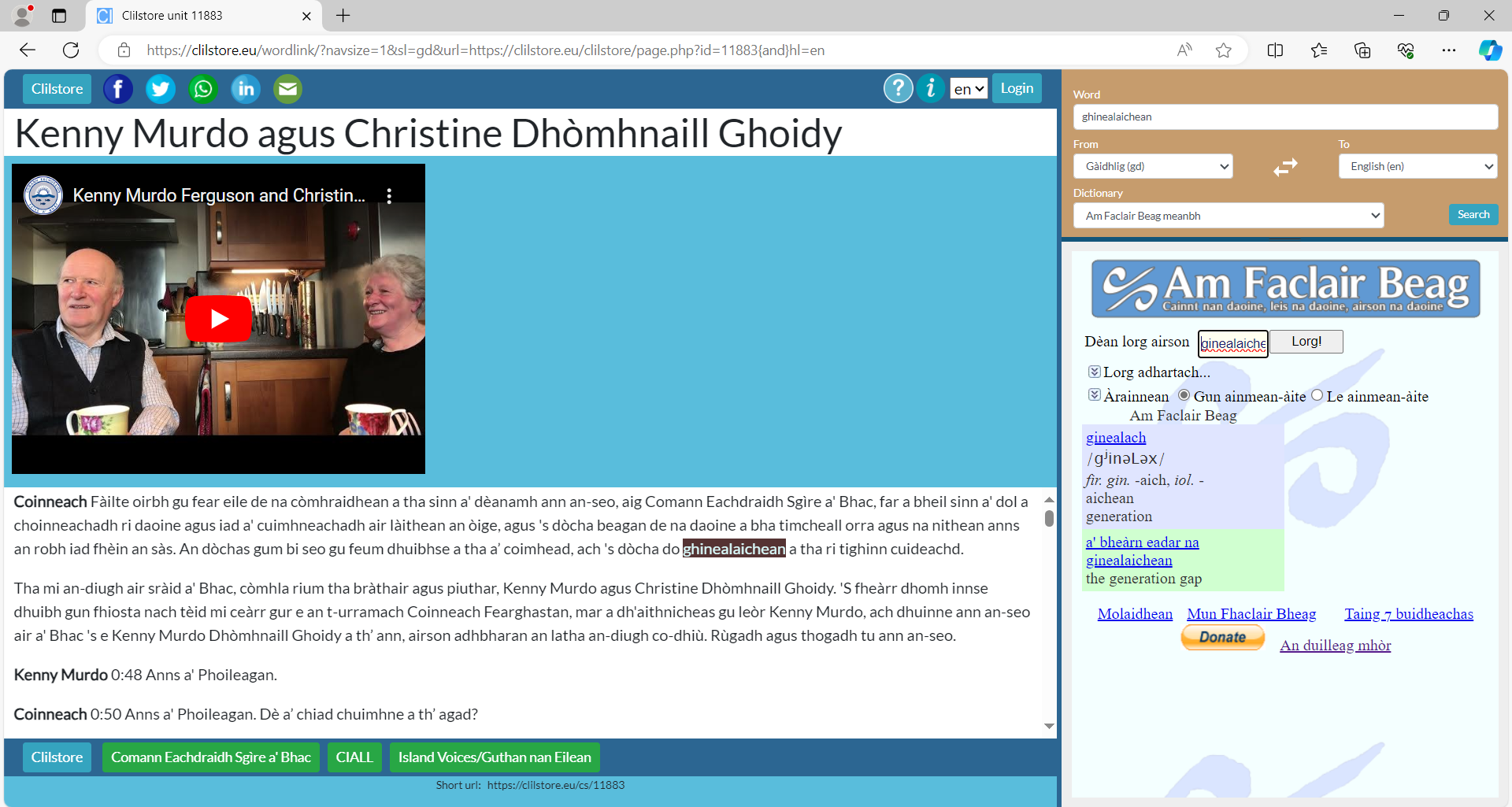
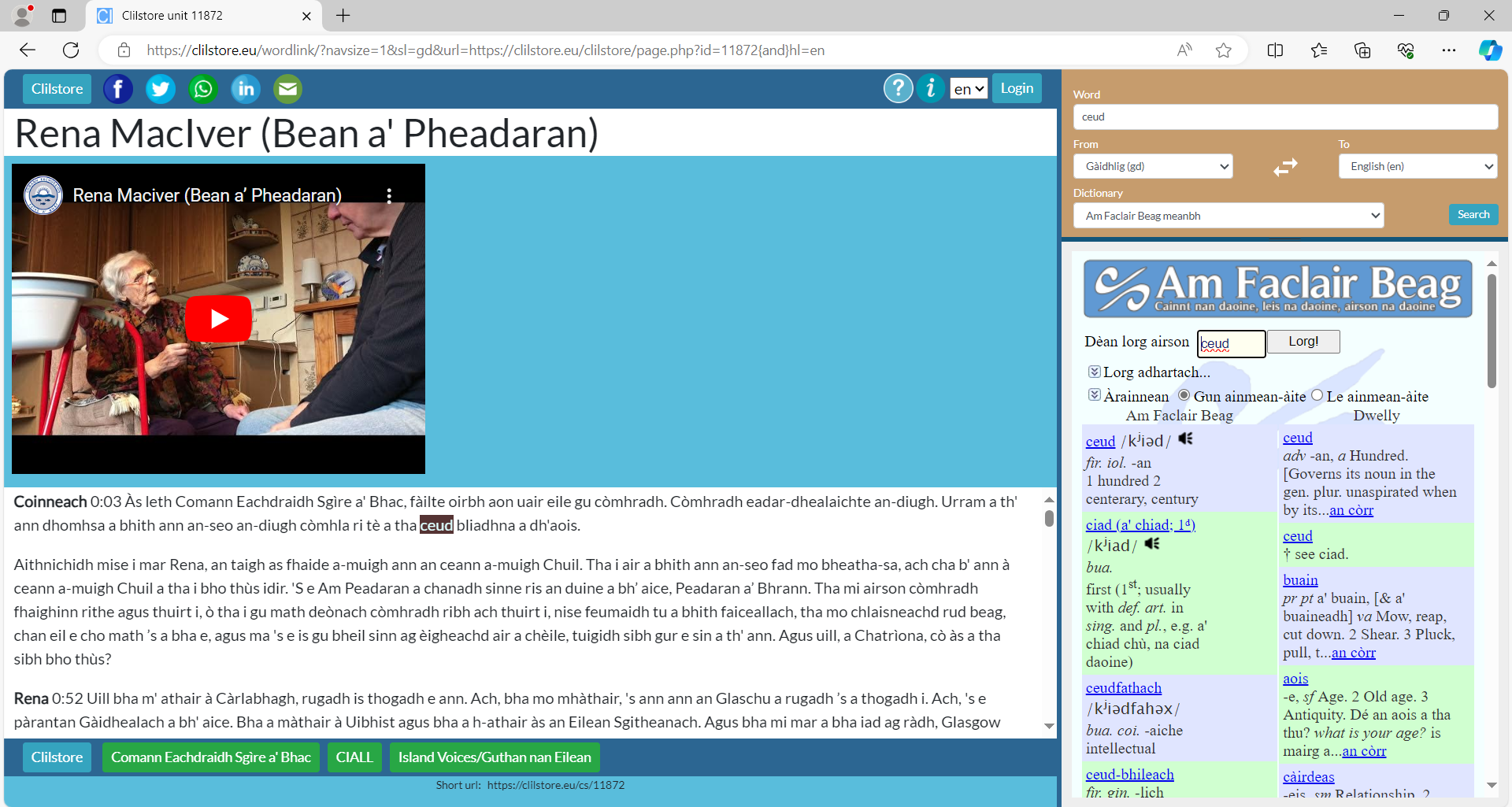
Kenny Murdo (Rev Ferguson) and his sister Christine are in conversation with Coinneach MacÌomhair in this video from Comann Eachdraidh Sgìre a’ Bhac, with memories of Sràid a’ Bhac, Bùth Bellann and their careers. This “Clilstore treatment” provides an online wordlinked transcript with the video embedded. You can get a translation of any word you don’t know by clicking on it: https://clilstore.eu/cs/11883

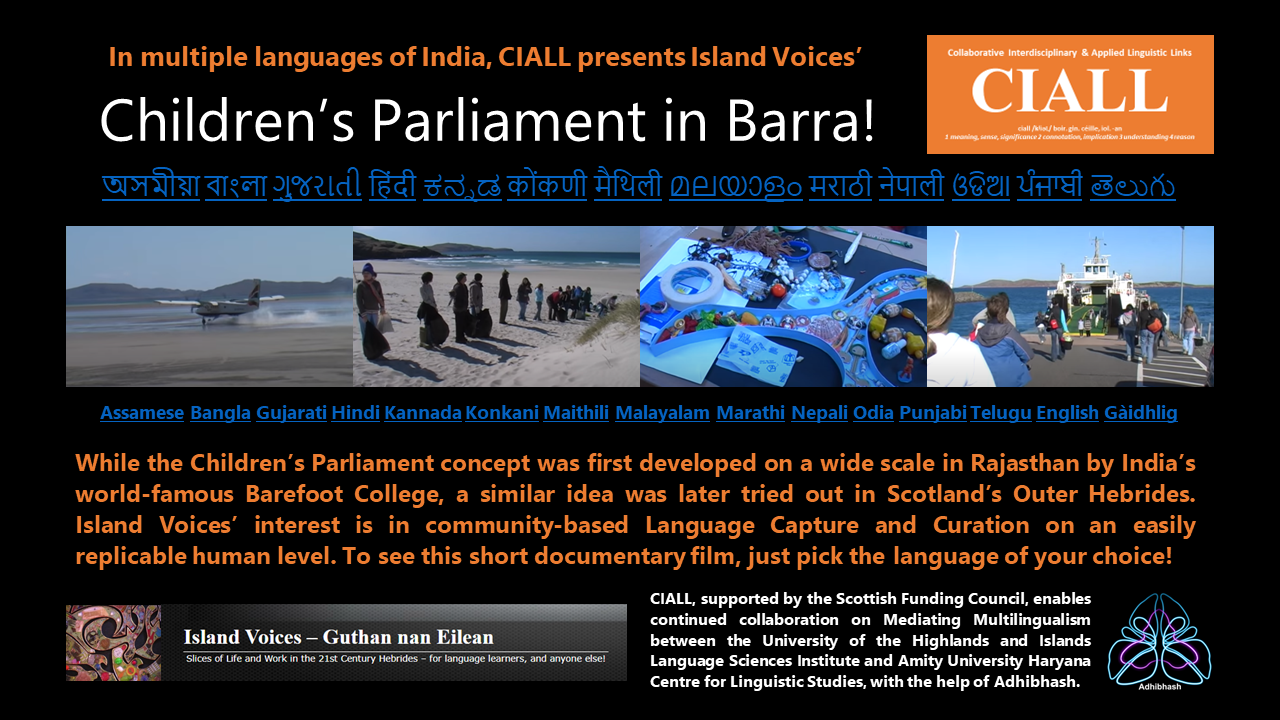
Island Voices through Indian Languages

Indian Languages Poster Picture FinalSelect any language in this landscape poster, or use the phone-friendly portrait layout.

The Children’s Parliament concept was first developed to scale in Rajasthan by India’s world-famous Barefoot College. UNESCO documented some of this fascinating history-in-the-making in video form. A similar idea was later tried out in the Outer Hebrides by the Scottish Children’s Parliament organisation, which continues to work across the country to this day.

Around the time of the Children’s Parliament in Uist and Barra project, Island Voices was already developing its interest in community-based Language Capture and Curation on a shareable human scale, so recording this meeting of the Children’s Parliament in Barra (as well as the follow-up in Benbecula) was a natural step to take, with versions in both Gaelic and English included under the Series 2 Generations theme.

Following years of grounded Hebridean growth and developing partnerships, Island Voices came to Indian linguistic attention through the Mediating Multilingualism collaboration between the UHI Language Sciences Institute and AUH Centre for Linguistic Studies, serviced initially through the Soillse network and continued now by CIALL. This work has been generously supported by the Scottish Funding Council, and publicised through their EDI blog.

This brings us up to the present day, and this testing at scale of the notion that short documentary films with a focus on localised linguistic communities can be both easily and usefully re-purposed in other languages in which similar issues around contact, use, and sustainability may also be pertinent. We’ve been doing it off and on in ones and twos for a while through our Other Tongues theme. Moving in one go from two versions of one film to fifteen is a significant step-change!

The image at the top of this post, available in landscape or portrait layout, supplies live links to the film in each of the languages listed, as well as to relevant websites of the partners mentioned. Alternatively, you can just click on any of the language names in the top row of the tables below to get straight through to the YouTube version of your choice.

অসমীয়া বাংলা ગુજરાતી हिंदी ಕನ್ನಡ
Assamese Bangla Gujarati Hindi Kannada
कोंकणी मैथिली മലയാളം मराठी नेपाली
Konkani Maithili Malayalam Marathi Nepali
ଓଡିଆ ਪੰਜਾਬੀ తెలుగు English Gàidhlig
Odia Punjabi Telugu English Gaelic

(The English name of the language in the second row is a live link you can click to get to the Clilstore unit, in which the online transcript – with the video embedded – enables one-click access to an online dictionary for any words you don’t know.)

We are particularly indebted to Adhibhash for their vital work in recruiting and co-ordinating a wonderful team of translators and narrators who worked at pace to deliver these great new recordings!

The primary aim for Mediating Multilingualism was to deliver innovative and collaborative work of genuine value for partners outside Scotland. We have continued in that spirit, while recognising also the mutual benefit derived. It will not have escaped local notice that several of the languages listed above, notably Punjabi, as well as Bangla and Gujarati, are widely spoken (and taught to some degree) in “diaspora” communities here, while Hindi (or Urdu) may still serve as a link between speakers of different South Asian languages in the UK.

And as we, in Scotland, continue to struggle at community level to develop an equitable working relationship between English and Gaelic which would enable both to be fruitfully used, we might do well to remind ourselves that other countries appear to handle regional linguistic variation of far greater complexity. India has 22 scheduled languages written in to its constitution, including all those on our list above, mostly associated with different regions or states. It’s a longstanding example of differential recognition of, and official support for, local languages across multiple regions within one overall polity, as well as some which cross international boundaries. If there’s truly a mind for it, is it really beyond Scotland’s wit to meaningfully recognise “Areas of Linguistic Significance” for Gaelic within its own borders?

Returning to the Indian context and the Barefoot College, they had their own 50th anniversary celebrations in 2022. If you follow this video news report, at 11.36 you can find an interesting alternative take on literacy and education from founder Bunker Roy, in terms that again chime nicely with the Island Voices focus on the Primacy of Speech:

“Illiteracy is not a barrier for anyone to become a barefoot engineer, communicator, designer, architect… We have learnt that there’s a big difference between literacy and education. Literacy is what you learn to read and write. Education is what you get from your family environment, and your community. So our stress at the Barefoot College has always been on education. Literacy may be there, but it’s incidental for me. What is more important is the human being behind – the person who is working with us. Has he or she got the compassion, patience, tolerance, simplicity? All these are Gandhian values, which we think should set an example for anyone working in the college…”

This may be considered a simple statement of fundamental principles. But it is also perhaps another reason, alongside the recently cited example of Duncan Ban MacIntyre, to recognise anew the importance of natural speech in a community setting as the crucial ingredient in any attempt at creating a definitive recipe for promoting genuinely communicative use of any language, no matter what its circumstances. That said, none of the newly added languages here could be considered at risk of disuse in the way Gaelic is, except perhaps in diaspora contexts. But if the Island Voices home-grown and “haund-knitted” (may we call it “barefoot”?) capture and curation model works for these, could it not also be applied with other indigenous and endangered languages, whether in India, Scotland, or elsewhere?
Donnie Macaulay – Sgìre a’ Bhac

Donnie Macaulay Sgìre a' Bhac

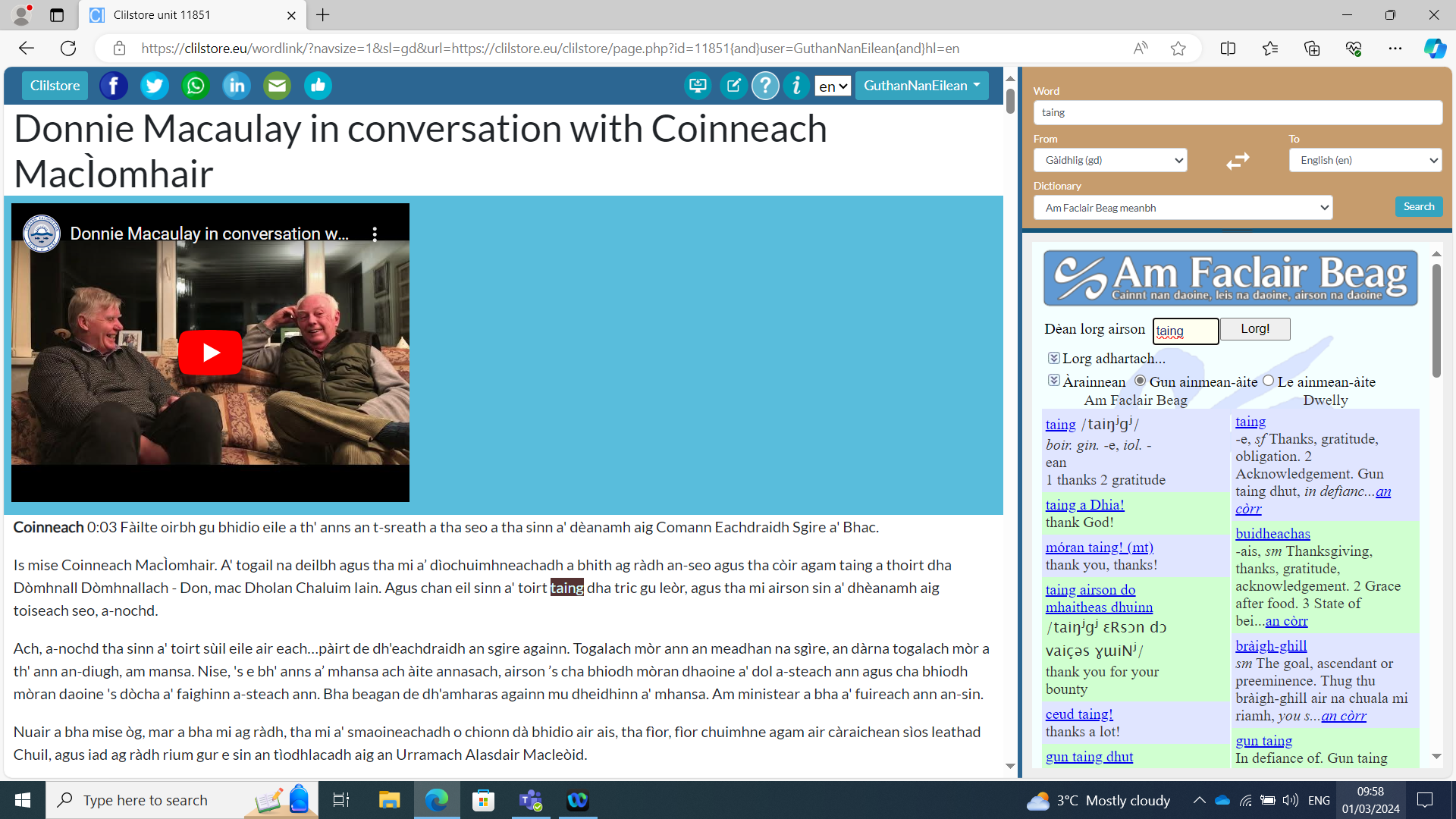
March opens with the further extension of our CIALL-supported collaborative work with Comann Eachdraidh Sgìre a’ Bhac through the creation of another wordlinked transcript on the Clilstore platform, this time based on their video of Coinneach MacÌomhair in conversation with Donnie Macaulay. Donnie Macaulay is the son of the late Rev Murdo Macaulay, who was the minister of Back Free Church between 1956 and 1975.

It’s another fascinating recording of naturally spoken Gaelic, full of stories and treasured reminiscences. And now the Clilstore treatment offers enhanced access to Gaelic learners, and any others who may also like to see written Gaelic alongside the spoken word.

Here’s the link: https://clilstore.eu/cs/11851

Back School Memories

SchoolMemories

We’ve previously drawn attention to some of the fascinating YouTube videos coming out of Comann Eachdraidh Sgìre Bhac, and to the fact that a number of the Gaelic ones have now been enhanced with optional same language subtitling (which can also be auto-translated into numerous other languages, including English).

Of course, once the subtitling has been done, that also forms a base on which other platforms can be built – such as a learner-friendly “Clilstore” unit. This is an online tool which creates a new webpage with the video embedded alongside a scrollable text, so you can look at and listen to the video while at the same time following the transcript in real time. Plus, there’s a special trick which allows learners to click on any word they don’t know and immediately gain access to a dictionary translation of it.

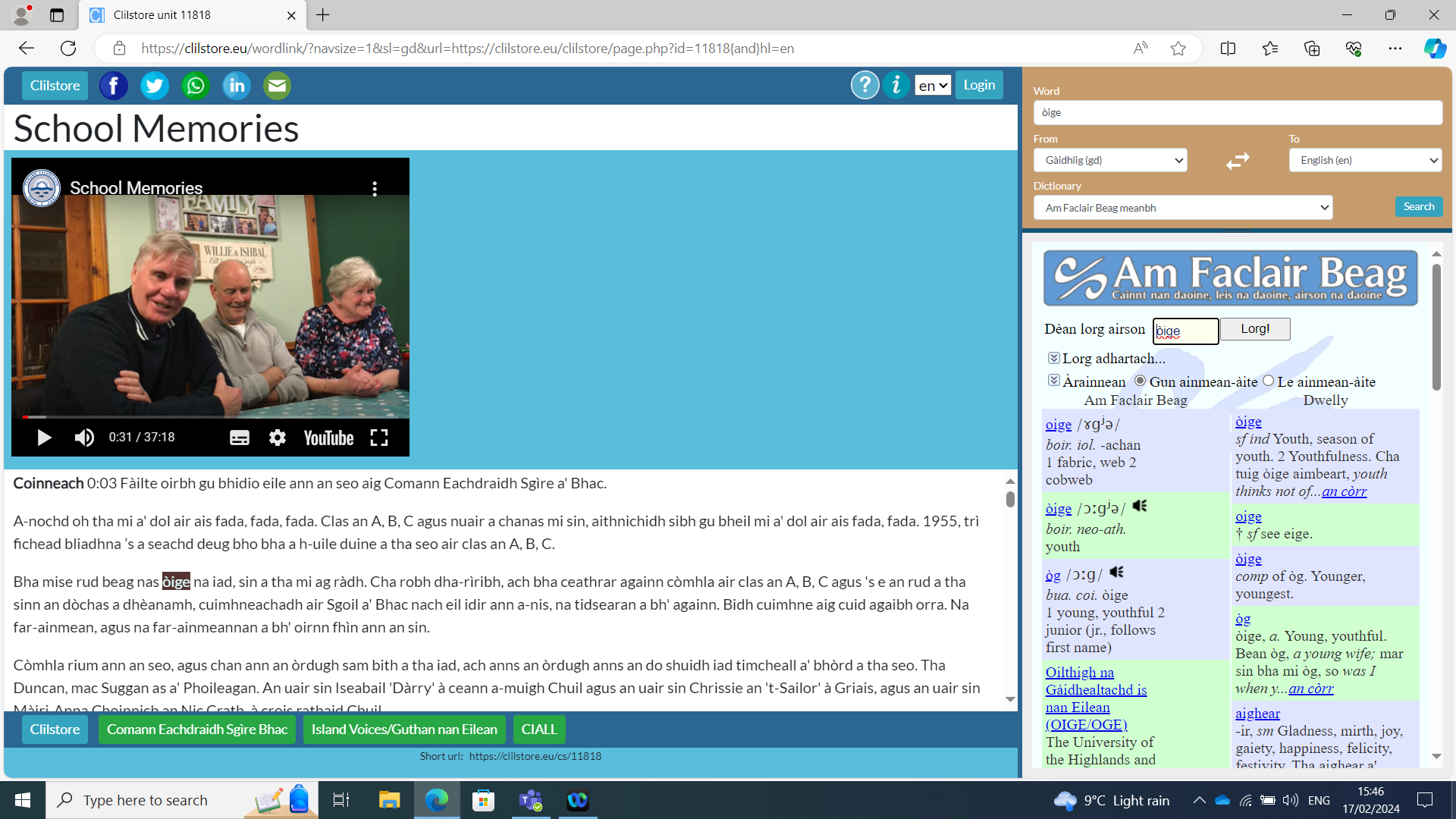
So here, with support from the University of the Highlands and Islands’ “CIALL” initiative, is another example of the Clilstore software being put to use with a community-produced recording about School Memories from Sgoil a’ Bhac, with Coinneach MacÌomhair in conversation with some of his former classmates.

Clilstore Unit 11818 – “School Memories”: https://clilstore.eu/cs/11818

Retro Retrieval

Nicosia video makers

We’ll continue our review of previous Gaelic recordings into the winter months, given the popularity of our autumn social media season. But we’re going to start the New Year with something a little bit different – and warmer – while sticking with the Gaelic unifying theme. We’ll kick off with some earlier films made “in the style of” or “about” Island Voices, before returning to more classics from the original series.

Island Voices in fact owes its inception to the stimulus provided by the EU’s Leonardo funded POOLS project of 2005-2007. It was through that successful partnership that the Guthan nan Eilean idea came into being – and won the 2007 European Language Label. POOLS turned out to be just the first of many follow-up projects that built on the original theme, with Island Voices linked to many of them.

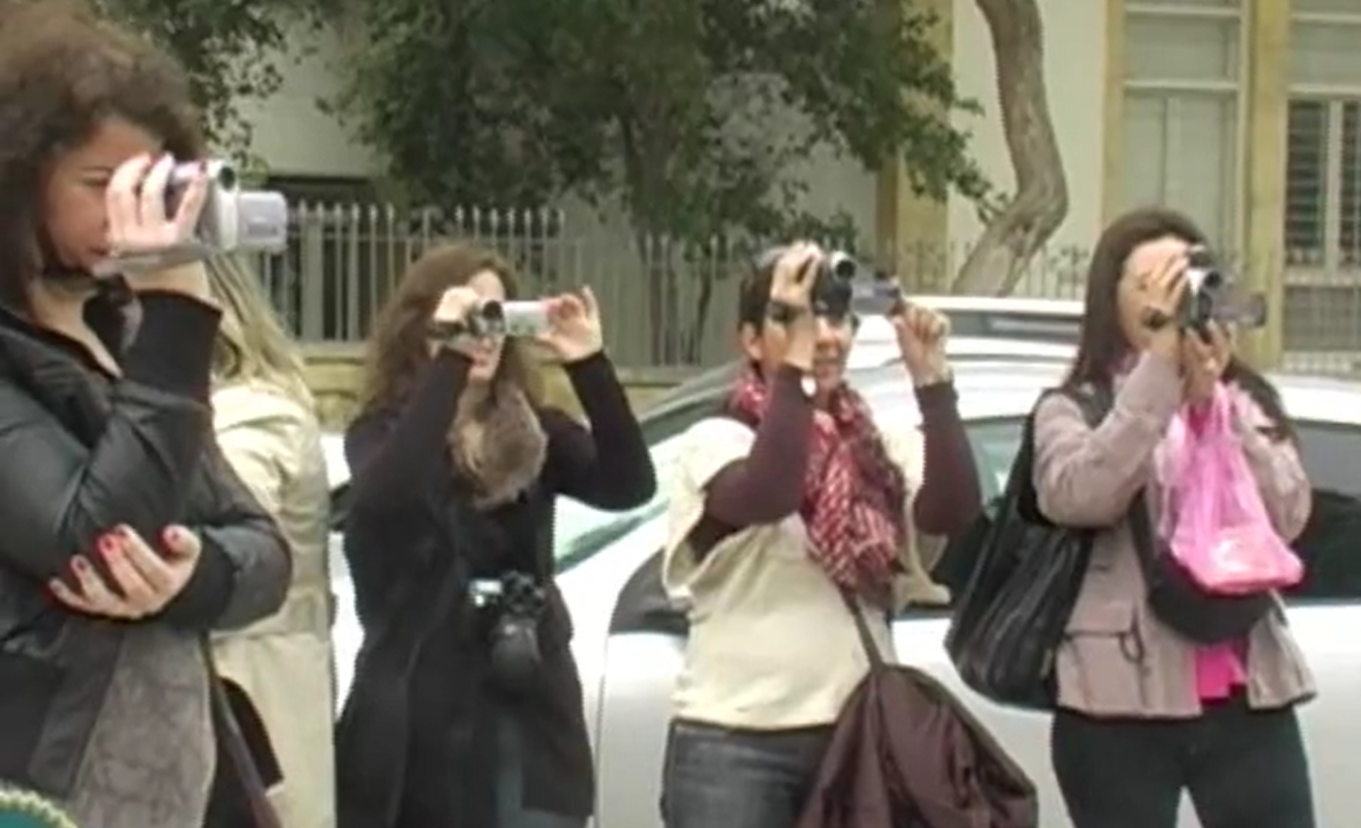
POOLS-2 (2009-2011) was an early example, again with a video production element included, which enabled us to link with other European islands like Cyprus and Malta. In these demo clips from a 2010 video workshop in Nicosia, the fundamental learning point is made that serviceable video-making need not be the exclusive preserve of industry professionals. And in language teaching terms, it can be a highly productive process, with multilingual knock-on benefits potentially within reach in return for the initial creative input.

These videos were put together as a demo for language teachers interested in the use of ICT in language teaching. Participants spent a morning taking pictures. The following day, after pooling their resources, they each edited together their own short film, using this demo as an exemplar.

They were recently “rediscovered”, and the Gaelic version has now been additionally equipped with the learning assisting enhancements that have since become available – including the now standard Clilstore transcript (Unit 11794), plus optional YouTube subtitles (that can further be auto-translated through the Settings Wheel).

A bheil Portagailis agad, neo am bu toil leat beagan ionnsachadh?!

Tionndadh Gàidhlig:

English version:

We’ll place direct YouTube links to more Gaelic films on a similar outward-looking and multilingual theme on Facebook and Twitter in days to come…