Robert Burns on Benbecula

As rumours circulate that Prestwick Airport is to be renamed “Robert Burns International Airport” the Island Voices project expands its linguistic scope still further, placing local recitations of two of Scotland’s national bard’s most famous poems on the online Clilstore platform. Clicking on any word will take you directly to a choice of Scots, rather than English, dictionaries.

It’s true that the Hebrides are traditionally much more closely associated with Gaelic than with Scots, but here’s another reminder that people are much more mobile these days – even if they do still like to hold on to speech patterns acquired in younger days…

Dumfries-born Denis Johnston addresses the haggis, while simultaneously wielding the knife here, serving up a tasty verbal hors d’ oeuvre: http://multidict.net/cs/1454

And Rob Keltie, in a prodigious feat of memory, takes his audience through the very substantial main course with a dash of Doric seasoning, delivering Tam O Shanter in inimitable style here: http://multidict.net/cs/1451

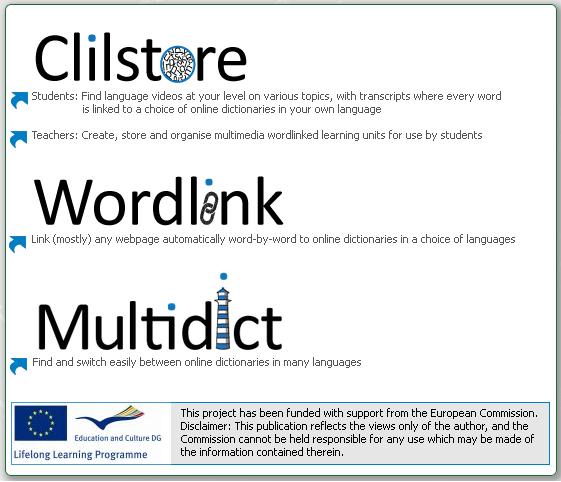
Clilstore remains “work in progress”, being taken forward by a multinational partnership through the TOOLS project, in which Sabhal Mòr Ostaig plays a key part. Comments and suggestions for improvement are always welcome!
A Crofter’s Life on Clilstore

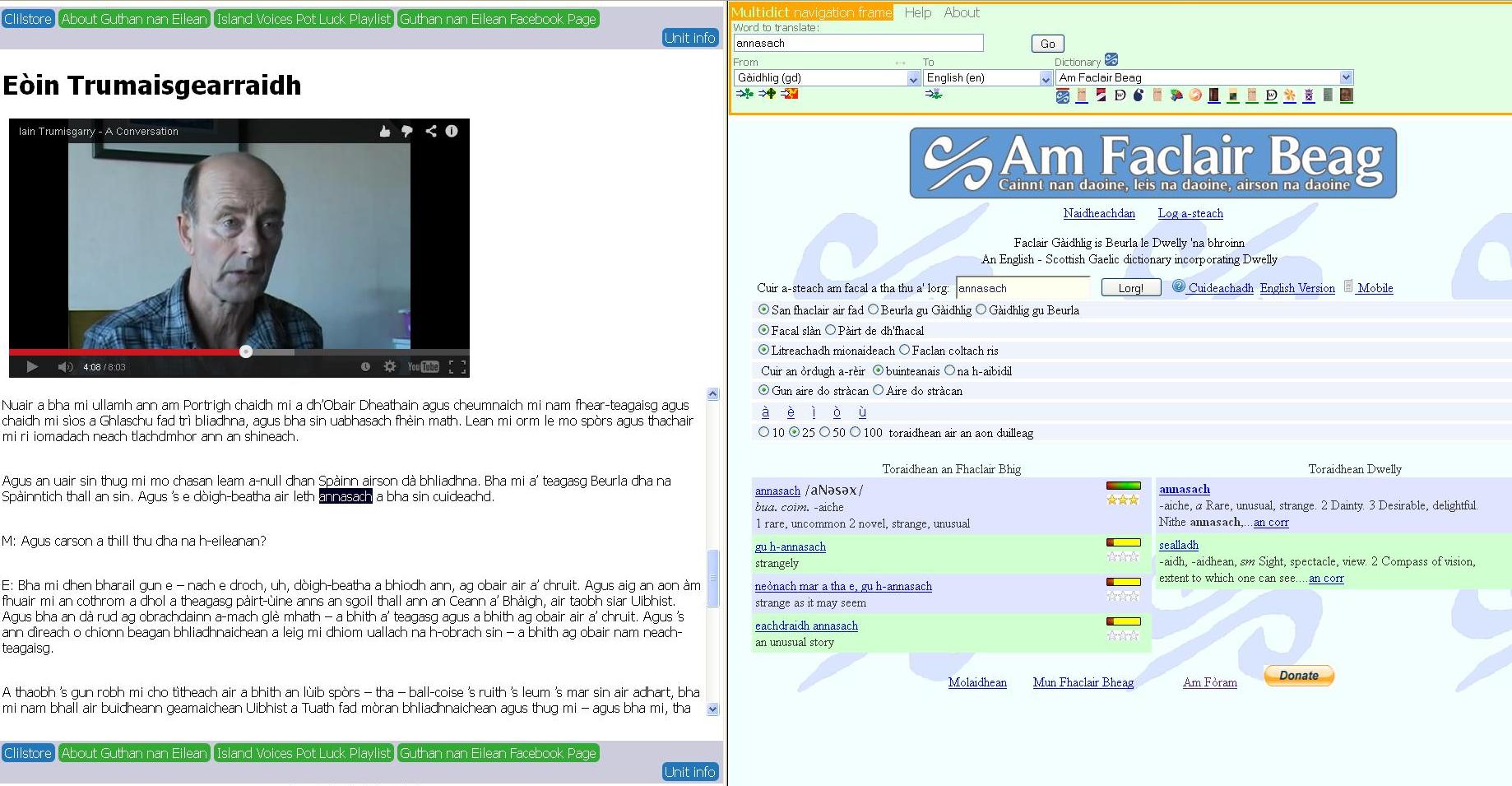
Mary Morrison’s revealing chat with Iain Trimsgarry has now been uploaded to Clilstore. This means that Gaelic learners who can’t follow everything that is said just by listening will be able to listen and read at the same time, simply by scrolling down the transcript as the video plays.

What’s more, if there’s a word you don’t know in the transcript you can simply click on it, which will take you to straight to the appropriate entry in an online Gaelic-English dictionary. What could be easier?!

You can access the unit on Clilstore by clicking on the picture or by following this link: http://multidict.net/cs/1411

Pròiseact “snasta gasta”

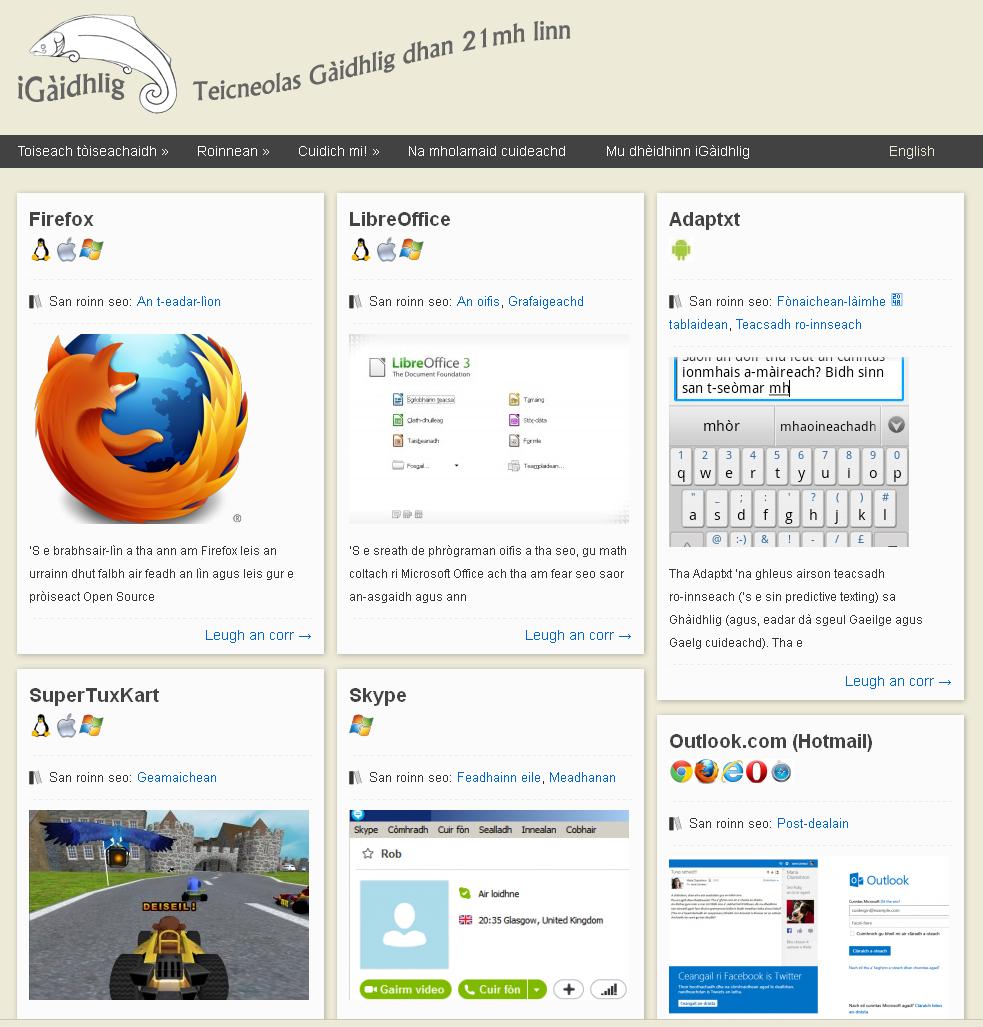
Tha làrach ùr spaideil ann airson daoine a tha airson “bruidhinn” ris na coimpiutairean aca ann an Gàidhlig seach Beurla. ‘S e “iGàidhlig” an t-ainm a th’ air a’ phròiseict. Chaidh ainmeachadh mar-thà le Guthan nan Eilean san aiste seo air “digital literacies” – ach tha coltas snasail ùr air a-nis.

Ma tha sibh fhèin airson gach cothrom a th’ ann a ghabhail airson Gàidhlig a chleachdadh nach cuir sibh fhèin sùil air an làrach? Gheibhear an seo e. Agus ma choimheadas sibh air na ceanglaichean a th’ aca (“Na mholamaid cuideachd”), chì sibh gu bheil àite sònraichte ann airson Guthan nan Eilean… Nach e pròiseact “snasta gasta” a th’ ann an iGàidhlig fhèin!

There’s a new look to the online iGàidhlig resource which offers Gaelic localisation for a wide range of programs and platforms. If you want to “talk” to your computer in Gaelic then this is the site to visit.

And Island Voices is delighted to find itself mentioned on the “We also recommend” page… We think iGàidhlig is pretty “amazin” too!

Catching up with Clilstore

The fourth meeting of the European TOOLS project has taken place in Evora, Portugal, following on directly from the 2013 Eurocall conference. At the heart of the project is the development of the innovative “Clilstore” software package.  In these short conversations Gordon Wells invited the project co-ordinator, Kent Andersen, and the program developer, Caoimhìn Ò Donnaile, to outline briefly how the project has developed and explain how it can help language learners and teachers. Kent speaks in English, and Caoimhìn in Gaelic.
Here’s Kent:

Here’s Caoimhìn:

The idea for Clilstore itself developed out of discussions and developments initiated in the “POOLS-T” project. You can hear Kent and Caoimhìn talking about that project three years ago in this Island Voices post.

In Russian, with Love

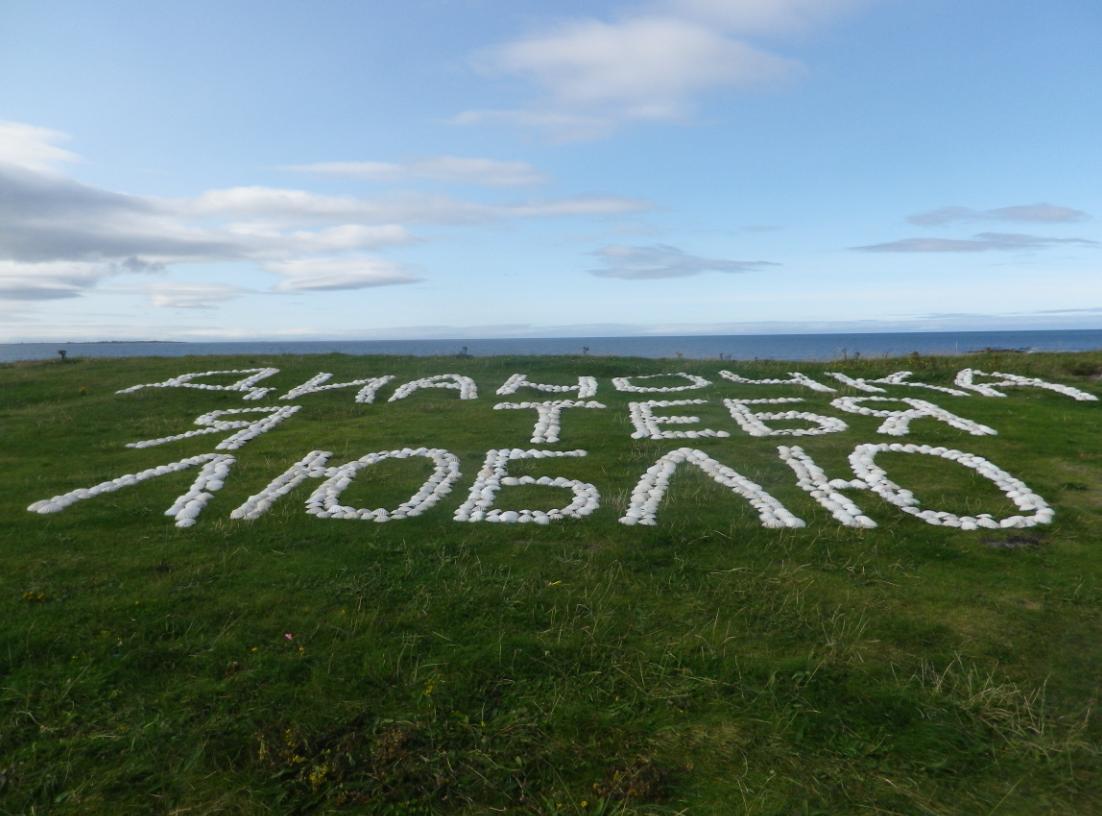
LyublyuThe Island Voices Facebook page took flight recently when we posted this picture of this stunningly simple but beautiful piece of “environmental art”. Carefully constructed out of scallop shells, the enormous lettering spells out дианочка я тебя люблю (Diana, I love you) on a patch of green at Poll nan Crann in Benbecula, conveniently under the flight path of outgoing or incoming aircraft.

If you haven’t already visited, please take a look at our Facebook page to see the excited discussion that ensued as folk tried to figure out the story behind the mystery message. In the end it turns out to be a heart-warming testament to the strength of a mother’s love. And it broke all viewing records for posts on the Facebook page…

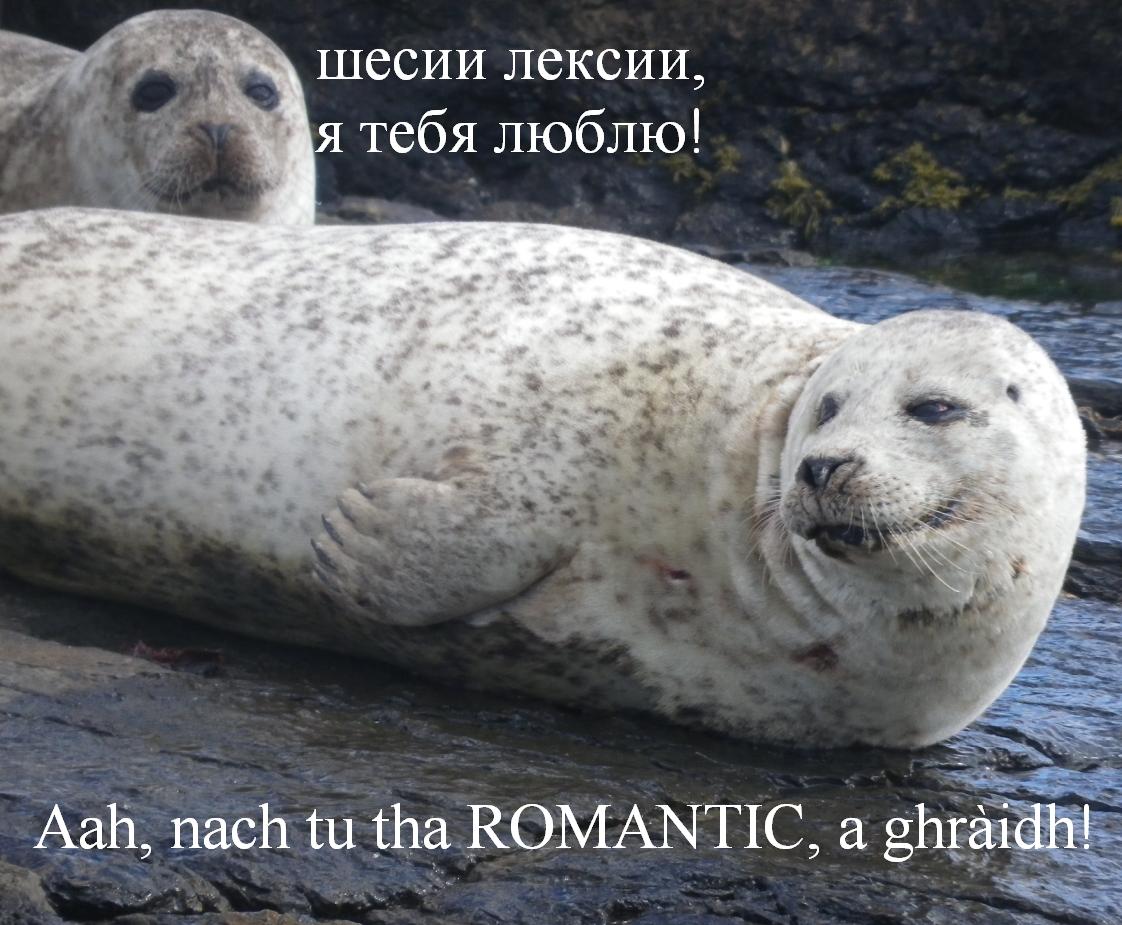
DithisRonJPGWe followed it up a few days later with this somewhat cornier picture of our own, depicting a “cross-cultural romance” between two seals.

The challenge to readers (and/or listeners…) was to figure out the name of the Gaelic-speaking seal. In the multi-media spirit of the Island VOICES project we even provided a link to let non-readers hear a synthesised pronunciation of шесии лексии via Google Translate – http://alturl.com/qqnnt. It took about a day before Jamie Wallace came up with the answer – Seasaidh Leagsaidh! If you like language games like this, why not follow the Facebook page with a “like”? There could be more to come…

Clilstore at Ceòlas and Online Feedback

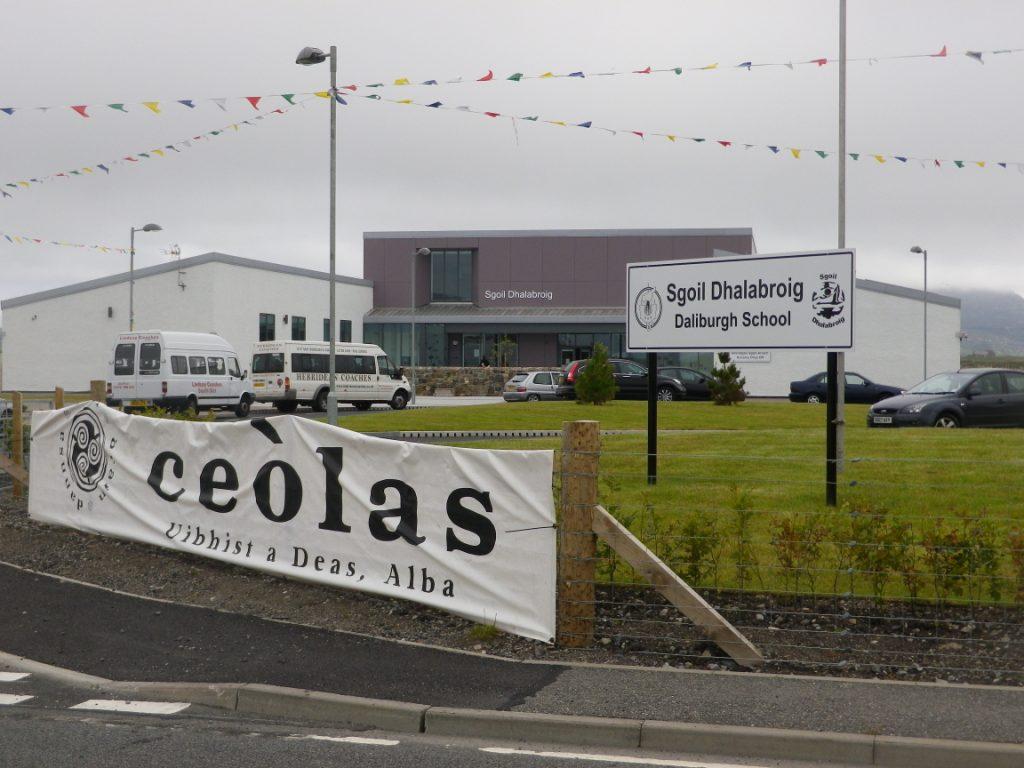
Sabhal Mòr Ostaig’s Caoimhín Ó Donnaíle is a regular attender at the Ceòlas Gaelic Music summer school in South Uist, but this year he’s taken along a laptop as well as his fiddle. In today’s “Gaelic for All” slot – and at other times during the week – he’s offering participants an introduction to the self-directed language learning and teaching opportunities offered through the Clilstore platform and associated programs.

For the first session he was joined by Uist-based Projects Officer Gordon Wells, who gave a quick run-through of the Island Voices/Guthan nan Eilean project, and how it now makes use of Clilstore to supply online transcripts of the project videos. Previously these were only available as Word documents, but now the added functionality of Clilstore means you can watch a video while simultaneously scrolling through the transcript and checking for dictionary translations of any words you don’t know, simply by clicking on them. It’s also an easy online process for any teacher to create similar multimedia units using their own audio or video recordings.

SMO is still developing the software and welcomes comments from any online users. If you would like to send in some feedback, please download this evaluation form, fill it in and e-mail it back to gne@smo.uhi.ac.uk.

Island Voiceovers

ClilstoreThrough Sabhal Mòr Ostaig, the Guthan nan Eilean project is involved with the European TOOLS project’s development of the “Clilstore” platform, which aims to help teachers create multimedia online language learning units which can include easy access to dictionary translations in over 100 languages. (There are over 150 Clilstore units based on Island Voices videos, for example. Take a look at the Series 1 or 2 pages on this site, or at the Extras page.)

The software development is led by Dr Caoimhín Ó Donnaíle on the Isle of Skye, and his work is then tested out by various European partners working in Danish, Lithuanian, Spanish, Portuguese, and Arabic – as well as Irish and Scottish Gaelic.

The overall project is led by Kent Andersen of SDE College in Denmark, who has developed and scripted teach yourself videos for teachers and learners to help them get to know how to use the platform. The scripts have been rendered in seven different languages, with Gordon Wells of Island Voices recording both the English and the Scottish Gaelic versions.

Although the videos are quite long, the plan is to integrate shorter selections from them into the e-book explaining Clilstore that will be another outcome of the TOOLS project. But if you really can’t wait for that, here are a couple of the full-length videos.

The learners’ one in English:

[youtube=http://www.youtube.com/watch?v=WjGt5d4AXBs&w=400&h=225]

The teachers’ one in Gaelic:

[youtube=http://www.youtube.com/watch?v=fGJzqaHGkis&w=400&h=300]

Trilingual Trip

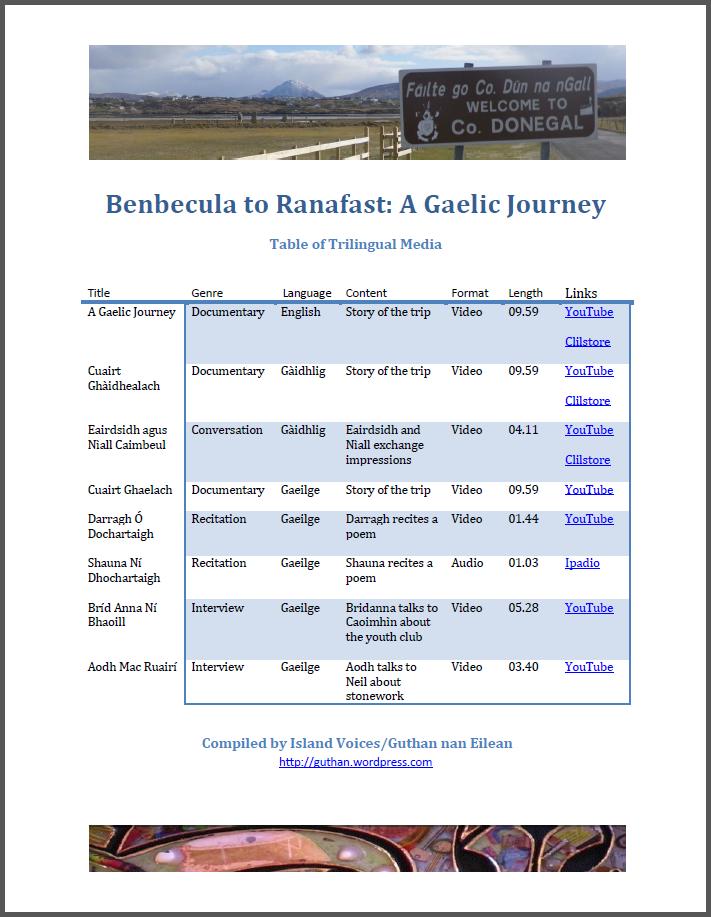
The recent short visit by the Guthan nan Eilean/Island Voices project to Ireland generated quite a range of recordings in various formats and genres – and in three different languages!

This online table brings them all together for ease of reference, with live clickable links to take you to the clip of your choice on the appropriate platform. That could be YouTube for video, or Ipadio for audio – or it could also be Clilstore if you want access to a wordlinked transcript while you watch and/or listen.

Clilstore is a learner-friendly platform being developed by Sabhal Mòr Ostaig in partnership with other institutions in the “TOOLS” project. It’s still work in progress, so if learners or teachers have comments to make on how it could be improved please feed them back to us!

New Look for New Word Look-up

ClilstoreScotland’s Gaelic College, Sabhal Mòr Ostaig, is a partner with other institutions across  Europe in the TOOLS project. Followers of the TOOLS blog will have noted that there has been recent discussion of possible designs for the central “Clilstore” platform – which, through the agency of SMO’s Dr Caoimhín Ó Donnaíle, performs the magic trick of linking words in an online text to a host of different language dictionaries. (Over a hundred languages are accessible through the program.)

While there is still work to be done on the student and teacher interface and log-in systems, the basics of the new design have been agreed. To mark the occasion, the Island Voices Series 1 and 2 pages have been substantially reconfigured. Caoimhín had already prepared Clilstore units for each of the 150 videos in the central collection, meaning you could scroll down a wordlinked transcript while watching the embedded video on the same page, simultaneously checking a dictionary translation of any words you didn’t know. Links to these units, which now have a new cleaner look, have been placed on the pages on this site, replacing the old transcriptions in Word. Check any of the Series 1 or Series 2 Outdoors, Generations or Enterprise pages, and see what you think.

CLIL stands for “Content and Language Integrated Learning”. It’s a philosophy which chimes well with the Island Voices approach of capturing language as it is used in the community, and aiming to reflect the everyday lives of real people. As the project continues to develop we hope to make more use of Clilstore as a supportive means of re-presenting real language to learners.