CALL Support in Context

toolslogoSabhal Mòr Ostaig, Scotland’s Gaelic College, and Ulster University have been working together on community-based recording and computer-assisted language learning (CALL) for three years now, starting with the European TOOLS project – which itself grew out of earlier POOLS projects in which Sabhal Mòr Ostaig had already been involved, and out of which Island Voices/Guthan nan Eilean developed. So the recent Irish visit to Benbecula can be seen as part of a wider collaborative venture, in which similarities (and differences) between Irish and Scottish Gaelic are explored, with the aim of developing practical solutions to common problems.

Another side to this work can be seen in the online publication of a joint paper – “CALL Support in Context: Contrasting Approaches in Irish and Scottish Gaelic” – written by Gordon Wells and Caoimhín Ó Dónaill. In the Scottish section the paper draws substantially on community-level work and research that has been conducted in parallel with Island Voices over the past few years. It is available online in the Research/Reports section of this site, or by clicking on this link.
CALLpaperTitle

Irish Hallowe’en

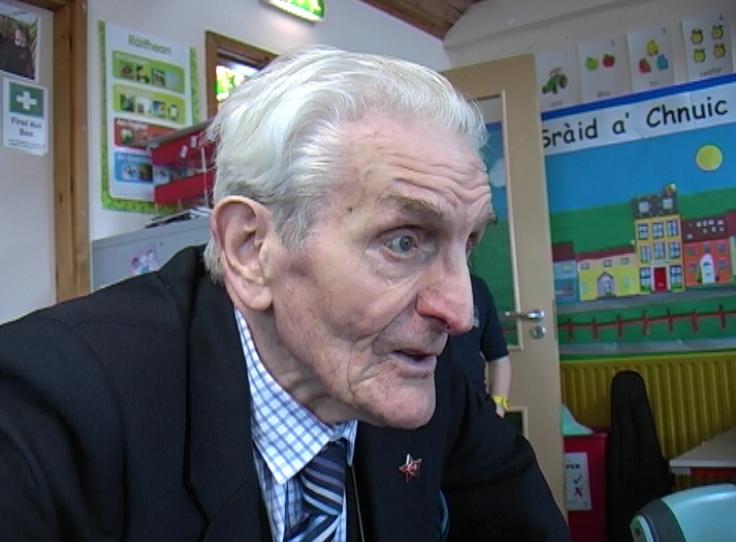
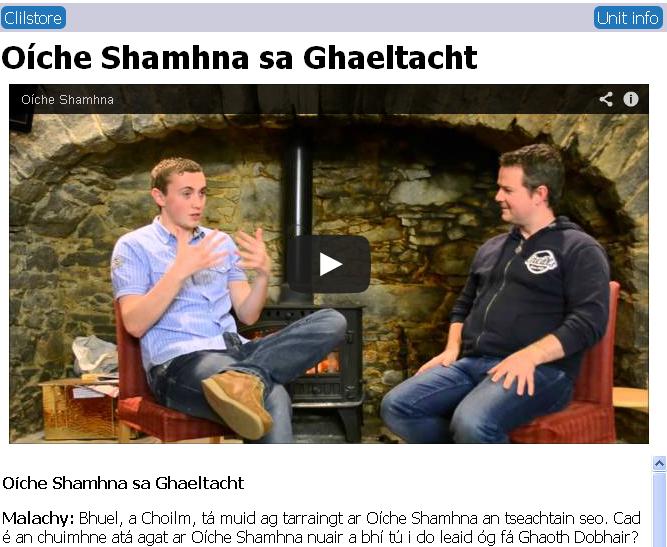
Sitting by the huge original fireplace in the historic Nunton House – on a dark and stormy night – Colm shares his childhood memories of what Scottish Gaels would call “Oidhche Shamhna” with Malachy.

Oidhche Shamhna Èireannach air Clilstore

The two of them are conversing in Irish. This would ordinarily be quite a challenge for Scottish Gaelic speakers, but help is at hand – through Clilstore!

Our Irish visitors have been very quick learners, not only recording, editing, and uploading fresh video, but also supplying a transcript and placing it on the Clilstore platform. This will allow speakers of Scottish Gaelic, and other languages, to read as they listen, and check any words they don’t know in an online dictionary at the click of a mouse. Try it out – Clilstore Unit 2355.

Czech Developments

Island Voices was born out of the involvement of Sabhal Mòr Ostaig in the original 2005-2007 POOLS project. SMO has continued to maintain an outward-looking European perspective ever since, and is now leading the POOLS-3 “Transfer of Innovation” project which sees POOLS outputs and ways of working being taken forward in three new languages – Irish, Catalan, and Czech.

But it’s a two-way process, in which new partners also bring fresh skills and knowledge to the table for sharing. The Pelican School in Brno has introduced “green screen” techniques into its video-making repertoire, and describes the process in this POOLS-3 blog post.

For anyone interested in “endangered languages” Czech offers an interesting historical contrast to the usual pessimistic trajectory. Wikipedia supplies this basic introduction to the language and its history. Our colleagues may have more to teach Gaelic enthusiasts than video techniques!

In any event, they clearly enjoyed the video-making process! Here’s an example:

You can find the full set of POOLS-3 Czech videos via this link.

Norman Maclean: Òran do Sgoilearan Chàirinis

TormodCarinishNorman Maclean’s grandfather (also Norman – Tormod Ailein) was lost at sea in the First World War, when Norman’s mother was still young.

In another contribution to the “An fheadhainn tha laighe sàmhach” project, Mary Morrison arranged for Norman to visit Sgoil Chàirinis, where his mother was a pupil, to recite this specially composed Gaelic song, and help the children learn to sing it.

In the video clip below Norman gives a crystal clear rendition of the words.

With his kind agreement, a written version is also made available on Clilstore so you can listen and read at the same time. Click on this link – Unit 2307 – to go to the transcription.

A Cautionary Clilstore Clip

Clilstore programmer Caoimhín Ó Donnaíle (SMO) attended the recent POOLS-3 meeting in Brno to present the multiple functionalities of the platform and associated programs. It was a fascinating session, and over the course of the meeting all participants had the chance to experiment with the software.

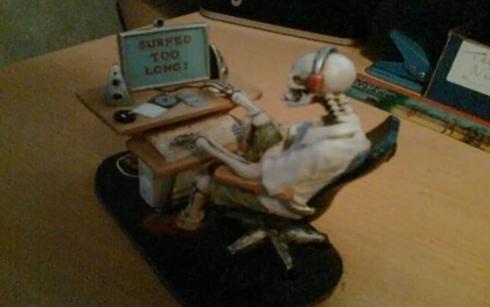
Caoimhín was also able to talk participants through the latest developments, including the file upload facility, which means that unit creators can now add Hot Potatoes exercises to their Clilstore units. Caoimhín produced a new unit himself, based on a poem by Skye-based Nìall Gordon – “Ro fhad’ air fairg’ an Eadarlìn”, which highlights the one drawback of the new possibilities offered by Internet technologies – their potentially addictive properties!

Uibhist Ioma-chànanach – Multilingual Uist

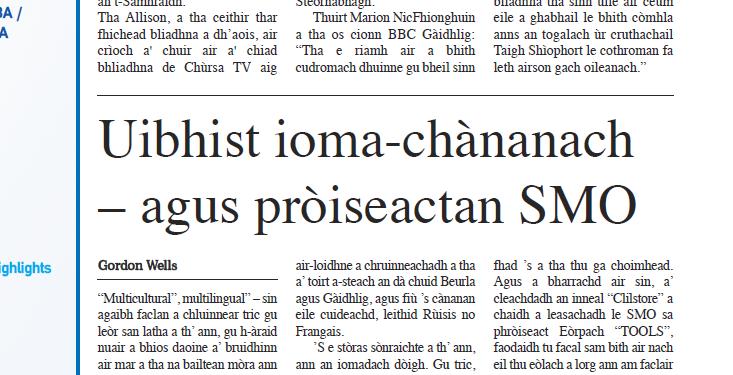
MultilingualUisttitleThe August issue of Am Pàipear carries a Gaelic article by Gordon Wells entitled “Uibhist ioma-chànanach agus pròiseactan SMO” (“Multilingual Uist and SMO projects). It suggests that other communities coming to terms with multicultural or multilingual growth may find some useful points of comparison with the longstanding Hebridean experience of bilingualism.

It also highlights how Sabhal Mòr Ostaig (SMO), Scotland’s Gaelic college, has been working with European partners over a number of years on development work, particularly for language learners, that is rooted in the everyday experiences and accounts of the residents of Uist (and other Hebridean Islands) through projects such as Guthan nan Eilean. You can read the article here.

NATECLA 2014 Workshop

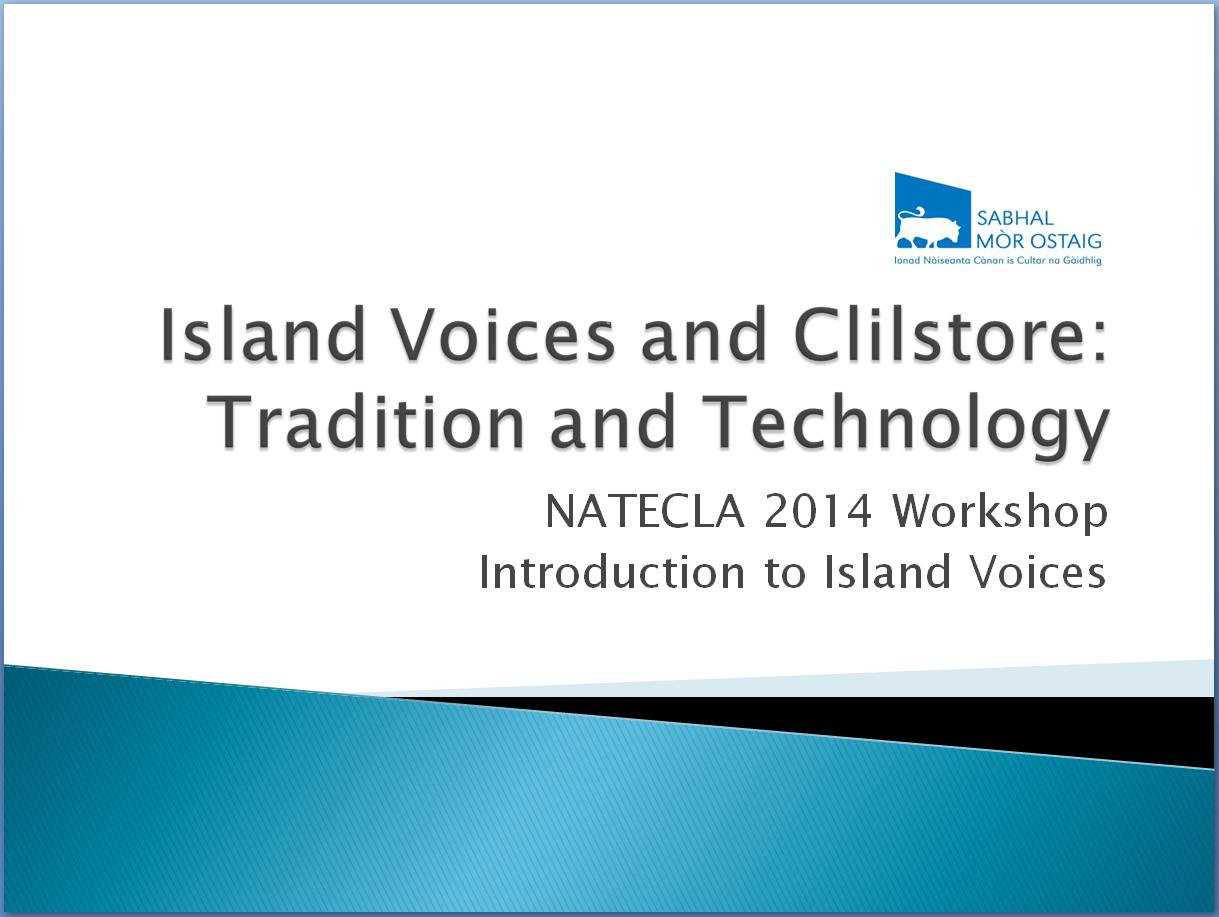
This is the introductory powerpoint presentation for the “Island Voices and Clilstore: Tradition and Technology” session at the NATECLA 2014 conference in Sheffield.

NATECLAFront

Following the presentation on Island Voices by Gordon Wells, Caoimhín Ó Donnaíle went on to demonstrate how to create Clilstore units.

You can read a step-by-step guide in this Clilstore guidebook, produced as part of the TOOLS project.

TOOLSEBOOKCOVER

You can get this guidebook in various other project languages and e-book formats suitable for iPads etc via this link. And on Page 34 you will find a table of links to YouTube video guides for teachers and learners.

Virtual St Kilda

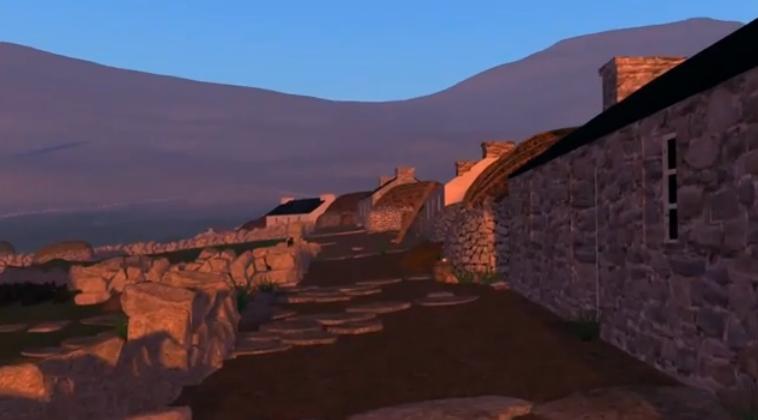
St Andrews Virtual St Kilda ExperienceThe Virtual St Kilda exhibition is up and running at Taigh Chearsabhagh, and the “mystery voice” is now revealed as that of regular Island Voices contributor, Archie Campbell, who also prepared the Gaelic version of the bilingual introduction. The project is headed up by the St Andrews University Open Virtual Worlds research group, working closely with local groups in Uist.

The exhibition gives you hands-on interaction, via an Xbox controller, with a digital re-creation of the St Kilda of the 1880s. You can walk around Village Bay (or fly over it!), exploring inside and outside various buildings. Clicking on various objects will take you to additional information, and the project is further enhanced by additional video work with island children offering imaginative interpretations of scenes and stories, ably facilitated by Mary Morrison – to whom Island Voices followers need no further introduction…

The film below was edited together by the St Andrews team.  It integrates their own digital reconstruction and video work with stunning natural footage from UistFilm, as well as, flatteringly, some re-purposed shots from Island Voices’ own St Kilda documentaries in English and Gaelic. Archie’s voiceover is truly bilingual, alternating regularly and consistently from Gaelic to English. It’s a very interesting and still experimental format, so comments and suggestions are most welcome.

More sample videos are available on the Open Virtual Worlds group’s Vimeo channel, and you can read more about the group’s work here.

Media Tips

POOLS-3 audio and video presentationThe Island Voices project originated with “Series One” in the 2005-2007 Leonardo-funded European project “POOLS”, and subsequently developed “a life of its own” after that. Technology and techniques have moved on since those early days, of course, but fundamental principles remain stable, and lessons can still be learned.

“POOLS-3” is a Transfer of Innovation project in which institutions involved in teaching Catalan, Czech, and Irish aim to replicate and develop some of the key outputs from the first POOLS project. At a recent meeting in Barcelona, Gordon Wells gave this brief presentation on approaches to media recording, based on his experiences with POOLS and Island Voices/Guthan nan Eilean.

Update (01/06/14): Stucom, our Catalan partners, have just placed online this video of Gordon’s presentation, delivered in their Smart Room. Gordon talks through the power point, simultaneously demonstrating how NOT to wear a lapel mike…

[youtube https://www.youtube.com/watch?v=diSSoY2S9y4?rel=0]