We’re deeply indebted to Sharon Pisani, our Maltese “Island Voice”, for the latest addition to our “Other Tongues” collection! This takes up to 22 the number of languages in which we have Island Voices films. Abair ioma-chànanas!
We first came into contact with Sharon through Comann Eachdraidh Uibhist a Tuath, the North Uist Historical Society, for whom she’s doing great work in supporting the “Aire air Sunnd” project.
Based at St Andrews University, where she’s doing doctoral research on augmented reality, she’s somehow also found the time to translate and record a Maltese version of our Series Two Enterprise “Seatrek to St Kilda” film. Apparently, the island theme struck a chord!
And for anyone learning Maltese, or who perhaps just wants to see what it looks like written down, we’ve also created one of our trademark Clilstore units – https://clilstore.eu/cs/11181 – which combines the video with an online transcript wordlinked to online dictionaries.
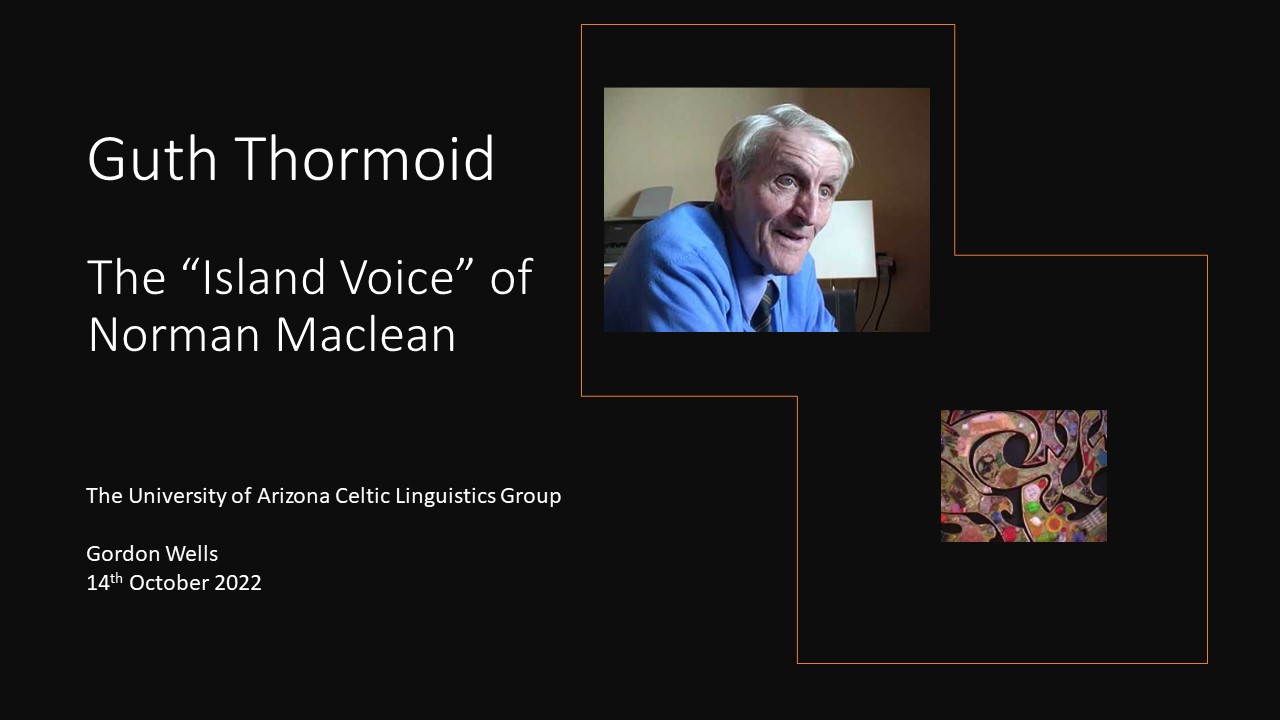
Island Voices Co-ordinator Gordon Wells was delighted to be invited to speak to the University of Arizona Celtic Linguistics Group recently (14th October) about Island Voices, with specific reference to Norman Maclean’s notable contribution to the project. Gordon’s presentation is available online, and includes lots of Island Voices screenshots with live embedded links so that anyone interested can explore the site further.
Here’s the abstract for the talk:
“Gordon’s presentation samples and contextualises some of the multi-faceted mainly Gaelic contributions by the multi-talented creative icon, Norman Maclean, to the “Guthan nan Eilean/Island Voices” online language capture and curation project. These include Norman’s final “Saoghal Thormoid” (“Norman’s World”) series of videoed conversations, recorded in April 2016, in which Norman spoke reflectively of his memories and impressions of bilingual life in Glasgow and the Hebrides from the middle of the Twentieth Century onwards. In addition to offering a vivid first-person voiced and experiential account of Gaelic life over a tumultuous period for the language, the Island Voices adherence to basic linguistic principles also pays dividends in relation to some initially unpredicted spin-off applications. These are discussed in conclusion.”
And here’s the recording of the talk on YouTube, including follow-up comments and questions from the group. Many thanks to the Celtic Linguists of Arizona!
And in a new departure for Island Voices, if you can’t find the time to watch the video, there is a Twitter thread which you can follow to get a quick slide-by-slide commentary on the main points. These also link back to the online PDF, and so to all the embedded webpages referenced if you want to dig deeper into the material at any point.
A talk on Tormod as a Twitter thread. Norman had many voices, not all island ones. This looks at his Island Voices contributions, with an Applied/Sociolinguistic perspective. Can the output of an exceptional exponent throw light on everyday speech? #1 https://t.co/jorxWZ7lT6pic.twitter.com/RqkXhTGTVO
— Guthan nan Eilean – Island Voices (@GuthanVoices) October 25, 2022
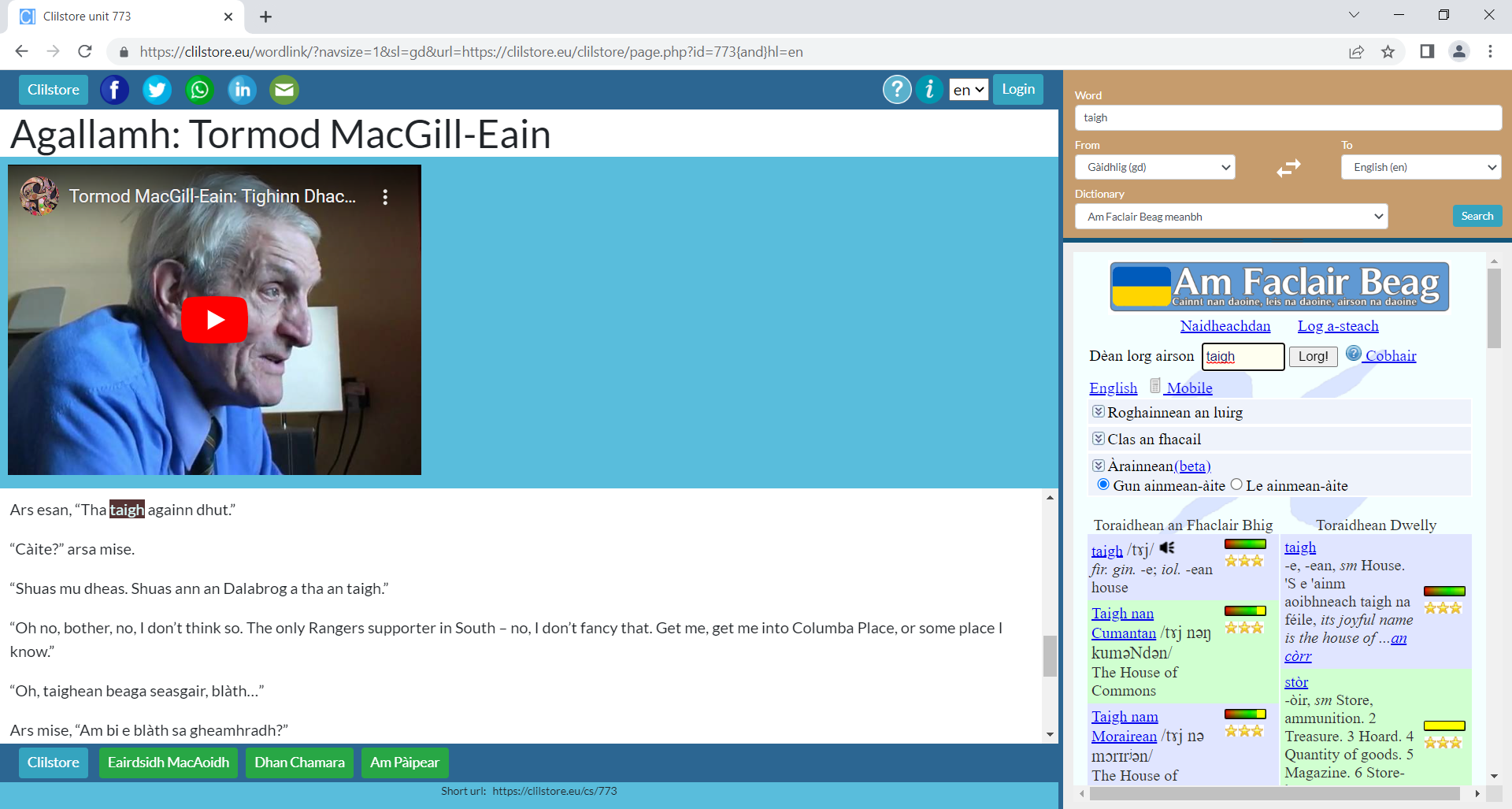
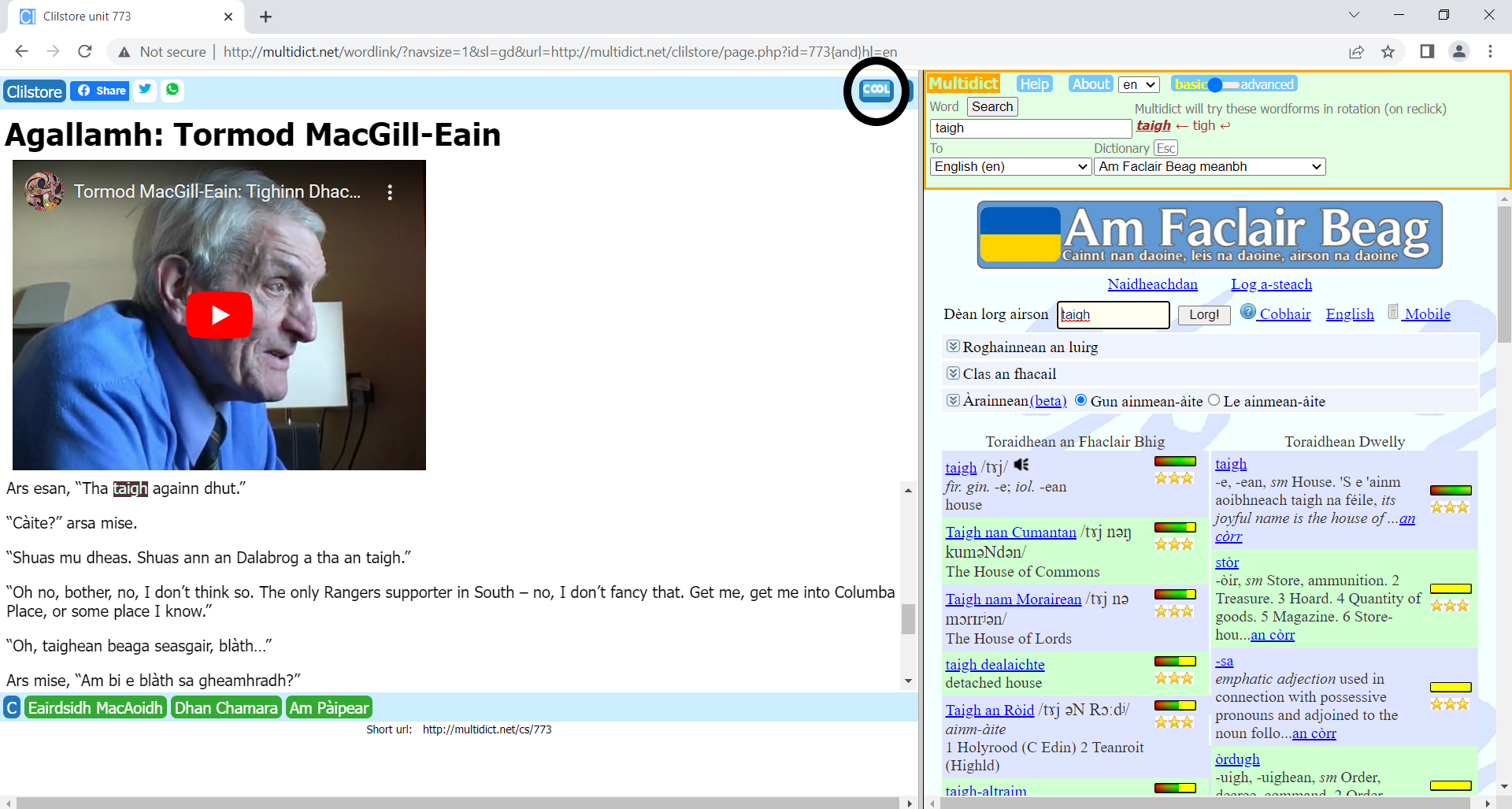
A cool blue facelift is now available at the click of a mouse to go from any original Clilstore link on the Island Voices website (or elsewhere) to the fresh-faced clilstore.eu alternative. Check the new button in the top right corner of the media screen to find your way from this:
To this!
Many thanks again to Caoimhín at Sabhal Mòr Ostaig for constant vigilance and inventiveness!
Here’s a refreshing change! We’ve been banging on about the “Primacy of Speech” since Island Voices first started, as part of the mission to positively acknowledge the communication skills we all possess in whichever languages we speak – irrespective of any additional literacy we may or may not also have. The title “Progress Report” perhaps brings something rather dry and dusty to mind, and doesn’t necessarily scream “Read me!” at everyone, but this one offers something different. Co-ordinated by Sharon Pisani, Aire air Sunnd project officer, it’s a collection of unscripted video recordings offered by participating university and other partners, all introduced by CEUT chair Ùisdean Robertson. The contributions are mostly in English, but the mix of accents may reveal (or perhaps conceal?) a linguistically diverse competence in more than one of the speakers! And, of course, apart from regional accents, there are various other features unique to natural speech. Tone of voice, rhythm stress and intonation patterns, facial expressions, physical gestures and other accompanying body language – all these are additional expressive elements that elude capture in the printed word.
Have a look and listen here:
We may hope that the variety of voices will keep the listener interested from beginning to end, by presenting the information – or “telling the story” indeed – in a different, perhaps more engaging, way than pages of written text. (Okay, “skimreading” may not be an option for the spoken word if time is short, but YouTube’s “Chapters” function is an alternative if you want to skip forwards at any point – or backwards – to focus on a particular speaker…)
Plus, there’s more – appealing to the eye as well as to the ear!
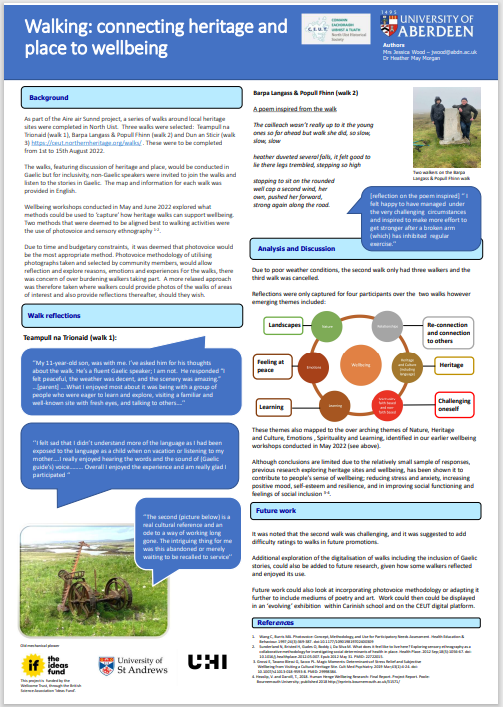
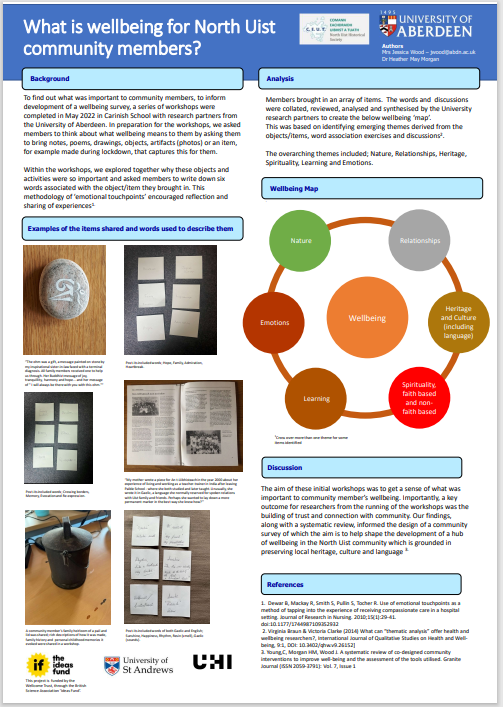
The Aberdeen team put together these two eye-catching posters for the Digital Fèis to explain in more detail how their Wellbeing strand is developing out of the workshops with which they started.
Packed with information, they also contain images of artefacts and photographs from the local Gaelic walks led by Archie Campbell.
You can click on the images of these posters to enlarge them and examine the detail more closely. And you can see more images and explanations of the artefacts on CEUT’s project page for the Wellbeing workshops.
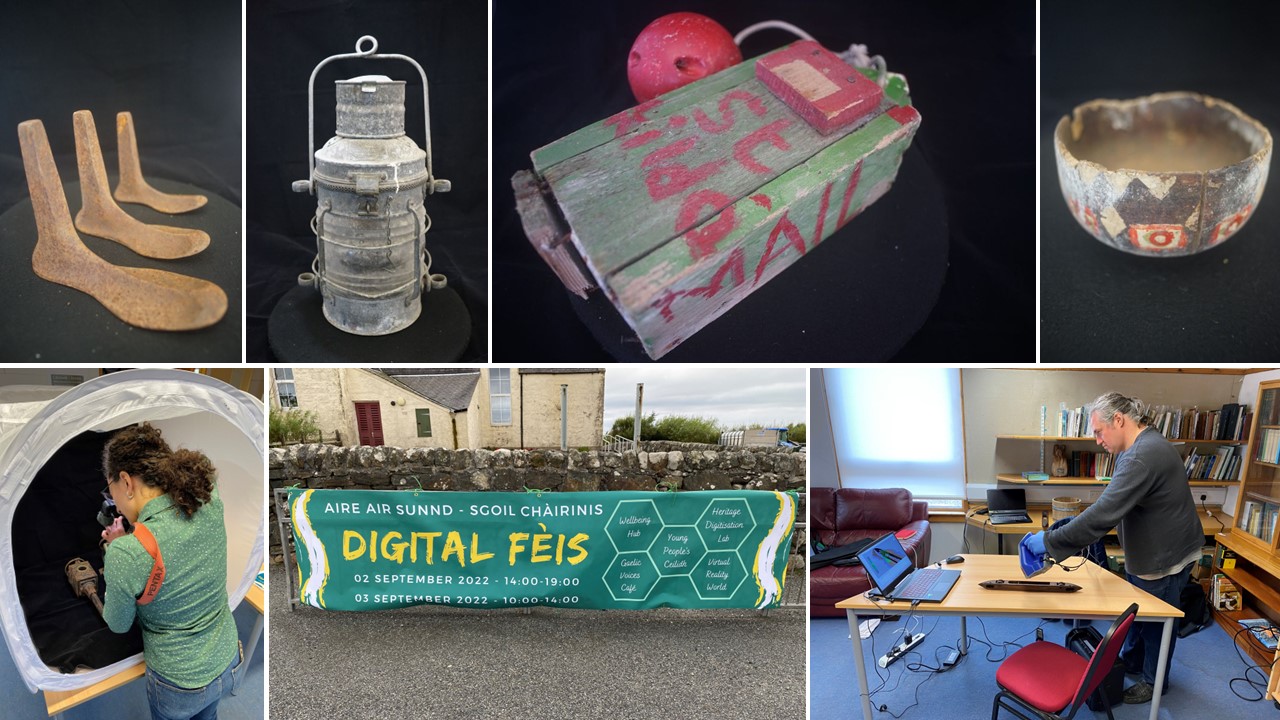
And finally, as the pictures below show, the St Andrews digitisers were kept busy throughout the same event. Again, you can click on the image to enlarge it, and will then be able to click through one more time on individual pictures to go straight to the 3D or video exhibit on the project’s Digital Fèis page.
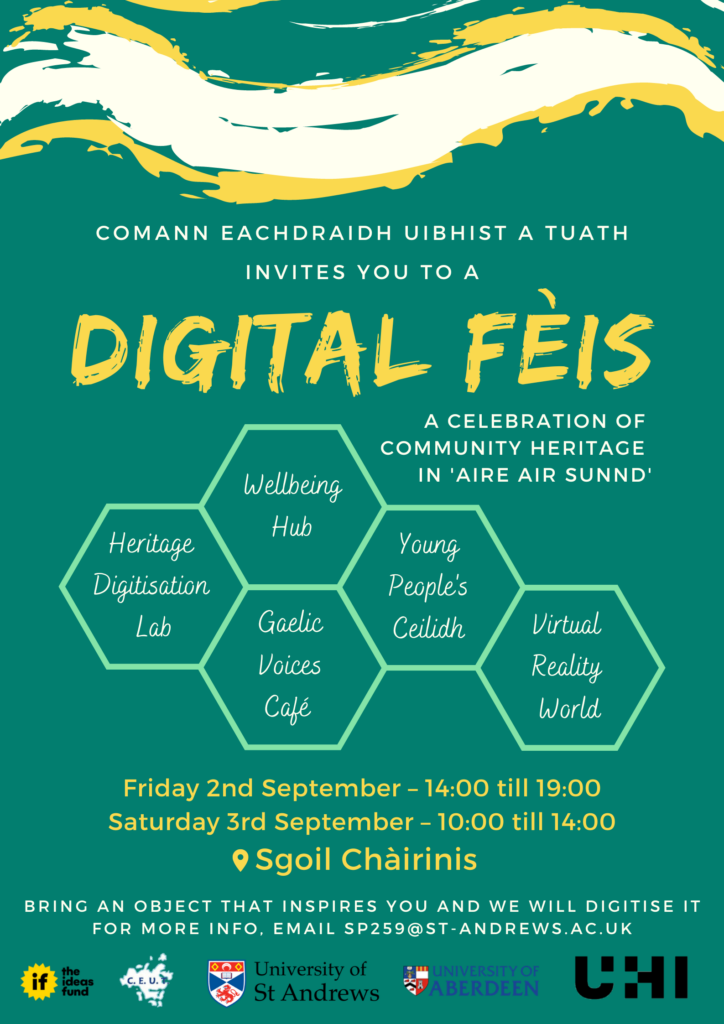
The rolling playlist roadshow moves on to Sgoil Chàirinis, North Uist, on the first weekend of September for the “Digital Fèis” hosted by Comann Eachdraidh Uibhist a Tuath, with Gaelic Voices among the various offerings for both real and virtual visitors. Be there – or see here!
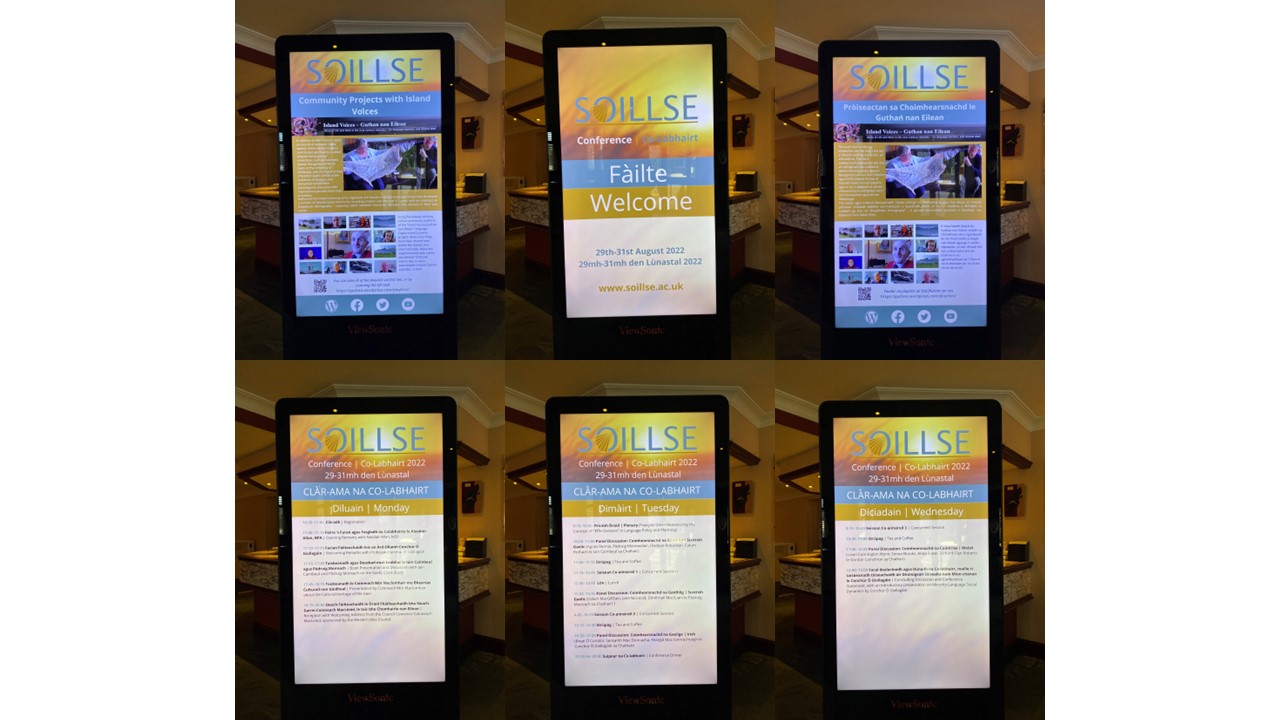
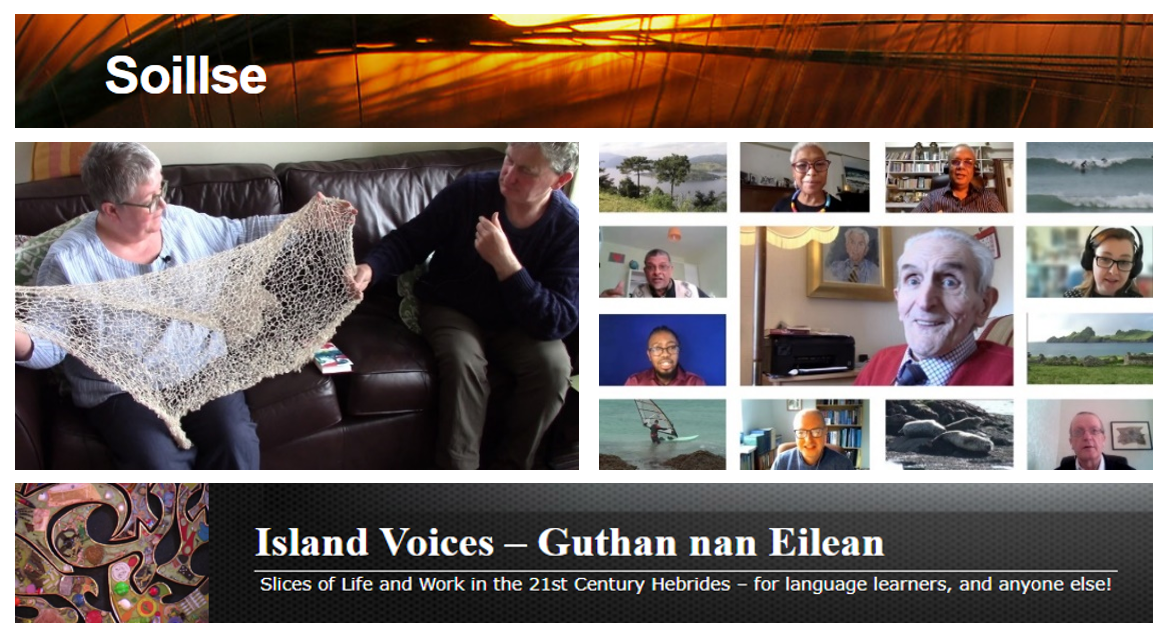
Participants at the Soillse conference on Rooting Minority Language Policy in the Speaker Community have come from across Europe and North America, from across Scotland, Wales, and Ireland, and from across the Hebridean islands that were the focus of the “Gaelic Crisis in the Vernacular Community” publication in 2020. The programme is challenging for those with an interest in generating and maintaining effective policy to address the declining use of the language in the heartland communities where it has survived until now.
In addition to these key policy questions on the formal programme, samples of the video recording work in which Island Voices has been engaged, frequently in association with the Soillse network, are also available to view on the conference “fringe”. Nach math gu bheil Guthan nan Eilean rin cluinntinn aig co-labhairt mu dheidhinn cànan nan Eilean!
Looped Island Voices playlists will again be on display in Sgoil Chàirinis, North Uist, at the Comann Eachdraidh Uibhist a Tuath Digital Fèis for the “Aire air Sunnd” well-being project at the beginning of September.
As part of the event, there is a drop-in café where people can stop by for a chat, or simply sample some of the many local Gaelic voices that have been recorded over the years. Gordon Wells will be in attendance, ready to talk to anyone interested in how the collections were made, or who might like to add to the ever-growing archive of recordings.
And on the Saturday morning, Archie Campbell, who has been leading a series of Gaelic walks over the summer, will also be on hand for anyone who likes to chat over a cup of tea. Agus ‘s e a tha math gu bruidhinn! You can view the full programme for the fèis here.
It’s a digital event, so virtual attendance is also possible for those reluctant or unable to attend in person. You can find the event on Facebook. Likewise, the playlists are all accessible online. Use the live links in this bilingual poster, and you can start watching right away!
A sharpening of focus on the vernacular Hebridean communities has become evident in some Gaelic sociolinguistic research in recent years. In this period, Island Voices has partnered with various related projects, and helped to spread news and discussion of findings and issues.
At the same time, a parallel interest in wider international comparators for the Gaelic context has also been broadcast through Island Voices channels.
Projects with close community links will be on display at the Stornoway conference on Rooting Minority Language Policy in the Speaker Community at the end of August. Series of videos will be viewable in Island Voices playlists, including “Stòras Beò nan Gàidheal”, “Saoghal Thormoid”, “Island Voices Series 1&2” and “International MOOT”.
And the playlists can be viewed remotely as well, with live links embedded in this PDF poster. This also includes additional information about the links between Soillse and Island Voices, and other collaborative research work with other universities in Scotland and internationally.
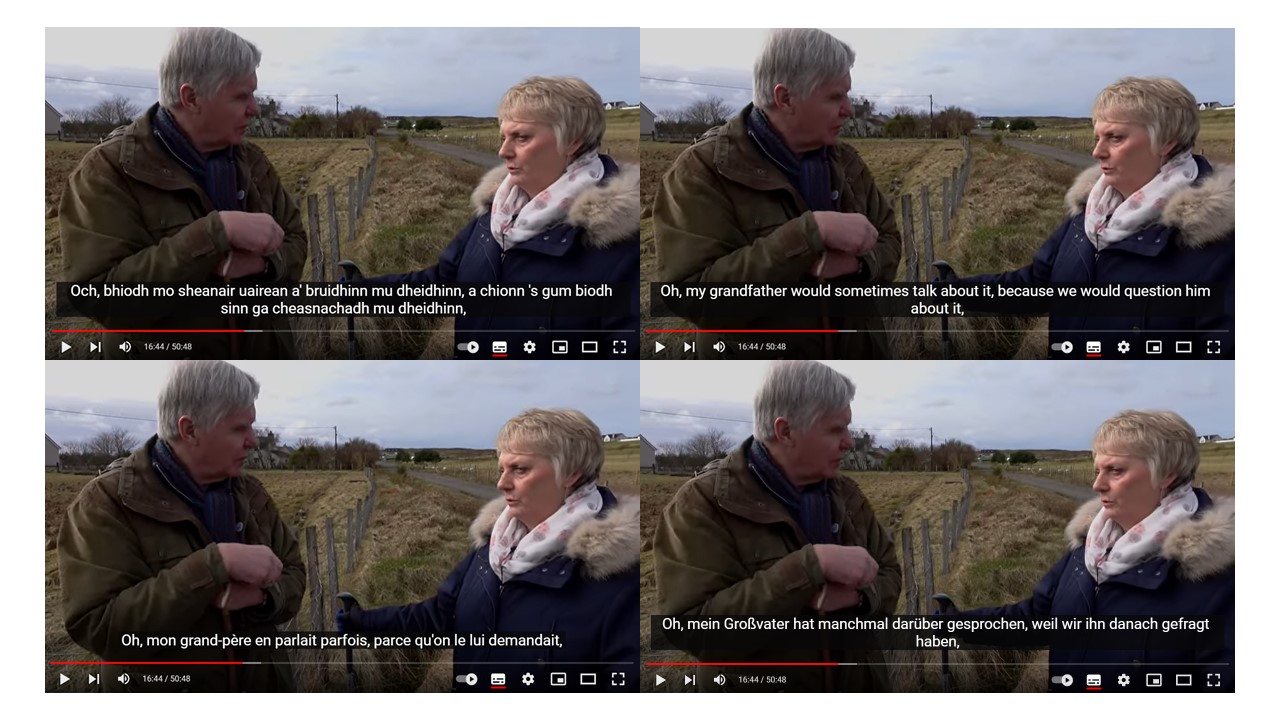
Here’s a new departure with some well-known and well-loved faces. Comann Eachdraidh Sgìre a’ Bhac (Back historical society) have been producing home-grown videos for YouTube for a while now, many of them fronted by Coinneach MacÌomhair, a very familiar voice from decades of sterling service with BBC Radio nan Gàidheal. In the video below, he’s joined by renowned singer Maighread Stiùbhart as they take viewers on a walking tour of Col Uarach.
It’s a remarkable film, in which the presenters’ deep knowledge and love of their home turf shine through, beautifully expressed in Gàidhlig Sgìre a’ Bhac. The video has been online for a few months now, but there’s been a new development – the addition of CC subtitles (which you can switch on or off, according to taste). This has been made possible following meticulous extra work by Maighread to transcribe the entire video so that it can be added to the Stòras Beò nan Gàidheal collection. And as followers of Guthan nan Eilean know, once the Gaelic subtitles are up, YouTube settings will also offer you auto-translation into many other languages – English included!
Plus, the “Stòras Beò” treatment means you can also access the full wordlinked transcript online through this Clilstore unit: https://clilstore.eu/cs/10540
Naturally, we’re delighted at Island Voices to be able to work with another local history society in the Western Isles. We hope such partnerships will continue to blossom and grow!
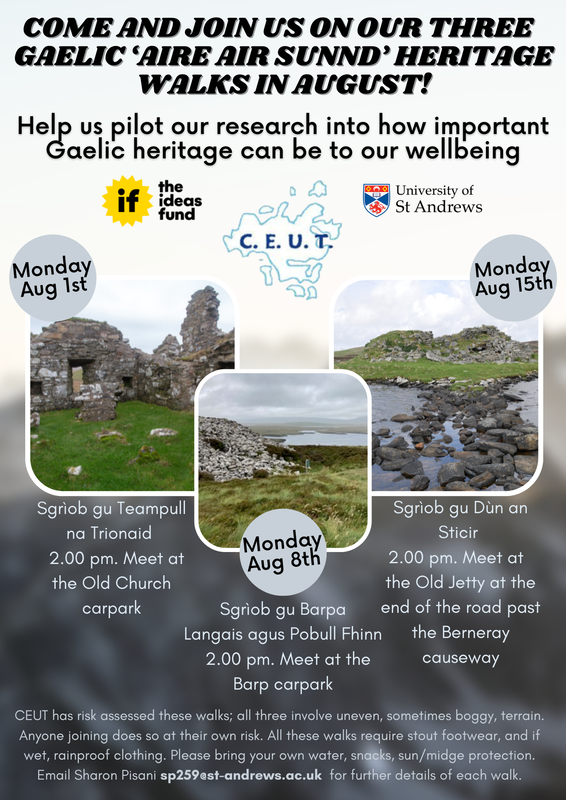
Three “Gaelic walks” have been announced for August, as part of the Aire air Sunnd project led by Comann Eachdraidh Uibhist a Tuath. Gum bi deagh shìde ann air an son!
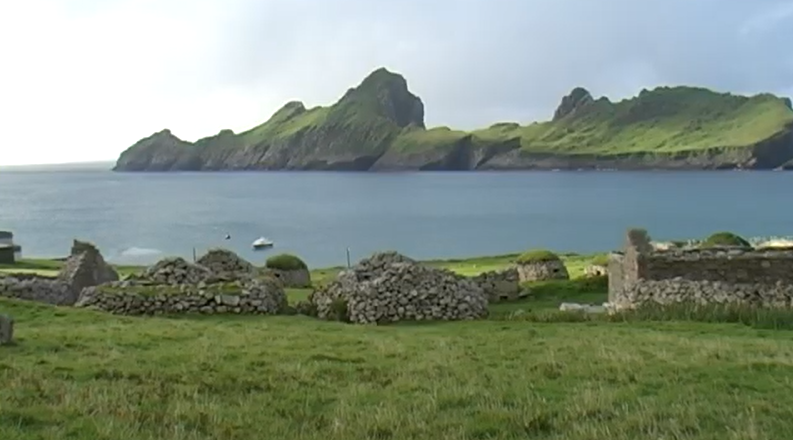 We’re deeply indebted to Sharon Pisani, our Maltese “Island Voice”, for the latest addition to our “Other Tongues” collection! This takes up to 22 the number of languages in which we have Island Voices films. Abair ioma-chànanas!