Shaetlan Voice in Exile

Christie Poster pic
Select any video clip in this landscape format, or use the phone-friendly portrait layout.

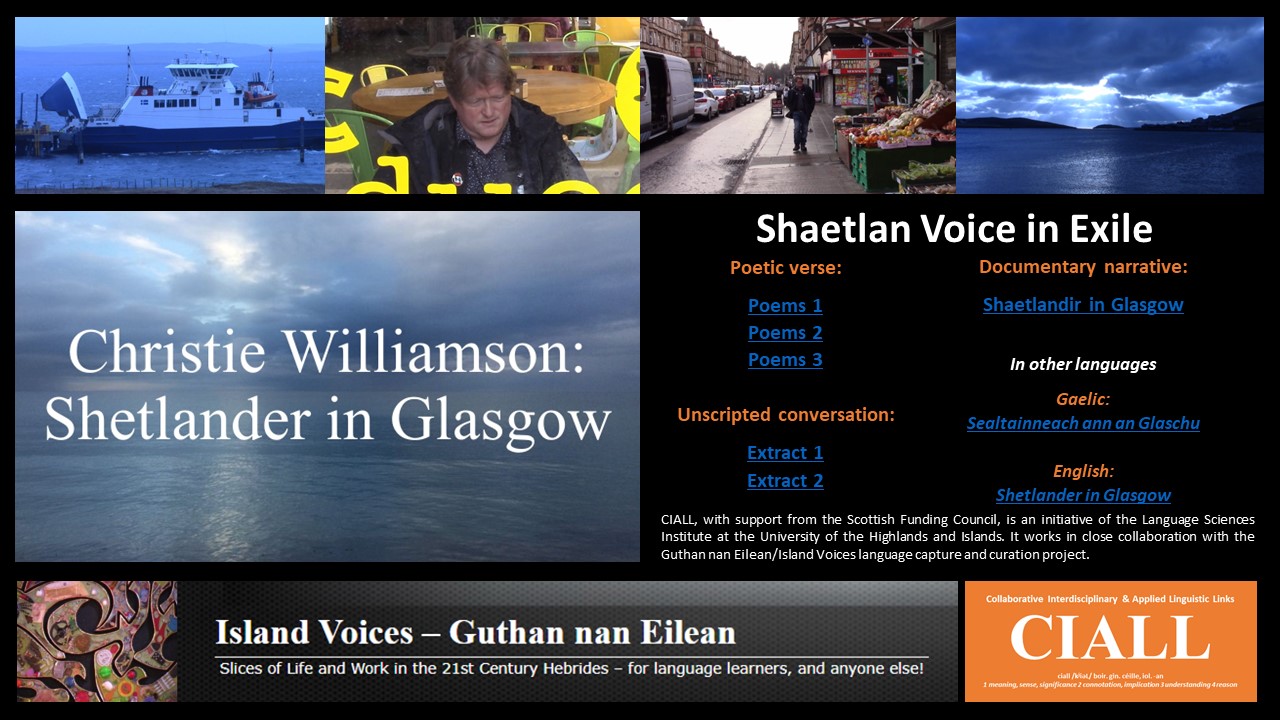
Shetlander Christie Williamson is the focus of this third “poets in exile” collection in our experimental extension of the Island Voices “capture and curation” model into new contexts and languages. This follows on from Jamaican in Wales with Audrey West, and Gaelic in Shetland with Donald S Murray, all supported by CIALL.

As the documentary reveals, while Christie has been a resident of Glasgow for over twenty years, he has also travelled extensively to present his poems around the world, while keeping a firm grip on his Shetland roots from which he derives so much inspiration. The documentary also presents snatches from his poetry and a conversation with Chris Stout. Lengthier examples are presented in additional video clips.

In the first poetry clip, Christie recites a selection of his Shetlandic poems from his collection “Oo an Feddirs”. In the second clip he reads from “Doors tae Naewye”. The third clip features contributions to the collections “Break in Case of Silence”, and “What Winter Wants”.

The examples of unscripted speech are from a conversation in which Christie talks to fellow Shetlander Chris Stout, who is also now a Glasgow resident.

In Part 1 the topics covered include Shetland schooldays and hostel living, ferry journeys to the mainland in student days, and what living in Glasgow is like for Shetlanders.

In Part 2, they talk about what it’s like to go home to Shetland for visits, and how mobile phones, particularly in the wake of Covid, have enabled Shetlanders to keep in closer contact.

All films in the collection (including additional versions of the documentary in Gaelic and English*) can be accessed through the above poster in either landscape or phone-friendly portrait layout.

*September 2025 update

Since original publication four new versions of the documentary have been added to the collection in Welsh, JamaicanCatalan, and Portuguese with accompanying transcripts and background information. 
Tales from Local History Sites

Tobhtaichean montage

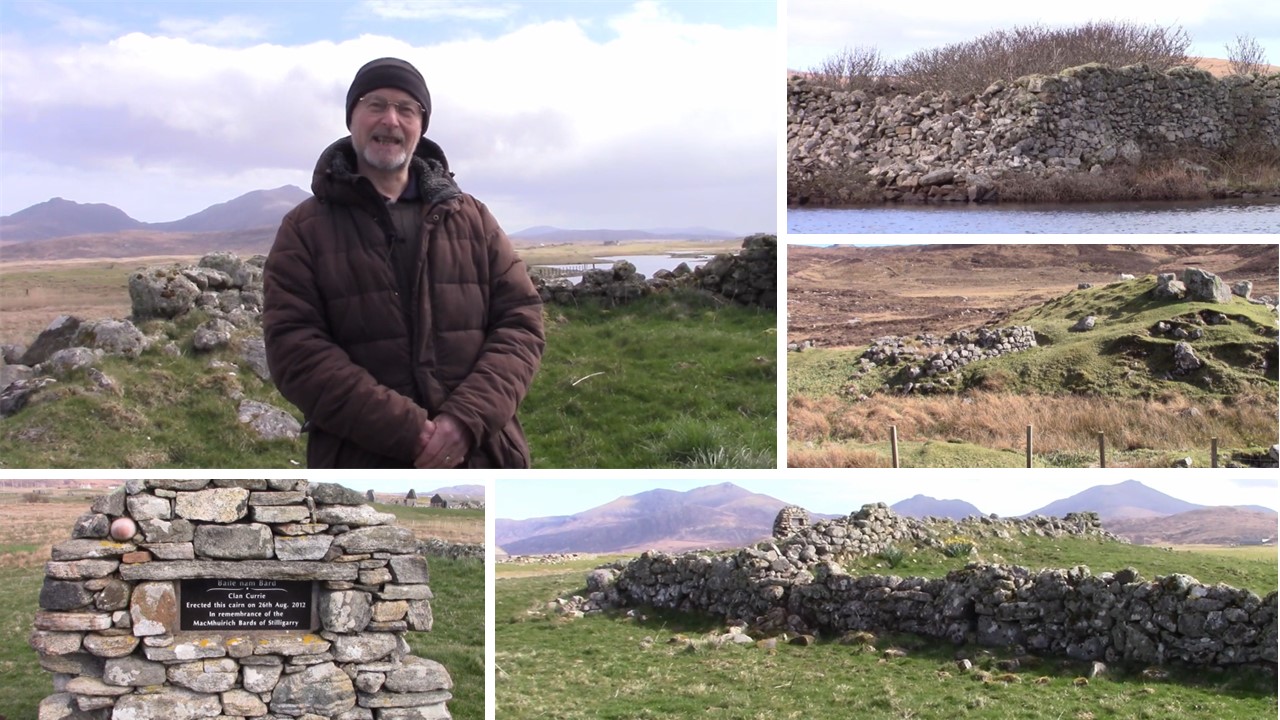
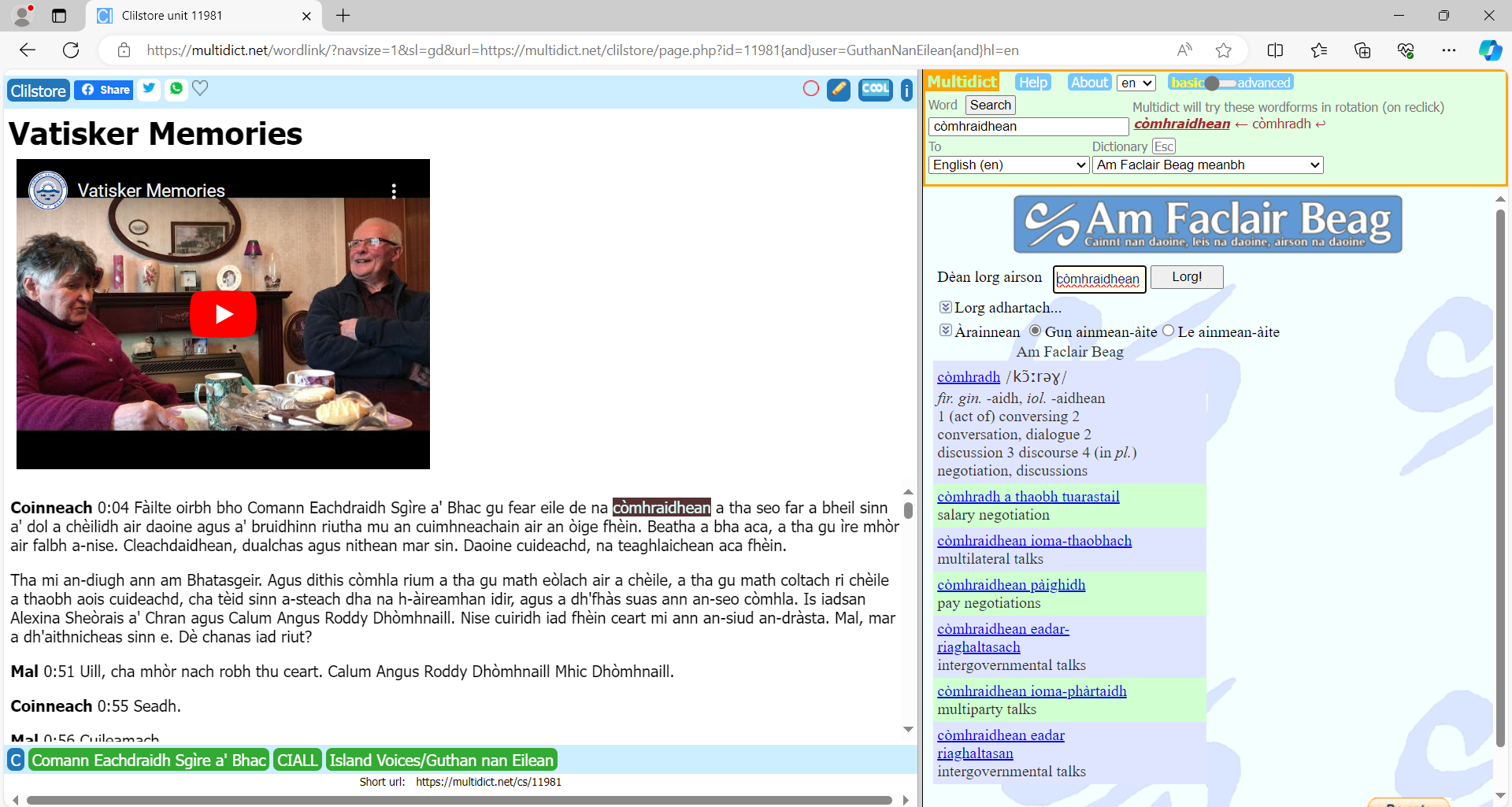
Tommy Macdonald tells some of the history of Clann ‘ic Mhuirich (“Clan Currie”) from the ruin of the ancestral home in Stilligarry, South Uist, and recounts some tales from other nearby sites.

In Part 1, he relates where Clann ‘ic Mhuirich came from, and when, and how they came to settle in Uist eventually. Their hereditary bardic role spanned centuries of Scottish history, before petering out with the loss of patronage, of skills, and eventually of manuscripts.

In Part 2, Tommy explains how Stilligary came to be known as “Baile nam Bàrd”. He goes on to talk about changes of the Mac Mhuirich family name. The impressive size of the ruin and some archaeological finds point to their importance in the community, and the power the family could exercise through their poetic and scholarly skills. He finishes with a short recitation.

In Tobhta Fhearchair, Tommy goes on to tell some of the history of the Beatons from the ruin of Fearchar’s home on the boundary between Tobha Mòr and Dreumasdal. He explains that the Beatons were renowned as doctors, especially in the West of Scotland, with strong connections to Skye and Islay as well as Uist. He refers to the work of Alasdair Carmichael (Carmina Gadelica) to illustrate their knowledge of plants and their uses, while acknowledging that Fearchar himself may not have been as knowledgeable as his forebears. A finishing quote from Martin Martin underlines the family’s historical association with the medical profession.

At Dùn Raghnaill, built for Clanranald, Tommy relates the story of why it was built – to protect the clan chief Mac ‘ic Ailein from his own family – in a time of sometimes bloody sea-borne raids along the Minch. According to local history, it was later used to imprison a daring sea-faring Mac Mhuirich, whose hereditary bardic skills were such that the style of his composition from within the prison walls of the song “Mulaid Prìosanach ann an Dùn Raghnaill” was sufficient for him to be recognised and identified by his own estranged father.

All four films – with optional subtitling available for learners or non-speakers of Gaelic – have been added to the taighean-tughaidh playlist. This work is supported by CIALL.