Recording Community Conversations

AASReviewImageFollowing on from the North Uist “Wellbeing” survey, Gordon Wells this week reviewed the Island Voices contribution to the Aire air Sunnd project led by Comann Eachdraidh Uibhist a Tuath.

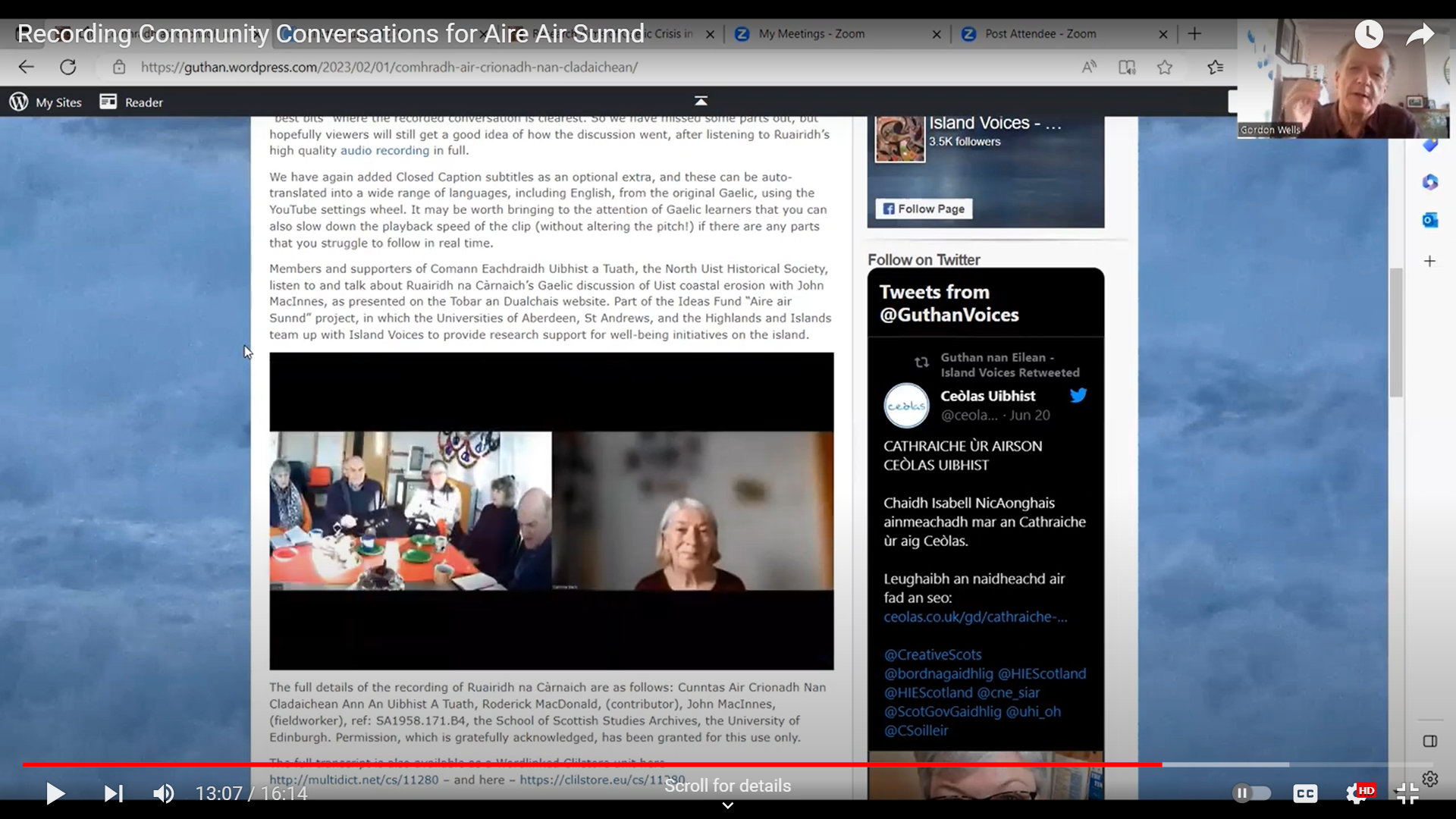
Adopting a slightly different format to Jess Wood’s presentations last week, Gordon speaks to camera on Zoom while screen-sharing key content from the Island Voices Aire air Sunnd webpage. Speaking in Gaelic he reinforces the point that using this language does not exclude non-speakers or early learners, given the multilingual technical resources that are now available online.

His video recaps the various recordings that have been created for the project in the past year or so, including the “Gaelic Crisis” presentation, and the Progress Report, as well as the recording sessions with community members covering storytelling, artefact description, and environmental issues. In so doing, it also shows how the YouTube subtitling and auto-translation functions can be put to effective use, and includes a quick demonstration of the Clilstore platform too, while emphasising the alternative effectiveness of recorded speech in a world where written communication is often taken for granted as the default norm.

Summing up, Gordon stresses the untapped value of various recording collections (in addition to Island Voices’ own), noting in particular how open resources such as Tobar an Dualchais have the potential to bring present and past communities together in a new manner to support North Uist cultural wellbeing, offering innovative ways of forward-looking engagement with the island’s Gaelic heritage so positively valued by all. At the same time, it needs to be recognised that community-wide engagement in such activity is dependent on community-wide comfort with the new digital tools that enable it. This is probably an area of work that needs closer attention.

Here’s Gordon’s talk on YouTube:

You can get a wordlinked transcript, with the video embedded, in this Clilstore unit: https://clilstore.eu/cs/11436
Wellbeing – and the place of Gaelic

The results of the Aire Air Sunnd community survey in North Uist are going online!

Jess Wood from the University of Aberdeen kicked off on Monday 19th June with an overview, split between two videos on a dedicated CEUT YouTube playlist, both of which are well worth watching to get a sense of the breadth and depth of the project. It’s been an ambitious collaborative exercise, turning out interesting and challenging findings for anyone interested in taking a rooted and holistic approach to community wellbeing across the board.

For those with a particular interest in Gaelic, Jess has devoted quite a bit of time in the first video to analysis of responses on this topic. We’ve picked out some headlines below.

The overall sample of 79 respondents divided themselves up roughly equally between Fluent Speakers, Learners, and Non-speakers of Gaelic.

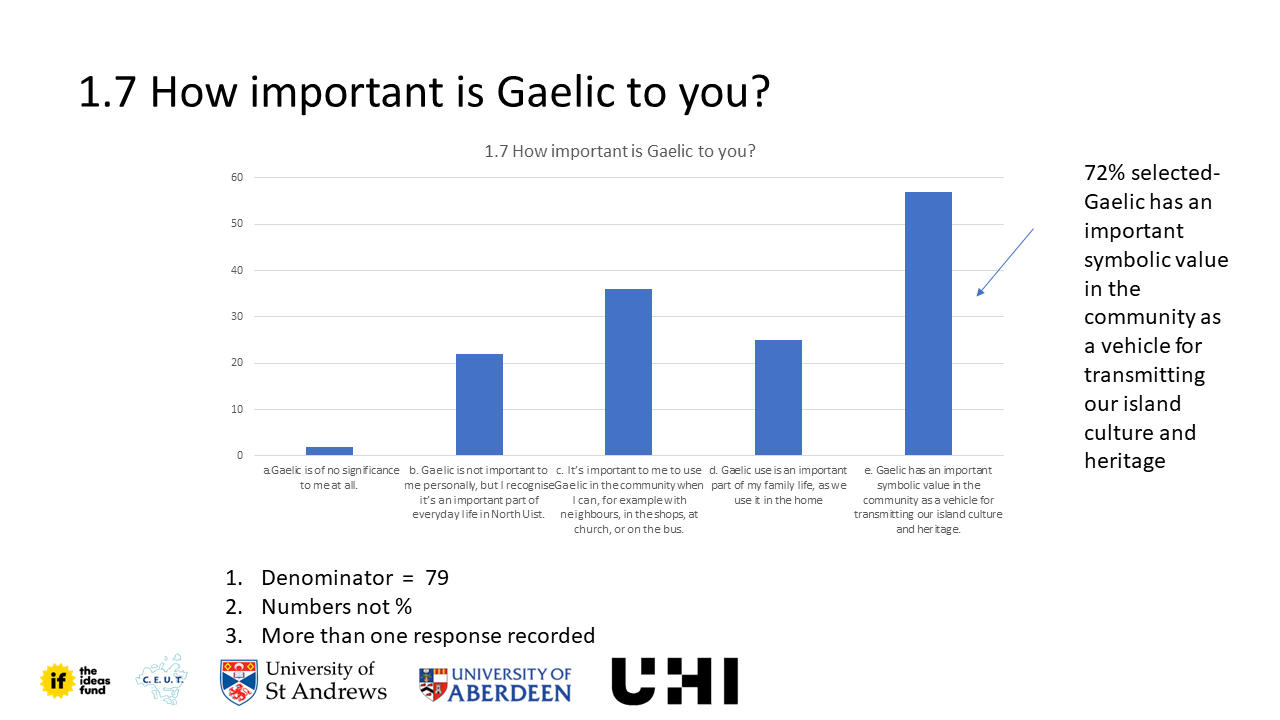
The slide below shows a really strong level of agreement in the group overall with the notion that “Gaelic has an important symbolic value in the community as a vehicle for transmitting our island culture and heritage”.

Aire Air Sunnd, Wellbeing survey methods results_15. 06.23_part 1_finalHowImportant

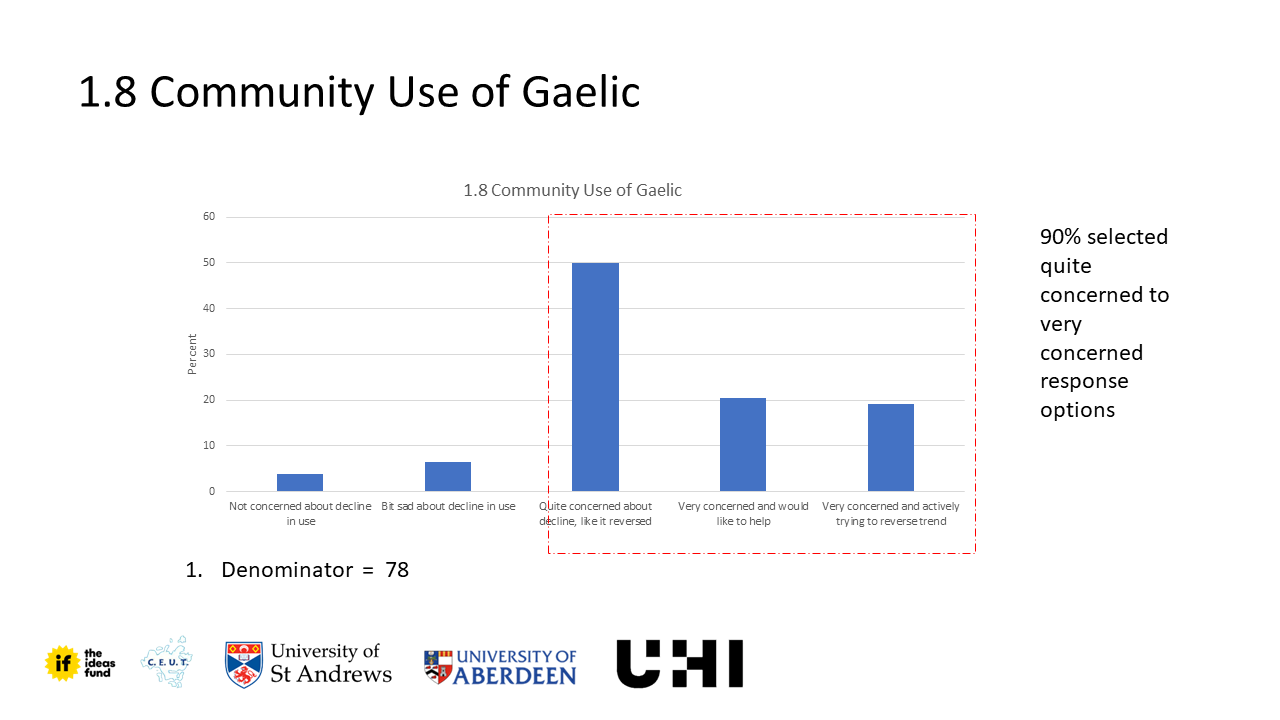
Another immediately striking statistic is the 90% figure for those expressing concern over the declining trend in use of Gaelic, as shown in this slide:

Aire Air Sunnd, Wellbeing survey methods results_15. 06.23_part 1_finalninetyOverallconcern

And what may be particularly interesting about this figure is the way that similar sentiment is shared across all three groups – Fluent Speakers, Learners, and Non-speakers – with even 58% of those who have no Gaelic expressing concern about it.

While Jess is duly cautious in her presentation, a topic eliciting a 90% level of concern might well be considered a community wellbeing issue worthy of further investigation…

If these figures pique your interest do take a look at the online presentation to find out more. The project also plans to run another face-to-face event in August at which Gaelic and other questions arising from the survey will be further discussed and developed. You can find full details and keep abreast of other events leading up to it on the CEUT Facebook page.

Here’s Part 1 of Jess’s presentation, in which she provides an update on the findings of Section 1 of the survey (including the questions on Gaelic):

In Part 2, Jess talks about the key findings of Section 2 – Use of the School, and Section 3 – Personal Wellbeing:

And coming soon, keep an eye out for an Island Voices video follow-up from Gordon Wells on “Recording Community Conversations”, to be followed shortly after by more detail on Digital Use and Activities with Alan Miller and Sharon Pisani from St Andrews University.

Eighteen Years of Island Voices

New Island Voices compositePNGcrop

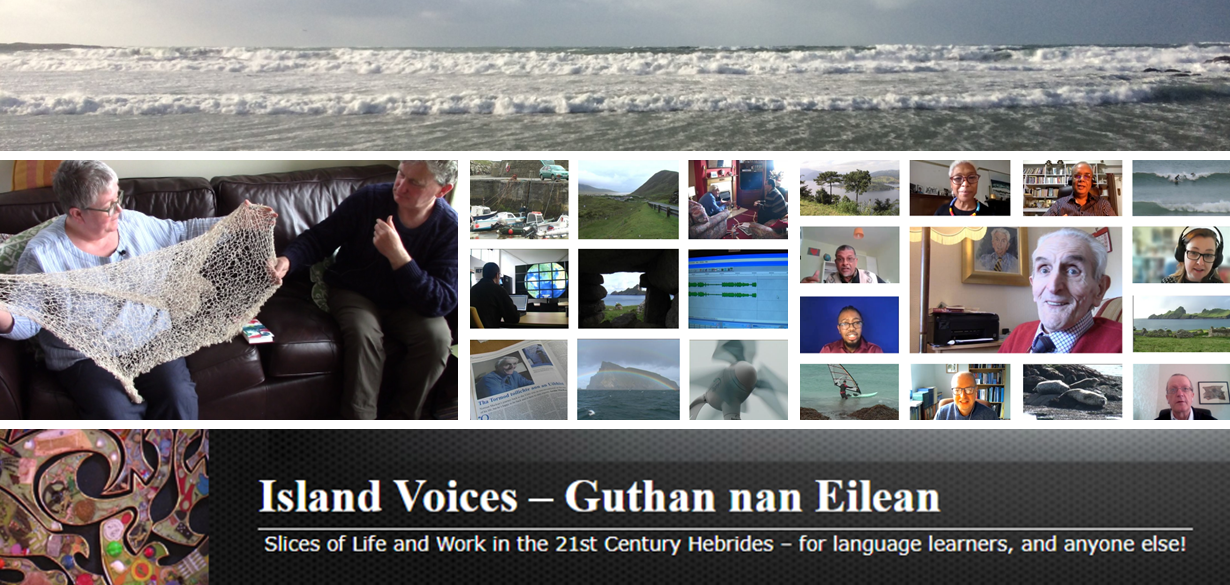
The beginnings of the Island Voices/Guthan nan Eilean project can be traced back to 2005 and the original European POOLS project in which Sabhal Mòr Ostaig (SMO) played a key co-ordinating role, with Gordon Wells appointed as Project Officer. It’s been a fascinating journey ever since, from the bilingual English and Gaelic recording of the first Craigard documentary video onward, in an ever growing and diversifying collection of “slices of  life and work in the 21st Century Hebrides” combined with thoughts and reflections from both community members and interested observers.

Now in its eighteenth year, and fully independent of SMO, the project may be said to be “coming of age”, so Gordon has compiled a detailed report on its history and content to give an account of progress so far: “Island Voices – Guthan nan Eilean: Hebridean Language Capture and Curation, 2005-2023”.

From the summary:

“This article provides a comprehensive description of the Island Voices/Guthan nan Eilean language capture and curation project as it stood in Spring 2023. The introduction presents information on its main features and aims, the linguistic rationale focussing on the primacy of speech and the salience of bilingualism, and the Hebridean community context in which the project operates. This is followed by a detailed account of the project contents and chronology, divided into four separate sections or phases: Staff-led Production; Participatory Production; Multilingual Diversification; and Research Alignment. In conclusion, connections to further research and development projects and opportunities are sketched out, and some final reflections question a polarising juxtaposition of local versus global interests, while pointing towards responsibilities alongside the opportunities this kind of work entails.

Describing a primarily oral project through written text presents a challenge. Copious footnotes point to online samples of the materials discussed, and readers are encouraged to engage through screen as well as page in order to extract full benefit. The article is bookended by a preamble and postscript which offer written exemplification from short, transcribed extracts.”

And from the conclusion:

“There may be a lesson here for applied and socio-linguistic professionals. In a meaningfully socially aware mission, the development and display of academic and linguistic prowess should surely show and serve a genuine community connection and purpose. Such, at least, are the principles which the Island Voices project aspires to uphold. The project trajectory, while linguistically guided, thus aims at inclusiveness in content organisation and presentation, remains open to new inputs, and has an undefined end-point still over the horizon.”

Watch this space, a chàirdean! Agus cumaibh cluas ri claisneachd…