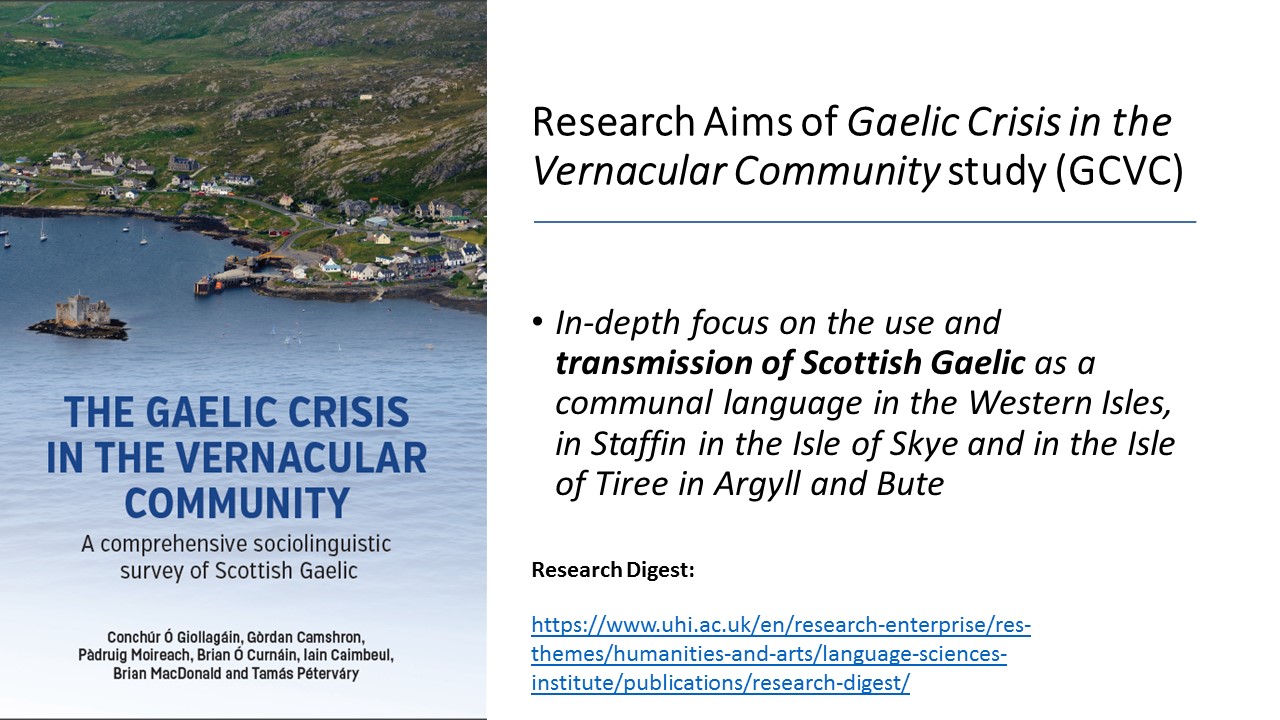
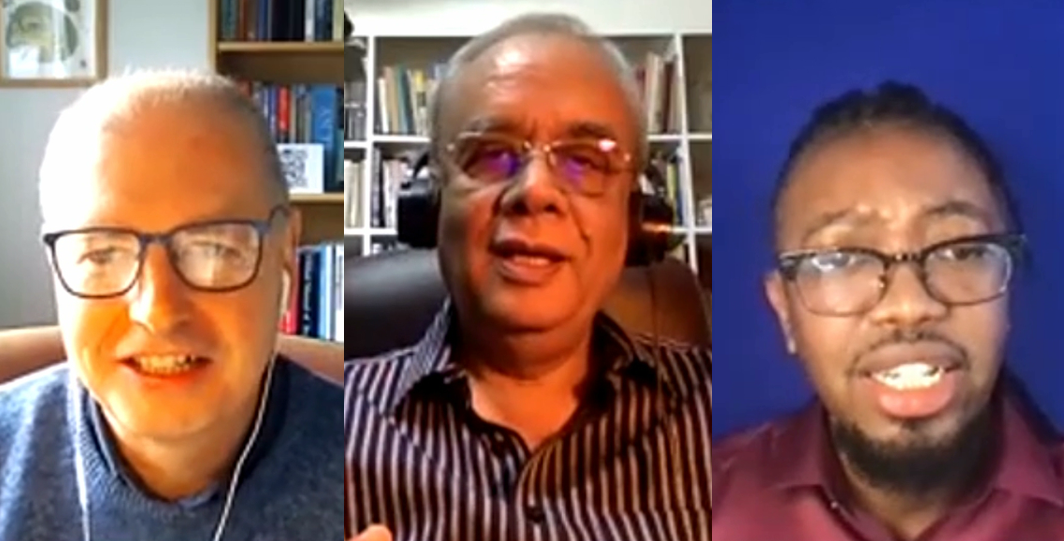
Following on from the May launch of the Aire air Sunnd project with Comann Eachdraidh Uibhist a Tuath, the first online session of the Gaelic-focussed strand was held on 17th June. As planned, the “hybrid” session was open to participation by Zoom as well as physical attendance at Sgoil Chàirinis, with Ùisdean Robertson taking the chair. The session started with a presentation by members of the research team behind the publication of “The Gaelic Crisis in the Vernacular Community“, principally Iain Caimbeul with support from Conchúr Ó Giollagáin. This presentation was recorded and has now been placed on the Island Voices YouTube channel. You can view it here:
The session was held entirely in Gaelic. YouTube subtitling will also allow viewers to read as they listen, and offers auto-translation into other languages, including English, using the settings wheel.
The presentation was followed by a lively and open discussion between CEUT members and the presenters about many of the points raised. This has laid a valuable foundation for further Gaelic activities as part of the Aire air Sunnd project, which will include walks and other events over the summer period, before returning to further online workshops planned for the autumn, which may take a closer look at selected Island Voices recordings.
Iain’s full Powerpoint presentation is available in PDF format here.
This is one of four linked blogposts, building on the Norman Maclean “Talking Points” series of discussions, which focus on specific contributions from the participants.
Jane NicLeòid was raised speaking Gaelic, and later English as well, on the Isle of Lewis. A trained teacher, she worked on the mainland for some years, before recently returning to her home island, where she continues to teach Gaelic, and is also closely involved in the new pressure group, Guth nan Siarach, to promote the interests of vernacular speakers.
Jane made a thoughtful and challenging early response to the 2020 “Gaelic Crisis” report by the Soillse team led by Conchúr Ó Giollagáin, on the influential Bella Caledonia website, in which she drew on her rooted teaching and community experience. You can read it here.
And in this final extract from the Norman Maclean Language Contact discussion Jane summarises key points of commonality identified in Norman’s thoughts, and underlines her own perception of the disconnect between institutional support for Gaelic, and a grassroots activism and egalitarian sensibility uniting the various interest groups.
Links to the three other blogposts in this short series are given below:
This is one of four linked blogposts, building on the Norman Maclean “Talking Points” series of discussions, which focus on specific contributions from the participants.
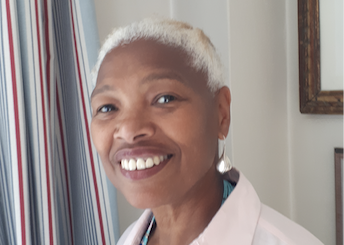
Audrey West’s first language is Jamaican, and she’s trained to teach Spanish and French, as well as in Cultural Memory.
This gives her an awareness of the intergenerational post-trauma resulting from the trans-Atlantic practice of enslaving Africans for European colonial gain.
Resident in North Wales, she works as an artist, poet, linguist, psychotherapist, trainer, and community development practitioner.
In this extract from the Norman Maclean Language Hierarchies discussion Audrey reflects on her unrecognised bilingualism, being brought up in a Jamaican home in London. Norman’s exhortation to maintain the mother tongue struck home as she acknowledges how stigmatisation prevented ongoing intergenerational transmission.
Over the course of the Talking Points sessions, Audrey also circulated this filmand the script of her poem amongst the participants, an extract from which is given at the end of the Language Contact discussion. She’s kindly agreed to share the full text below.
How did you end up here? Where do you come from?
I remember a place Where I am cradled by the Mountains Rocked by the sea…
Mi memba a plies We di mountin dem kriegl mi We di sii rak mi in aar skort Op di goli, pan tap a di hil Mi kyan si faar faar Plenti chrii, plenti griin, plenti sii
Memba a plies We dem nuo mi niem Dem nuo mi mada, nuo mi faada Nuo mi fambili Mi a smadi
Mi nuo se mi kom fram wie bak A Timboktuu dem kaal it? Mi piipl dem chravl a Hiijip Riich bak uom, A di mountin an di sii
Iz ou mi hen op ier?
Mi nuo se som a wi De pan buot Pak op pak op, stingk op stingk op Kyaan briid Bot wi riich
A wan plies dem kaal Jamieka Nier di mountin, bai di sii We dem Mek wi wok Brok wi bak Tek wi uman Kil wi pikni Fi notn
Bot iz ou yu en op ier?
Mi nuo se mi kom fram faar faar Mosi wan plies we niem Fraans We dem fait. Nier di mountin, bai di sii Fait so bad, dem kaal dem Espeute, fi suod. Dem kaal dem Juu Mek dem ron
Chravl faar faar Riich klier a San Domingue We dem Mek dem wok Bruk dem bak Tek dem uman Kil dem pikni Fi notn
Mais d’ou viens tu?
Ron klier a Virginia Weh dem Mek dem wok Bruk dem bak Tek dem uman Kil dem pikni Fi notn
Bot iz ou yu en op ier?
Mosi chruu wan plies we niem India Nier di mountin, bai di sii Dem bring wi bak Fi wok Til wi bak brok Lef wi uman Lef wi pikni Fi likl ar notn
¿Pero, como llegaste aquí?
Ron we, beli onggri Go klier a Panama Nier di mountin, bai di sii Luk fi wok Til mi bak brok Dem tek mi uman Kil mi pikni Fi notn
Bot, a we yuu kom fram?
Mosi fram wan plies dem kaal Skatlan. Plenti hil, An di sii skort uova aar fiit Nier di mountin, bai di sii Iz ou yu gaan klier a Skatlan? Iz ou yu en op dier?
Onggri beli Kech buot, kom a Hingglan Riich a Soutamton bai di sii Riich a Landan. Bes suut Fi luk wok Til mi bak brok Sen fi mi uman Dem kil mi pikni Fi notn
Mi no si no sii. Mi no si no mountin. Grie so til. Gaan bak uom. We dem nuo mi niem, Nuo mi fambili Mi a smadi Tek mi uman Lef mi pikni Dem aal rait
How did you end up here? O le wyt t’in dod?
Pikni riich a Naat Wales I’ve come a long way baby Back to the mountains, Back to the sea Back home, to Luxe, calme, et volupté
Homage to my parents
Alvin and Mary West
Copyright: Audrey West
June 2020
You can follow this link to get Audrey’s own translation of her poem into Standard English.
Links to the three other blogposts in this short series are given below:
This is one of four linked blogposts, building on the Norman Maclean “Talking Points” series of discussions, which focus on specific contributions from the participants.
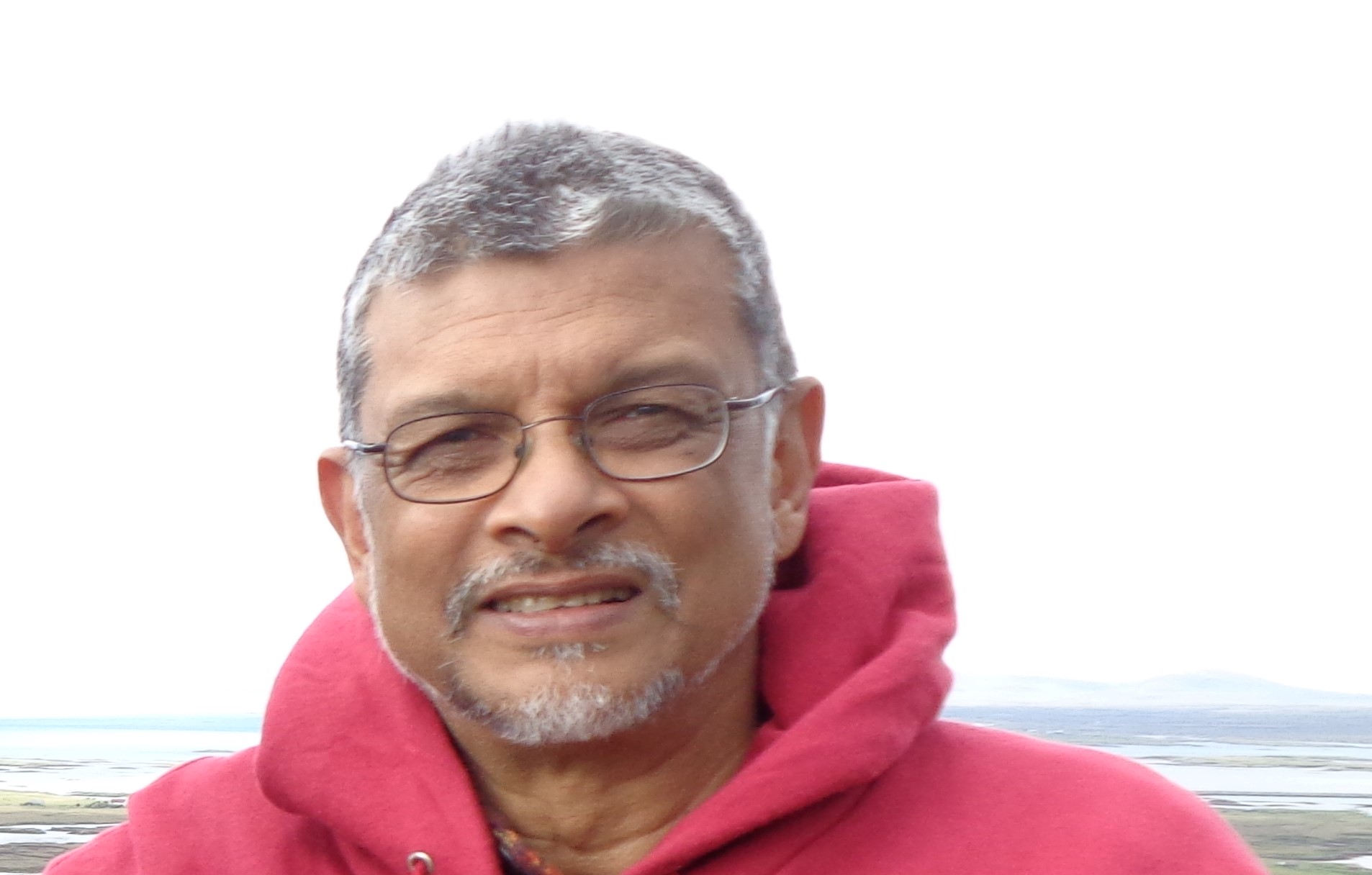
Kalyan Das Gupta was raised in Kolkata, speaking Bengali, Hindi, and English, and spent a large part of his professional career running Community Interpreting and Translating Services, first in Edinburgh, and later in Lewisham in London, where he now lives in retirement.
Below is a transcript of Kalyan’s opening points in theTalking Points session on Language Hierarchies, in which he looks back over his life and career and recalls a series of personal and professional experiences related to this topic.
As an English speaker, I personally seldom experienced direct “linguistic hierarchism”, if you will, in Britain or in any English-speaking country, except as a function of blatant racism or a racist “colour-blindness” of the well- or ill-intentioned kind.
During my first visit to Britain, in the summer of 1980, our organised coach from London to Edinburgh halted at 2 a.m. at a motorway café in Doncaster, Yorkshire. As I squinted to try and read the menu stuck on the door, a group of white teenagers lounging inside saw me and decided to come out. One of them placed his face in mine and unleashed a torrent of what sounded like working class mock Indian words or sounds, or Indian-accented slang English. They all laughed. I headed for the toilet. Unfortunately, that was outside too, in the dark, in the back. They surrounded me, inside, whistling. I quickly exited onto the better-lit pathway and dived into the café, losing them.
As a new junior lecturer in Coventry, I and my white English boss stood confused and bemused as the dinner lady asked her “And what’s he having?”. We both just burst out laughing at this uncannily immediate real-life illustration of the example we had been discussing in our anti-racism trainer briefing session just before breaking for lunch, where we used the example “Does he take sugar?”.
More serious examples sometimes came second- or third-hand, and I hope my memory serves me well. A senior lecturer in our training team, a very dark-skinned Ugandan Asian gentleman, and former national hockey star from Uganda who spoke eleven languages, including highly polished English with a Rugby School accent, routinely received uncomprehending blank stares from his local white bank-tellers when he greeted them at the counter. Once, a concerned English white health professional requested him to see if, with his eleven languages, he could perhaps crack a seeming mystery. A distressed Asian mental health patient, sectioned in a ward for four years, had been known to break into animated apparent gibberish quite frequently at mealtimes. It turned out she had been desperately asking for the occasional Indian meal with chapatis in Gujarati, but no-one had bothered to check till now.
As the co-ordinator of the interpreting and translating service, I was once invited to Saughton Prison in Edinburgh to see if I could help a Chinese inmate there. When he was jailed for murder ten years earlier, his English was virtually non-existent and he was offered no interpreter at all to put his own side of the story to anyone. Now, ten years later, this handsome, clean-cut, polite young man spoke very clear English, having taught himself the language in prison, as well as law. He cheerfully, but with great propriety and almost professional self-restraint, entreated me to trigger a review, insisting he had been framed.
My Chinese predecessor in the job had campaigned for years against the practice of English-only registration forms being left dangling unexplained and unsignposted at health service receptions in clinics and hospitals. His mostly rural-derived women clients from Hong Kong were often illiterate even in Chinese. They frequently waited in those reception lounges, unserved for a while before leaving. There was no proactive guidance, service or translated signposting or explanatory literature, and many of them with urgent care needs simply felt like cyphers.
In France, around the same time, a woman who had come into a hospital for a pregnancy check-up was wrongly given an abortion before anyone realised what was happening. Staff there had not bothered noting the clear difference between her full Vietnamese name and the full name of another Vietnamese woman patient actually waiting for that procedure.
Community Interpreting and Translating Services started to be grudgingly set up as a public service in Britain, initially just in the voluntary sector, and purely as an adjunct to health or local community council or local authority or legal services, or immigration and refugee services, only following in the wake of a series of Race Relations Acts which themselves were legislated following a decade or two of major uprisings and struggles across cities in Britain, such as in Handsworth (Birmingham), Brixton (London), Toxteth (Liverpool), Cardiff and so on. A key stimulus in this was the Iqbal Begum case.
Iqbal Begum had been jailed for life in 1981 for murdering her abusive husband. In 1985, a chance visitor discovered that Mrs Begum had not had any clue as to what was being said to her and what the language mediator was either asking her or saying to her, so she had stayed silent in her confusion. This silence had been interpreted as an admission of guilt. The mediator, who was a Gujarati-speaking accountant press-ganged into service by the court, did not communicate to her clearly for her purposes. Mrs Begum’s particular dialect was a Pakistani variant of Punjabi. Mrs Begum was released, but, having spent four years in jail already, unable to bear the humiliation she later killed herself.
Under the joint cosh of the notorious Tory and Labour Private Finance Initiative drive, PFI, to privatise public services, the Interpreting and Translating services, which had for a while become grudgingly incorporated into the general local or health-initiated funded local authority services, started to become out-sourced to private, non-local, money-making outfits around the turn of the century, eventually succumbing to the re-worked version of the racist rant “Speak English!”, now sounding to our ears like “Learn English!” but with no difference in funding or support involved.
Many will find this testimony moving and powerful, yet elsewhere in the series Kalyan made a point of cautioning against over-reliance on personal experiences and anecdotes. In this clip from the session on Language Endangerment, he disavows linguistic expertise in favour of an explicitly political analysis.
Links to the three other blogposts in this short series are given below:
This is one of four linked blogposts, building on the Norman Maclean “Talking Points” series of discussions, which focus on specific contributions from the participants.
This post features the Linguistic Scholars Professor Conchúr Ó Giollagáin, Professor Udaya Narayana Singh, and Doctor Joseph Farquharson.
Conchúr Ó Giollagáin is Gaelic Research Professor at the University of the Highlands and Islands in Scotland, and the Director of the UHI Language Sciences Institute and of the Soillse inter-university Gaelic research network.
Udaya Narayana Singh is Dean of the Faculty of Arts and Humanities and Chair-Professor of the Amity Centre for Linguistic Studies at Amity University Haryana in India, and formerly Pro-Vice-Chancellor of Visva-Bharati, Shantiniketan, and Director of the Central Institute of Indian Languages, Mysore. He also has a keen interest in Creative Writing.
Joseph Farquharson is Senior Lecturer in Linguistics in the Department of Language, Linguistics, and Philosophy at the University of the West Indies Mona Campus in Jamaica. He is also the Co-ordinator of the Jamaican Language Unit and the Unit for Caribbean Language Research.
Professor Conchúr Ó Giollagáin
In the opening session on Language Endangerment – Gaelic Trajectory?Conchúr elaborates on 5 major points touched on by Norman, linking them to sociolinguistic research and findings. He finishes with a challenge to academics and policy-makers to engage in honest debate with the Gaelic-speaking community.
Professor Udaya Narayana Singh
In the second session onLanguage Hierarchies – English Ascendancy?Udaya reflects on prevalent linguistic accommodation in South Asia and offers an overview of language hierarchies in that region. He acknowledges the status of English as a “High Code” while emphasising the dynamic and enduring inter-relationships of other languages.
Doctor Joseph Farquharson
In the third session onLanguage Contact – Bilingual Balance?Joseph considers the normalisation of the “monolingual ghetto”, agreeing with Norman on the narrowed worldview it affords. He goes on to introduce the concept of “Conquest Diglossia” resulting from a colonial schooling process that denigrates low-status languages.
Other Posts
The format for the other contributions to this series of blogposts is slightly different, as they include (or link to) significant additional writing as well as similar short video clips: